

Pearson+ LogoPearson+ Logo
Ch. 5 - Sex Determination and Sex Chromosomes
Klug - Essentials of Genetics 10th Edition
Klug10th EditionEssentials of GeneticsISBN: 9780135588789Not the one you use?Change textbook
Chapter 5, Problem 27

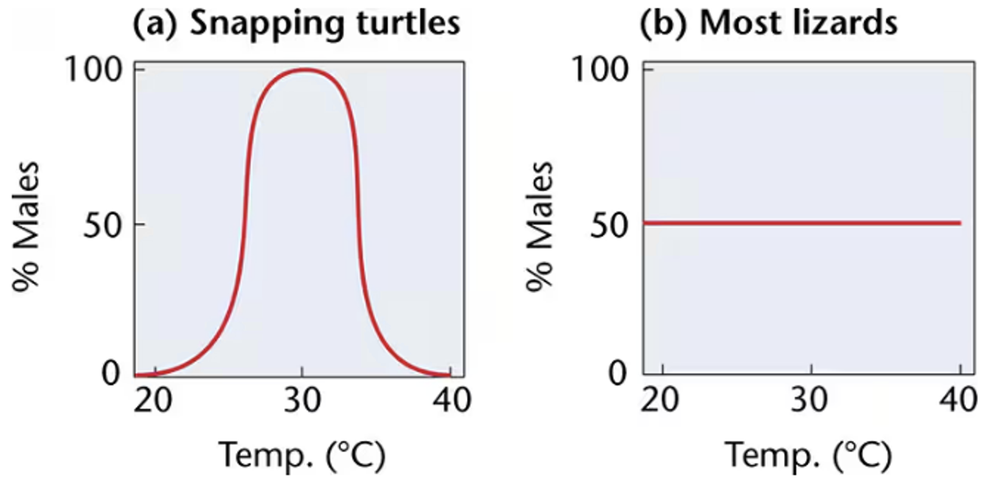
Shown here are graphs that plot the percentage of fertilized eggs containing males against the atmospheric temperature during early development in (a) snapping turtles and (b) most lizards. Interpret these data as they relate to the effect of temperature on sex determination.
Graphs showing male percentage vs. temperature: snapping turtles peak at 30°C, lizards remain constant at 50%.

Verified step by step guidance
1
Step 1: Observe the graph for snapping turtles (a). Notice that the percentage of males varies with temperature, peaking near 30°C and dropping to nearly 0% at both lower and higher temperatures. This suggests that temperature influences sex determination in snapping turtles, with a specific temperature range favoring male development.
Step 2: Examine the graph for most lizards (b). The percentage of males remains constant at about 50% across the entire temperature range from 20°C to 40°C. This indicates that temperature does not affect sex determination in these lizards, and sex is likely determined genetically rather than by environmental temperature.
Step 3: Understand the concept of temperature-dependent sex determination (TSD), which is a mechanism where the environmental temperature during early development determines the sex of the offspring. The snapping turtle graph is a classic example of TSD, where certain temperatures produce mostly males or mostly females.
Step 4: Contrast this with genetic sex determination (GSD), where sex is determined by chromosomes and is independent of temperature. The lizard graph exemplifies GSD, as the sex ratio remains stable regardless of temperature changes.
Step 5: Summarize the interpretation: In snapping turtles, temperature during early development plays a critical role in determining sex, with a narrow temperature window producing males. In most lizards, sex determination is not influenced by temperature, resulting in a consistent 50:50 sex ratio.

Key Concepts

Here are the essential concepts you must grasp in order to answer the question correctly.

Temperature-Dependent Sex Determination (TSD)

TSD is a mechanism where the environmental temperature during early embryonic development determines the sex of the offspring. In species like snapping turtles, sex ratios vary with temperature, producing mostly males at intermediate temperatures and females at extremes. This contrasts with genetic sex determination, where sex is fixed by chromosomes.
Recommended video:
Guided course
04:24
Sex Determination

Genetic Sex Determination (GSD)

GSD involves sex being determined by specific chromosomes inherited at fertilization, independent of environmental factors. The graph for most lizards shows a constant 50% male ratio across temperatures, indicating GSD where temperature does not influence sex outcome.
Recommended video:
Guided course
04:24
Sex Determination

Sex Ratio and Evolutionary Adaptation

Sex ratios influenced by temperature can affect population dynamics and evolutionary fitness. Species with TSD may adapt to environmental conditions by producing sex ratios that optimize survival or reproductive success, while species with GSD maintain stable sex ratios regardless of temperature.
Recommended video:
Guided course
04:24
Sex Determination
Related Practice
Textbook Question

The genes encoding the red- and green-color-detecting proteins of the human eye are located next to one another on the X chromosome and probably evolved from a common ancestral pigment gene. The two proteins demonstrate 76 percent homology in their amino acid sequences. A normal-visioned woman (with both genes present on each of her two X chromosomes) has a red-color-blind son who was shown to have one copy of the green-detecting gene and no copies of the red-detecting gene. Devise an explanation for these observations at the chromosomal level (involving meiosis).

597
views
Textbook Question

In mice, the X-linked dominant mutation Testicular feminization (Tfm) eliminates the normal response to the testicular hormone testosterone during sexual differentiation. An XY mouse bearing the Tfm allele on the X chromosome develops testes, but no further male differentiation occurs—the external genitalia of such an animal are female. From this information, what might you conclude about the role of the Tfm gene product and the X and Y chromosomes in sex determination and sexual differentiation in mammals? Can you devise an experiment, assuming you can 'genetically engineer' the chromosomes of mice, to test and confirm your explanation?

748
views
Textbook Question

In chickens, a key gene involved in sex determination has recently been identified. Called DMRT1, it is located on the Z chromosome and is absent on the W chromosome. Like SRY in humans, it is male determining. Unlike SRY in humans, however, female chickens (ZW) have a single copy while males (ZZ) have two copies of the gene. Nevertheless, it is transcribed only in the developing testis. Working in the laboratory of Andrew Sinclair (a co-discoverer of the human SRY gene), Craig Smith and colleagues were able to 'knock down' expression of DMRT1 in ZZ embryos using RNA interference techniques. In such cases, the developing gonads look more like ovaries than testes. What conclusions can you draw about the role that the DMRT1 gene plays in chickens in contrast to the role the SRY gene plays in humans?

878
views