How do we know that specific mutant phenotypes are due to changes in chromosome number or structure?
Ch. 6 - Chromosome Mutations: Variation in Number and Arrangement
All textbooks
Klug 10th Edition
Ch. 6 - Chromosome Mutations: Variation in Number and Arrangement
Problem 3
Klug 10th Edition
Ch. 6 - Chromosome Mutations: Variation in Number and Arrangement
Problem 3Chapter 6, Problem 3
Define these pairs of terms, and distinguish between them.
aneuploidy/ euploidy
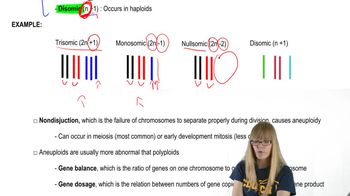
monosomy/ trisomy
Patau syndrome/ Edwards syndrome
autopolyploidy/ allopolyploidy
autotetraploid/ amphidiploid
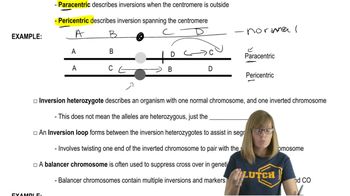
paracentric inversion/ pericentric inversion
Verified step by step guidance1
Start by defining aneuploidy and euploidy: Aneuploidy refers to the presence of an abnormal number of chromosomes in a cell (not an exact multiple of the haploid number), while euploidy means having a chromosome number that is an exact multiple of the haploid set.
Next, define monosomy and trisomy: Monosomy is a type of aneuploidy where one chromosome is missing from the normal diploid set (2n - 1), whereas trisomy is when there is an extra chromosome present (2n + 1).
Then, explain Patau syndrome and Edwards syndrome: Patau syndrome is caused by trisomy of chromosome 13, characterized by severe intellectual disability and physical abnormalities; Edwards syndrome results from trisomy of chromosome 18, also causing developmental issues but with a different set of clinical features.
After that, distinguish autopolyploidy and allopolyploidy: Autopolyploidy occurs when multiple chromosome sets come from the same species (e.g., chromosome duplication within one species), while allopolyploidy involves combining chromosome sets from different species through hybridization.
Finally, differentiate between paracentric and pericentric inversions: Paracentric inversion is a chromosome rearrangement that does not include the centromere and involves only one arm of the chromosome, whereas pericentric inversion includes the centromere and involves both arms.

Verified video answer for a similar problem:
This video solution was recommended by our tutors as helpful for the problem above.
Video duration:
1mWas this helpful?
Key Concepts
Here are the essential concepts you must grasp in order to answer the question correctly.
Aneuploidy vs. Euploidy
Aneuploidy refers to the presence of an abnormal number of chromosomes in a cell, such as missing or extra chromosomes, disrupting the normal chromosome set. Euploidy describes cells with complete sets of chromosomes, either the normal diploid number or multiples thereof, maintaining genomic balance.
Recommended video:
Guided course
Aneuploidy
Monosomy vs. Trisomy
Monosomy is a type of aneuploidy where one chromosome from a pair is missing, resulting in a single copy instead of two. Trisomy involves having an extra chromosome, making three copies of a particular chromosome, which often leads to developmental disorders.
Recommended video:
Guided course
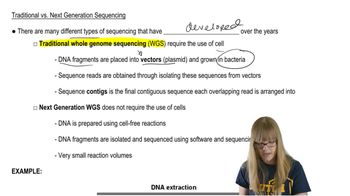
Traditional vs. Next-Gen
Paracentric Inversion vs. Pericentric Inversion
Paracentric inversion is a chromosome rearrangement where a segment flips within one arm of a chromosome, excluding the centromere. Pericentric inversion includes the centromere and involves flipping a chromosome segment that spans both arms, potentially affecting gene order and function.
Recommended video:
Guided course
Inversions
Related Practice
Textbook Question
506
views
Textbook Question
How do we know that the mutant Bar-eye phenotype in Drosophila is due to a duplicated gene region rather than to a change in the nucleotide sequence of a gene?
373
views
Textbook Question
Write a short essay that discusses five altered phenotypes that result from specific chromosomal aberrations.
442
views
Textbook Question
For a species with a diploid number of 18, indicate how many chromosomes will be present in the somatic nuclei of individuals that are haploid, tetraploid, trisomic, and monosomic.
694
views
Textbook Question
What evidence suggests that Down syndrome is more often the result of nondisjunction during oogenesis rather than during spermatogenesis?
943
views
Textbook Question
Contrast the fertility of an allotetraploid with an autotriploid and an autotetraploid.
809
views