Back

Addition and Subtraction Operations definitions

Control buttons has been changed to "navigation" mode.
1/15
  • Scientific Notation

    A method for expressing very large or small numbers using a coefficient and a power of ten.
  • Exponent

    The power of ten indicating how many times the coefficient is multiplied or divided by ten.
  • Coefficient

    The decimal value multiplied by a power of ten in scientific notation.
  • Decimal Place

    A position to the right of the decimal point, used to determine rounding in calculations.
  • Rounding

    The process of adjusting a number to a specified number of decimal places based on calculation rules.
  • Power

    The value indicating the number of times a base, such as ten, is used as a factor.
  • Significant Figures

    Digits in a number that contribute to its precision, important in multiplication and division.
  • Operation

    A mathematical process such as addition or subtraction performed on numbers.
  • Adjustment

    The process of changing a coefficient or exponent to align values for calculation.
  • Calculation

    The process of performing mathematical steps to find a result, following specific rules.
  • Value

    A numerical quantity expressed in scientific notation, consisting of a coefficient and exponent.
  • Base Ten

    The number system used in scientific notation, where each place represents a power of ten.
  • Constant Exponent

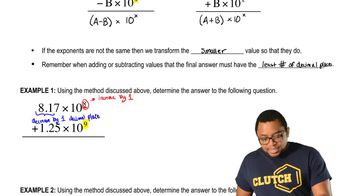
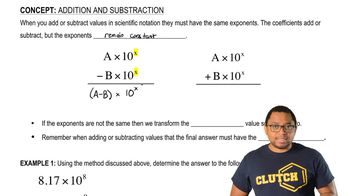
    A requirement for addition or subtraction in scientific notation, ensuring exponents are identical.
  • Transformation

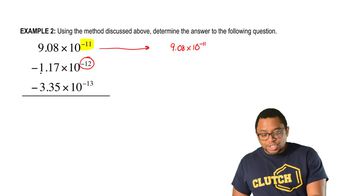
    The act of converting a value to match another's exponent by shifting the decimal in the coefficient.
  • Reciprocal Relationship

    A rule where increasing the exponent requires decreasing the coefficient by moving the decimal.