Back

Addition and Subtraction Operations quiz

Control buttons has been changed to "navigation" mode.
1/15
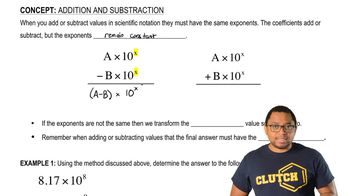
  • What must be true about the exponents when adding or subtracting values in scientific notation?

    The exponents must be the same before you can add or subtract the coefficients.
  • When adding or subtracting numbers in scientific notation, what happens to the exponent?

    The exponent remains constant during the operation.
  • How do you adjust a number in scientific notation if its exponent is smaller than the other number's exponent?

    Increase the smaller exponent to match the larger one by moving the decimal point of the coefficient in the opposite direction.
  • What is the relationship between changing the exponent and the coefficient in scientific notation?

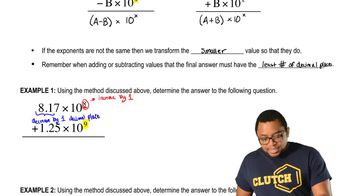
    If you increase the exponent by 1, you decrease the coefficient by one decimal place, and vice versa.
  • What is the rule for decimal places when adding or subtracting in scientific notation?

    The final answer should have the least number of decimal places from the coefficients involved.
  • In the example 8.17 x 10^8 + 1.25 x 10^9, how is 8.17 x 10^8 adjusted?

    It is rewritten as 0.817 x 10^9 to match the exponent of the other term.
  • After adjusting exponents and adding coefficients, what is the unrounded sum of 0.817 x 10^9 and 1.25 x 10^9?

    The unrounded sum is 2.067 x 10^9.
  • How is the final answer 2.067 x 10^9 rounded, and why?

    It is rounded to 2.07 x 10^9 because the answer must have the least number of decimal places, which is 2.
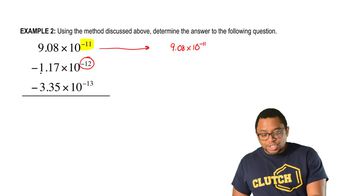
  • When converting 1.17 x 10^-12 to match an exponent of 10^-11, what does it become?

    It becomes 0.117 x 10^-11 after moving the decimal one place to the left.
  • If a value is 3.5 x 10^-13 and needs to be expressed with an exponent of 10^-11, what is the new coefficient?

    The new coefficient is 0.035 x 10^-11 after moving the decimal two places to the left.
  • What is the final answer when subtracting adjusted values with exponents of 10^-11 and coefficients with 2, 3, and 4 decimal places?

    The answer is rounded to 2 decimal places, resulting in 8.93 x 10^-11.
  • Why do you move the decimal point in the coefficient when adjusting exponents in scientific notation?

    You move the decimal to maintain the value of the number while changing the exponent to match the other term.
  • What should you do if the exponents in two scientific notation numbers are not the same before adding or subtracting?

    Adjust the smaller exponent to match the larger one by changing the coefficient accordingly.
  • When adding 0.817 and 1.25, how many decimal places should the result have if the numbers have 3 and 2 decimal places respectively?

    The result should have 2 decimal places, matching the least number of decimal places.
  • What is the general process for adding or subtracting numbers in scientific notation?

    First, adjust the exponents to be the same, then add or subtract the coefficients, and finally round the result to the least number of decimal places.