Back

Amino Acid Three Letter Codes quiz

Control buttons has been changed to "navigation" mode.
1/15
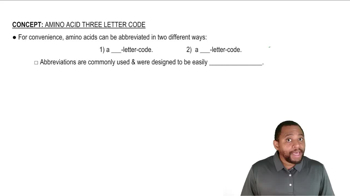
  • What are the two main types of amino acid abbreviations?

    The two main types are the three-letter code and the one-letter code.
  • Why were amino acid abbreviations created?

    They were created for easy memorization and efficient discussion of amino acids.
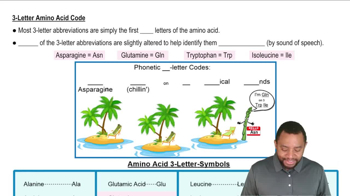
  • How many amino acids use the first three letters of their name for the three-letter code?

    Sixteen out of twenty amino acids use the first three letters of their name for the three-letter code.
  • Which four amino acids do not follow the first-three-letters rule for their three-letter code?

    Asparagine, Glutamine, Tryptophan, and Isoleucine do not follow the rule.
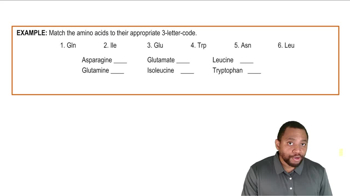
  • What is the three-letter code for Asparagine?

    The three-letter code for Asparagine is ASN.
  • What is the three-letter code for Glutamine?

    The three-letter code for Glutamine is GLN.
  • What is the three-letter code for Tryptophan?

    The three-letter code for Tryptophan is TRP.
  • What is the three-letter code for Isoleucine?

    The three-letter code for Isoleucine is ILE.
  • What mnemonic can help you remember the four amino acids with unique three-letter codes?

    The mnemonic is 'Asparagine chilling on 3 tropical islands.'
  • What does the '3' in the mnemonic 'Asparagine chilling on 3 tropical islands' refer to?

    It refers to the three-letter code system for amino acids.
  • What does 'tropical' represent in the mnemonic for unique three-letter codes?

    'Tropical' represents Tryptophan (TRP) in the mnemonic.
  • What does 'islands' represent in the mnemonic for unique three-letter codes?

    'Islands' represents Isoleucine (ILE) in the mnemonic.
  • Why are the unique three-letter codes for four amino acids phonetically altered?

    They are altered to help identify them by sound and aid memorization.
  • How do the majority of amino acids get their three-letter code?

    Most use the first three letters of their name as their code.
  • What is the benefit of using three-letter codes when discussing proteins?

    Three-letter codes allow for quicker and more efficient writing and discussion of amino acids in proteins.