Skip to main content
GOB Chemistry
My Course
Learn
Exam Prep
AI Tutor
Study Guides
Textbook Solutions
Flashcards
Explore
Try the app
My Course
Learn
Exam Prep
AI Tutor
Study Guides
Textbook Solutions
Flashcards
Explore
Try the app
Back
Enzyme Inhibition quiz
You can tap to flip the card.
What is enzyme inhibition?
You can tap to flip the card.
👆
What is enzyme inhibition?
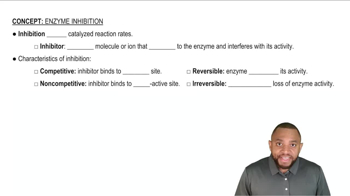
Enzyme inhibition is the decrease of catalyzed reaction rates due to an inhibitor binding to the enzyme and interfering with its activity.
Track progress
Control buttons has been changed to "navigation" mode.
1/15
Related flashcards
Related practice
Recommended videos
Enzyme Inhibition definitions
Enzyme Inhibition
15 Terms
Enzyme Inhibition
19. Enzymes
7 problems
Topic
Laura
Enzyme Regulation: Allosteric Control
19. Enzymes
1 problem
Topic
Laura
19. Enzymes
9 topics
15 problems
Chapter
Laura
Guided course
2:04
Enzyme Inhibition Example 1
3355
views
2
rank
Guided course
1:19
Enzyme Inhibition Concept 1
3368
views
2
rank
Guided course
3:26
Enzyme Inhibition Concept 2
3413
views
2
rank
Terms in this set (15)
Hide definitions
What is enzyme inhibition?
Enzyme inhibition is the decrease of catalyzed reaction rates due to an inhibitor binding to the enzyme and interfering with its activity.
What types of molecules can act as enzyme inhibitors?
Small molecules or ions can act as enzyme inhibitors.
Where does a competitive inhibitor bind on an active enzyme?
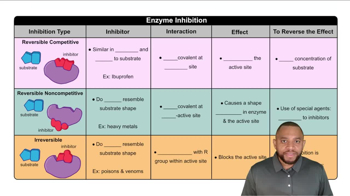
A competitive inhibitor binds to the active site of the enzyme.
How does a competitive inhibitor affect substrate binding?
It blocks the substrate from binding to the active site by occupying it.
What is an example of a competitive inhibitor?
Ibuprofen is an example of a competitive inhibitor.
How can the effect of a reversible competitive inhibitor be reduced?
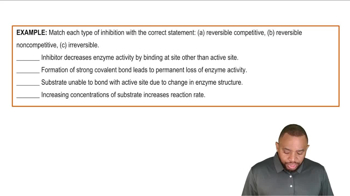
Increasing the concentration of the substrate can reduce the effect of a reversible competitive inhibitor.
Where does a noncompetitive inhibitor bind on an enzyme?
A noncompetitive inhibitor binds to a non-active site, such as an allosteric site.
Does a noncompetitive inhibitor resemble the substrate?
No, a noncompetitive inhibitor does not resemble the substrate in shape.
What is a typical example of a noncompetitive inhibitor?
Heavy metals are typical examples of noncompetitive inhibitors.
How does noncompetitive inhibition affect the enzyme's active site?
It causes a shape change in the enzyme, which affects the active site's ability to bind the substrate.
How can reversible noncompetitive inhibition be reversed?
Special agents can be used to bind the inhibitor and prevent it from binding to the enzyme.
What is the difference between reversible and irreversible inhibition?
Reversible inhibition allows the enzyme to regain activity, while irreversible inhibition causes permanent loss of enzyme activity.
What type of interaction is involved in irreversible inhibition?
Irreversible inhibition often involves covalent binding of the inhibitor to the enzyme's active site.
Give an example of substances that cause irreversible inhibition.
Poisons and venoms are examples of substances that cause irreversible inhibition.
What is the effect of irreversible inhibition on enzyme activity?
Irreversible inhibition results in permanent loss of enzyme activity.
 BackBack
 2:04
2:04