Skip to main content
GOB Chemistry
My Course
Learn
Exam Prep
AI Tutor
Study Guides
Textbook Solutions
Flashcards
Explore
Try the app
My Course
Learn
Exam Prep
AI Tutor
Study Guides
Textbook Solutions
Flashcards
Explore
Try the app
Back
Enzyme Regulation: Covalent Modification definitions
You can tap to flip the card.
Enzyme
You can tap to flip the card.
👆
Enzyme
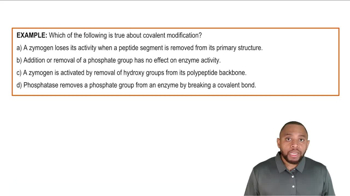
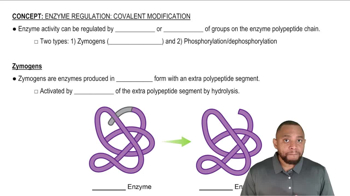
Protein molecule whose activity can be regulated by chemical group addition or removal on its polypeptide chain.
Track progress
Control buttons has been changed to "navigation" mode.
1/13
Related flashcards
Related practice
Recommended videos
Enzyme Regulation: Covalent Modification quiz
Enzyme Regulation: Covalent Modification
15 Terms
Enzyme Regulation: Covalent Modification
19. Enzymes
2 problems
Topic
Laura
Enzyme Regulation: Feedback Control
19. Enzymes
1 problem
Topic
Laura
19. Enzymes
9 topics
15 problems
Chapter
Laura
Guided course
2:21
Zymogens Example 1
3213
views
4
rank
Guided course
1:53
Phosphorylation/Dephosphorylation Example 2
3145
views
1
rank
Guided course
1:37
Covalent Modification/Zymogens Concept 1
2951
views
2
rank
Terms in this set (13)
Hide definitions
Enzyme
Protein molecule whose activity can be regulated by chemical group addition or removal on its polypeptide chain.
Polypeptide Chain
Linear sequence of amino acids forming the backbone of protein molecules, including enzymes.
Zymogen
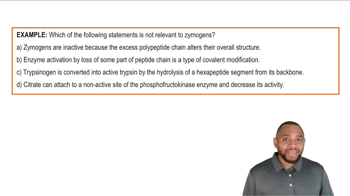
Inactive enzyme precursor containing an extra polypeptide segment, requiring cleavage for activation.
Proenzyme
Inactive form of an enzyme, synonymous with zymogen, activated by removal of a specific segment.
Hydrolysis
Chemical process involving water to cleave and remove a segment from a polypeptide, activating certain enzymes.
Phosphorylation
Addition of a phosphate group to an enzyme, often switching it from inactive to active state.
Dephosphorylation
Removal of a phosphate group from an enzyme, which can activate or deactivate the enzyme depending on its type.
Phosphate Group
Chemical group whose attachment or removal alters enzyme activity, represented by the letter 'P' in diagrams.
Kinase
Enzyme responsible for attaching a phosphate group to another enzyme, facilitating phosphorylation.
Phosphatase
Enzyme that removes a phosphate group from another enzyme, enabling dephosphorylation.
Covalent Modification
Regulatory mechanism involving the addition or removal of chemical groups to alter enzyme function.
Activation
Transition of an enzyme from an inactive to an active state, often through structural change.
Cleavage
Process of cutting a polypeptide segment, typically by hydrolysis, to convert an inactive enzyme to its active form.
 BackBack
 2:21
2:21