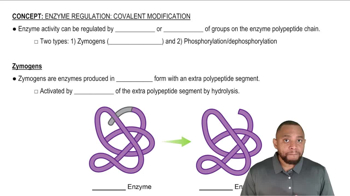
A zymogen is an enzyme produced in an inactive form with an extra polypeptide segment. It becomes active when this segment is removed by hydrolysis.
How is a zymogen activated?
A zymogen is activated by cleavage, specifically by hydrolysis that removes the extra polypeptide segment. This transforms the enzyme from inactive to active.
What is phosphorylation in enzyme regulation?
Phosphorylation is the addition of a phosphate group to an enzyme's polypeptide chain. This process is typically carried out by a kinase.
What enzyme is responsible for phosphorylation?
A kinase is the enzyme responsible for adding a phosphate group to an enzyme during phosphorylation. This often activates the enzyme.
What is dephosphorylation?
Dephosphorylation is the removal of a phosphate group from an enzyme's polypeptide chain. This process is typically carried out by a phosphatase.
What enzyme is responsible for dephosphorylation?
A phosphatase is the enzyme responsible for removing a phosphate group from an enzyme during dephosphorylation. This can activate certain enzymes.
How does phosphorylation affect enzyme activity?
Phosphorylation can convert an inactive enzyme into an active form by adding a phosphate group. However, some enzymes are only active when the phosphate group is removed.
How does dephosphorylation affect enzyme activity?
Dephosphorylation can activate enzymes by removing a phosphate group. Some enzymes are only active after dephosphorylation.
What is the role of hydrolysis in zymogen activation?
Hydrolysis cleaves the extra polypeptide segment from a zymogen. This removal activates the enzyme.
What is the difference between phosphorylation and dephosphorylation?
Phosphorylation adds a phosphate group to an enzyme, while dephosphorylation removes it. Both processes can regulate enzyme activity.
What is a proenzyme?
A proenzyme is another term for a zymogen, an inactive enzyme precursor. It requires removal of a segment to become active.
What group is added during phosphorylation?
A phosphate group is added to the enzyme during phosphorylation. This is often represented by the letter 'P'.
What group is removed during dephosphorylation?
A phosphate group is removed from the enzyme during dephosphorylation. This is done by a phosphatase enzyme.
Can all enzymes be activated by phosphorylation?
No, some enzymes are activated by phosphorylation, while others are activated by dephosphorylation. The effect depends on the specific enzyme.
What is the main purpose of covalent modification in enzyme regulation?
Covalent modification, such as phosphorylation or removal of polypeptide segments, regulates enzyme activity. It allows enzymes to switch between active and inactive forms.
 Back
Back
 2:21
2:21