Back

Ions and the Octet Rule (Simplified) definitions

Control buttons has been changed to "navigation" mode.
1/15
  • Valence Electrons

    Outer shell electrons that determine an atom's chemical properties and its tendency to gain or lose electrons.
  • Noble Gases

    Group of elements with naturally filled outer shells, resulting in high stability and minimal chemical reactivity.
  • Main Group Elements

    Elements in the s and p blocks of the periodic table that commonly follow the octet rule for stability.
  • Octet Rule

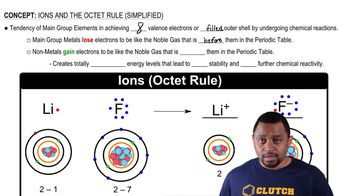
    Tendency of atoms to achieve eight electrons in their outer shell, mimicking the stability of noble gases.
  • Energy Levels

    Regions around the nucleus where electrons are arranged, with filled levels leading to greater atomic stability.
  • Chemical Reactivity

    Likelihood of an atom to undergo a chemical change, often reduced when outer shells are filled.
  • Cation

    Positively charged ion formed when an atom loses electrons, often seen in metals like sodium or lithium.
  • Anion

    Negatively charged ion formed when an atom gains electrons, commonly observed in nonmetals like fluorine.
  • Electron Arrangement

    Distribution of electrons among energy levels, influencing an atom's stability and chemical behavior.
  • Outer Shell

    Furthest energy level from the nucleus, where valence electrons reside and chemical interactions occur.
  • Periodic Table

    Organizational chart of elements, showing trends in electron configuration and chemical properties.
  • Stability

    State achieved when an atom's outer shell is filled, resulting in lower energy and reduced reactivity.
  • Electron Transfer

    Movement of electrons from one atom to another, enabling atoms to achieve filled outer shells.
  • Group 1A

    Column of the periodic table containing alkali metals, each with one valence electron prone to loss.
  • Filled Outer Shell

    Condition where the maximum number of electrons occupy the outermost energy level, leading to chemical inertness.