GOB Chemistry
My Course
Learn
Exam Prep
AI Tutor
Study Guides
Textbook Solutions
Flashcards
Explore
My Course
Learn
Exam Prep
AI Tutor
Study Guides
Textbook Solutions
Flashcards
Explore
Back
Power and Root Functions definitions
You can tap to flip the card.
Define:
Logarithmic Function
You can tap to
flip the card.
👆
Logarithmic Function
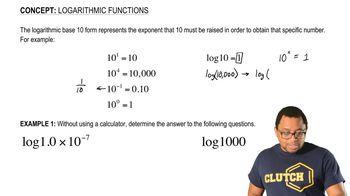
Represents the exponent needed for a base, usually 10, to yield a specific number; connects numbers to their powers of ten.
Track progress
Control buttons has been changed to "navigation" mode.
1/15
Recommended videos
Guided course
03:37
Logarithmic Functions
Jules
2803
views
4
rank
Guided course
01:34
Logarithmic Functions
Jules
2446
views
5
rank
Guided course
02:16
Logarithmic Functions
Jules
2340
views
7
rank
Terms in this set (15)
Hide definitions
Logarithmic Function
Represents the exponent needed for a base, usually 10, to yield a specific number; connects numbers to their powers of ten.
Antilogarithmic Function
Inverse process of a logarithm, converting an exponent back to its original number by raising the base to that exponent.
Natural Logarithm
Logarithm with base e, where e is approximately 2.718; used to find the exponent that produces a given number from e.
Exponent
Indicates how many times a base is multiplied by itself; central to expressing powers and roots in logarithmic contexts.
Base Ten
Standard base for common logarithms, where calculations revolve around powers and multiples of 10.
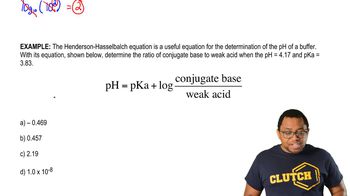
Henderson Hasselbalch Equation
Formula relating pH, pKa, and the ratio of conjugate base to weak acid in buffer solutions, often requiring antilog use.
Buffer
Solution that resists rapid pH changes by balancing acids and bases, crucial in biological and chemical systems.
Conjugate Base
Species formed when an acid donates a proton; paired with its corresponding weak acid in buffer calculations.
Weak Acid
Acid that partially dissociates in solution, forming an equilibrium with its conjugate base.
Natural Exponential Function
Function involving e raised to a variable power, serving as the inverse of the natural logarithm.
Logarithmic Manipulation
Rules for combining, separating, or transforming logarithmic expressions, such as converting multiplication to addition.
Root Function
Mathematical operation representing the inverse of raising to a power, often expressed as a fractional exponent.
pH
Scale measuring acidity or basicity, calculated using the negative logarithm of hydrogen ion concentration.
pKa
Negative logarithm of the acid dissociation constant, indicating acid strength and used in buffer equations.
Chemical Kinetics
Study of reaction rates, frequently involving natural logarithms to analyze concentration changes over time.