Back

Power and Root Functions quiz

Control buttons has been changed to "navigation" mode.
1/15
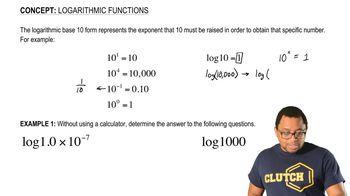
  • What does the logarithmic function log(x) represent when the base is 10?

    It represents the exponent to which 10 must be raised to obtain x.
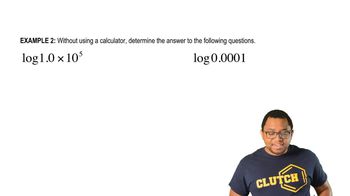
  • What is the value of log(10,000) and why?

    log(10,000) = 4 because 10 raised to the 4th power equals 10,000.
  • How do you interpret log(0.10) in terms of exponents?

    log(0.10) = -1 because 10 raised to the -1 power equals 0.10.
  • What is the result of log(1) and why?

    log(1) = 0 because any number raised to the 0 power equals 1.
  • What is the antilogarithmic function and how is it related to the logarithmic function?

    The antilogarithmic function is the inverse of the logarithmic function; if log(x) = y, then antilog(y) = x.
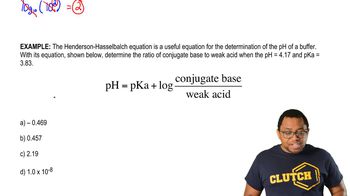
  • How is the antilog function used in the Henderson Hasselbalch equation?

    It is used to find the ratio of conjugate base to weak acid by taking the antilog of both sides after isolating the log term.
  • What does the natural logarithm (ln) of a number represent?

    It represents the exponent to which e must be raised to obtain that number.
  • How do you find the original value x if ln(x) = y?

    You take the inverse, so x = e^y.
  • What is the result of ln(1,000) and what does it mean?

    ln(1,000) = 6.908, meaning e raised to 6.908 equals 1,000.
  • How do you manipulate log(a * b) and log(a / b)?

    log(a * b) = log(a) + log(b), and log(a / b) = log(a) - log(b).
  • What happens to the exponent when you have log(a^x)?

    The exponent x moves in front, so log(a^x) = x * log(a).
  • How do you express the logarithm of an nth root, log(a^(1/x))?

    log(a^(1/x)) = (1/x) * log(a).
  • If log(3) = 0.48 and log(2) = 0.30, how can you find log(12) without a calculator?

    log(12) = log(3) + log(2) + log(2) = 0.48 + 0.30 + 0.30 = 1.08.
  • When solving ln(x) = value, what operation do you perform to find x?

    You exponentiate both sides with base e, so x = e^(value).
  • Why is it important to understand logarithmic manipulations in chemistry?

    Because they are used in equations like the Henderson Hasselbalch equation for buffers and in chemical kinetics involving natural logs.