 Back
Carbohydrates and Functional Groups: Study Guide for GOB Chemistry (Ch. 13-14)
Study Guide - Smart Notes
 Tailored notes based on your materials, expanded with key definitions, examples, and context.
Carbohydrates: Structure and Classification
Monosaccharides: Types and Identification
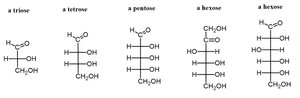
Monosaccharides are the simplest carbohydrates and serve as the building blocks for more complex sugars. They are classified based on the number of carbon atoms and the type of carbonyl group present.
Classification by Carbon Number: - Triose: 3 carbons - Tetrose: 4 carbons - Pentose: 5 carbons - Hexose: 6 carbons
Classification by Carbonyl Group: - Aldose: Contains an aldehyde group (CHO) - Ketose: Contains a ketone group (C=O)
Examples: - Aldotriose, Aldotetrose, Aldopentose, Ketohexose, Aldohexose
Chirality and Isomerism in Monosaccharides
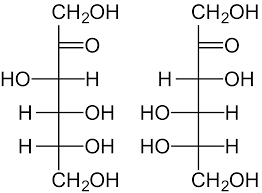
Chiral carbons are those attached to four different groups, leading to stereoisomerism. Molecules with chiral carbons are called stereoisomers or enantiomers.
L & D Isomers: - L (laevus): Hydroxyl group on the left - D (dexter): Hydroxyl group on the right - The configuration is determined by the position of the hydroxyl group on the last chiral carbon (next to last carbon from the bottom in Fischer projection).
Example: - Identify L or D isomers and name the monosaccharide.
Fischer and Haworth Projections
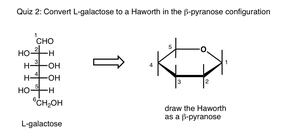
Monosaccharides can be represented in two main ways: Fischer projections (linear form) and Haworth projections (cyclic form). The conversion between these forms is essential for understanding carbohydrate chemistry.
Fischer Projection: Linear representation showing the arrangement of atoms.
Haworth Projection: Cyclic representation, commonly used for ring forms of sugars.
α & β Isomers: - Determined by the position of the hydroxyl group on carbon #1: - α: OH below the ring - β: OH above the ring
Example: Convert L-galactose to a β-pyranose Haworth configuration.
Disaccharides and Glycosidic Bonds
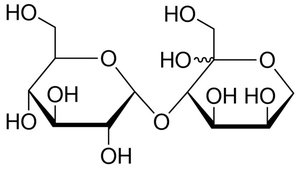
Disaccharides are formed by the linkage of two monosaccharides via glycosidic bonds. The type of bond and the monosaccharides involved determine the properties of the disaccharide.
Common Disaccharides: - Lactose: Glucose & Galactose - Maltose: Two glucoses - Sucrose: Fructose & Glucose
Glycosidic Bonds: - Named by the carbons involved and the configuration (α or β), e.g., α(1→4), β(1→3)
Example: Structure of lactose showing glycosidic bond.
Oxidation and Reduction of Monosaccharides
Monosaccharides can undergo oxidation to form carboxylic acids or reduction to form sugar alcohols. The naming conventions change accordingly.
Oxidation: - Product: Carboxylic acid - Naming: Replace -ose with -oic acid
Reduction: - Product: Sugar alcohol - Naming: Replace -ose with -itol
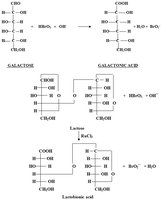
Example: Oxidation of D-galactose to D-galactoic acid.
Functional Groups: Carboxylic Acids, Esters, Amines, and Amides
Identification and Naming of Functional Groups
Organic molecules are classified by their functional groups, which determine their chemical properties and reactivity.
Carboxylic Acids: - Functional group: -COOH - Suffix: -oic acid
Esters: - Functional group: -COOR - Suffix: -oate
Amines: - Functional group: -NH2 - Suffix: -amine
Amides: - Functional group: -CONH2 - Suffix: -amide
Formation and Hydrolysis of Esters and Amides
Esters are formed by the reaction of alcohols and carboxylic acids (esterification), while amides are formed by the reaction of amines (or ammonia) and carboxylic acids (amidation). Both esters and amides can be hydrolyzed by acids or bases.
Esterification: - Alcohol + Carboxylic acid → Ester + Water
Acid Hydrolysis of Esters: - Ester + Water + Acid → Carboxylic acid + Alcohol
Base Hydrolysis of Esters: - Ester + Base → Carboxylate salt + Alcohol
Amidation: - Amine + Carboxylic acid → Amide + Water
Acid Hydrolysis of Amides: - Amide + Water + Acid → Carboxylic acid + Ammonium salt
Base Hydrolysis of Amides: - Amide + Base → Carboxylate salt + Amine
Summary Table: Monosaccharide Classification
Aldose or Ketose | Name for Number of C’s | Full Name |
|---|---|---|
aldose | triose | aldotriose |
aldose | tetrose | aldotetrose |
aldose | pentose | aldopentose |
ketose | hexose | ketohexose |
aldose | hexose | aldohexose |
Key Equations
Esterification:
Acid Hydrolysis of Ester:
Base Hydrolysis of Ester:
Amidation:
Acid Hydrolysis of Amide:
Base Hydrolysis of Amide:
Additional info:
Polysaccharides such as amylose, amylopectin, cellulose, and glycogen are composed of glucose units and differ in their glycosidic bonds and branching.
Reducing sugars contain a free aldehyde or ketone group and can be detected by Benedict’s or Tollens tests.
Functional groups determine solubility, acidity, and basicity of organic molecules.
