 Back
BackComprehensive Review of Organic and Biological Chemistry (Chapters 11–17)
Study Guide - Smart Notes
 Tailored notes based on your materials, expanded with key definitions, examples, and context.
Chapter 11: Introduction to Organic Chemistry – Hydrocarbons
Overview of Organic Compounds
Organic compounds are primarily composed of carbon atoms and are fundamental to the study of chemistry due to their diversity and importance in biological systems. They are classified based on their structure and functional groups.
Carbon Atoms: Organic compounds contain carbon atoms that typically form four covalent bonds, resulting in a tetrahedral shape.
Nonpolar Nature: Most organic compounds are nonpolar, leading to low melting and boiling points. They are generally insoluble in water and flammable.
Naming: The IUPAC system is used for systematic naming, and structures are often represented using expanded, condensed, and line-angle formulas.
Here are some simple examples to help:
1. IUPAC Naming
CH₄ → Methane
C₂H₆ → Ethane
C₃H₈ → Propane
👉 The name depends on how many carbon atoms are in the chain.
2. Expanded Formula (shows everything)
Example: Ethane (C₂H₆)
H H | | H–C – C–H | | H H
3. Condensed Formula (shortened)
Ethane → CH₃CH₃
Propane → CH₃CH₂CH₃
4. Line-Angle Formula (simplest drawing)
Each corner or end = a carbon atom
Hydrogens are not shown
Example:
Propane looks like a simple line: ∠ (two lines connected = 3 carbons)
👉 So:
Expanded = detailed
Condensed = shorter
Line-angle = simplest sketch
If you want, I can show examples with alcohols or more complex molecules too.
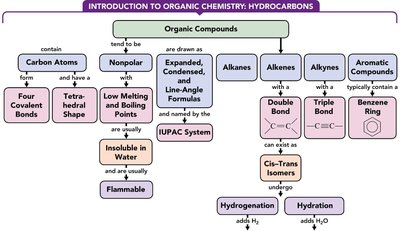
Classification: Hydrocarbons are divided into alkanes (single bonds), alkenes (double bonds), alkynes (triple bonds), and aromatic compounds (containing a benzene ring).
Isomerism: Alkenes can exhibit cis-trans isomerism due to restricted rotation around the double bond.
Reactions: Common reactions include hydrogenation (addition of H2) and hydration (addition of H2O).
Chapter 12: Alcohols, Thiols, Ethers, Aldehydes, and Ketones
Functional Groups and Their Reactions
This chapter explores organic compounds containing oxygen and sulfur, focusing on their structures, properties, and chemical reactions.
Alcohols: Contain a hydroxyl (-OH) group bonded to a carbon atom. Can undergo dehydration to form alkenes and oxidation to form aldehydes or ketones.
Thiols: Contain a sulfur analog of alcohols (–SH group).
Phenols: Aromatic compounds with a hydroxyl group directly attached to a benzene ring.
Ethers: Contain an oxygen atom connected to two alkyl or aryl groups.
Aldehydes and Ketones: Contain carbonyl groups (C=O). Aldehydes are formed by oxidation of primary alcohols, while ketones are formed by oxidation of secondary alcohols.
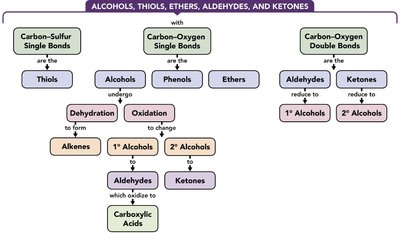
Further Oxidation: Aldehydes can be oxidized to carboxylic acids.
Reduction: Aldehydes and ketones can be reduced back to alcohols.
Chapter 13: Carbohydrates
Classification and Structure of Carbohydrates
Carbohydrates are essential biomolecules that serve as energy sources and structural components in living organisms. They are classified based on the number of sugar units.
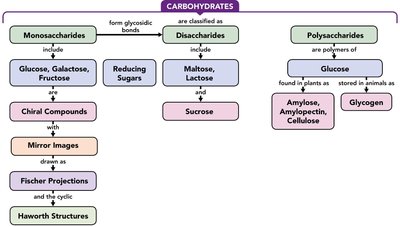
Monosaccharides: Simple sugars such as glucose, galactose, and fructose. They are chiral compounds, often represented using Fischer projections and cyclic Haworth structures.
Disaccharides: Formed by glycosidic bonds between two monosaccharides (e.g., maltose, lactose, sucrose). Some are reducing sugars.
Polysaccharides: Polymers of glucose, including amylose, amylopectin, cellulose (in plants), and glycogen (in animals).
Chapter 14: Carboxylic Acids, Esters, Amines, and Amides
Properties and Reactions of Carboxylic Acid Derivatives
This chapter covers the structure, properties, and reactions of carboxylic acids and their derivatives, as well as amines and amides.
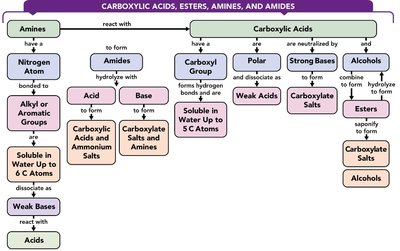
Carboxylic Acids: Contain a carboxyl group (-COOH). They are weak acids, soluble in water up to five carbon atoms, and react with bases to form carboxylate salts.
Esters: Formed by the reaction of carboxylic acids with alcohols. Hydrolysis of esters yields carboxylic acids and alcohols.
Amines: Contain a nitrogen atom bonded to alkyl or aromatic groups. They are weak bases and can form amides when reacted with acids.
Amides: Formed by the reaction of carboxylic acids with amines or ammonia. They can be hydrolyzed by acids or bases to yield carboxylic acids and amines or ammonium salts.
Chapter 15: Lipids
Classification and Biological Roles of Lipids
Lipids are a diverse group of hydrophobic biomolecules essential for energy storage, membrane structure, and signaling.
Fatty Acids: Long-chain carboxylic acids that can be saturated or unsaturated. They combine with glycerol to form triacylglycerols (fats and oils).
Waxes: Esters of fatty acids with long-chain alcohols.
Phospholipids: Contain polar and nonpolar parts, forming the lipid bilayer of cell membranes.
In simple terms:
Phospholipids have both polar (water-attracting) and nonpolar (water-repelling) parts.
The *head** is polar (likes water)
The *tails** are nonpolar (avoid water)
Because of this, they naturally form a lipid bilayer (double layer), which makes up the cell membrane.
👉 Think of it like a sandwich: heads on the outside, tails on the inside.
Steroids: Characterized by a steroid nucleus; includes cholesterol, bile salts, and steroid hormones.
In simple terms:
Steroids are a type of lipid with a special ring-shaped structure.
They include *cholesterol**
* Bile salts (help digest fats)
* Steroid hormones (like estrogen and testosterone)
👉 Think of steroids as important molecules that help with digestion, hormones, and cell structure.
Prostaglandins: Derived from fatty acids with hormone-like functions.
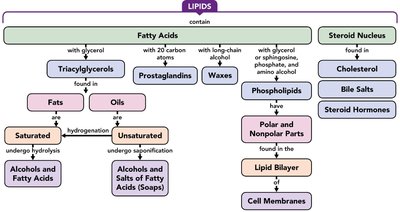
Reactions: Fats undergo hydrolysis to yield alcohols and fatty acids; saponification produces soaps.
Chapter 16: Amino Acids, Proteins, and Enzymes
Structure and Function of Proteins
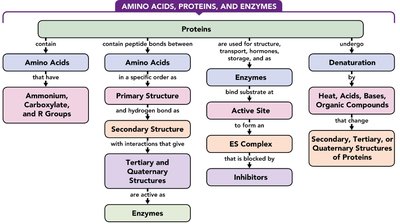
Proteins are polymers of amino acids and perform a wide range of biological functions, including catalysis, structure, and regulation.
In simple terms:
Proteins are long chains of amino acids that do many important jobs in the body.
They *speed up chemical reactions** (enzymes)
They *build and support structures** (like muscles and tissues)
They *help control body processes** (like hormones and regulation)
👉 Think of proteins as the body’s workers that keep everything running.
Amino Acids: Contain ammonium, carboxylate, and R groups. Linked by peptide bonds to form proteins.
Protein Structure:
Primary Structure: Sequence of amino acids.
Secondary Structure: Hydrogen bonding forms alpha helices and beta sheets.
Tertiary and Quaternary Structures: Further folding and assembly of polypeptide chains.
Enzymes: Proteins that catalyze biochemical reactions. They have an active site where substrates bind to form an enzyme-substrate (ES) complex. Enzyme activity can be inhibited by specific molecules.
Denaturation: Proteins lose their structure and function when exposed to heat, acids, bases, or organic compounds.
Chapter 17: Nucleic Acids and Protein Synthesis
Genetic Information and Its Expression
Nucleic acids store and transmit genetic information. Protein synthesis involves transcription and translation of genetic code.
DNA: Composed of deoxynucleotides (A, T, G, C) arranged in a double helix. Complementary base pairing (A-T, G-C) encodes genetic information.
RNA: Contains nucleotides (A, U, G, C) and is involved in protein synthesis as mRNA, tRNA, and rRNA.
Protein Synthesis: mRNA codons specify amino acids, which are assembled into proteins during translation.
Mutations: Changes in DNA sequence can lead to genetic diseases. Types include point mutations, deletion mutations, and insertion mutations.
Point mutations – A change in a single nucleotide (one base pair) in DNA. This can sometimes change one amino acid in a protein or have no effect at all.
Deletion mutations – One or more nucleotides are removed from the DNA sequence. This can cause a frameshift, which alters how the entire sequence is read.
Insertion mutations – One or more nucleotides are added into the DNA sequence. Like deletions, this can also cause a frameshift and significantly change the resulting protein.
Viruses: Contain DNA or RNA and can reproduce using reverse transcription.
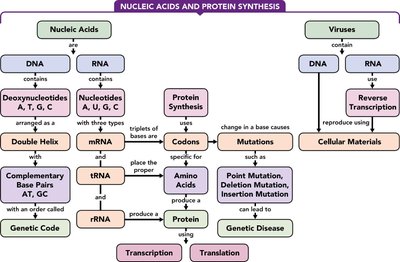
Key Processes: Transcription (DNA to RNA) and translation (RNA to protein).
Here it is in very simple terms:
* Transcription (DNA → RNA) = copying the instructions
Your cell makes a copy of DNA into RNA.
* Translation (RNA → protein) = using the instructions
The cell reads the RNA to build a protein.
👉 So basically:
DNA = instructions → RNA = copy → Protein = final product
