 Back
BackComprehensive Review of Organic and Biological Chemistry (Chapters 11–17)
Study Guide - Smart Notes
 Tailored notes based on your materials, expanded with key definitions, examples, and context.
Chapter 11: Introduction to Organic Chemistry – Hydrocarbons
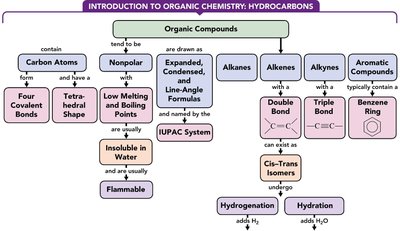
Overview of Organic Compounds
Organic compounds are primarily composed of carbon atoms and are fundamental to the study of chemistry due to their diversity and importance in biological systems. They are characterized by specific bonding patterns and physical properties.
Carbon Atoms: Form four covalent bonds, resulting in a tetrahedral molecular geometry.
Nonpolar Nature: Most organic compounds are nonpolar, leading to low melting and boiling points.
Solubility and Flammability: Typically insoluble in water and flammable.
Naming: The IUPAC system is used for systematic naming.
Classification of Hydrocarbons
Alkanes: Contain only single bonds.
Alkenes: Contain at least one double bond; can exhibit cis-trans isomerism.
Alkynes: Contain at least one triple bond.
Aromatic Compounds: Contain benzene rings.
Key Reactions: Hydrogenation (addition of H2) and hydration (addition of H2O) are important reactions for alkenes and alkynes.
Chapter 12: Alcohols, Thiols, Ethers, Aldehydes, and Ketones
Functional Groups and Their Reactions
This chapter explores organic compounds containing oxygen and sulfur, focusing on their structures, properties, and chemical reactivity.
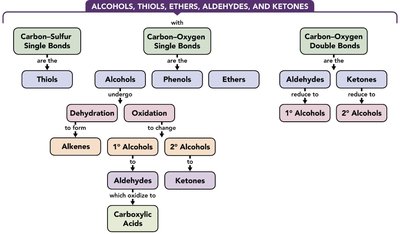
Alcohols: Contain a hydroxyl (-OH) group bonded to carbon.
Thiols: Contain a sulfhydryl (-SH) group.
Ethers: Have an oxygen atom connected to two alkyl or aryl groups.
Aldehydes and Ketones: Contain carbonyl (C=O) groups; aldehydes have it at the end of the chain, ketones within the chain.
Key Reactions
Dehydration of Alcohols: Produces alkenes and water.
Oxidation of Alcohols:
Primary alcohols oxidize to aldehydes, then to carboxylic acids.
Secondary alcohols oxidize to ketones.
Reduction of Aldehydes and Ketones:
Aldehydes reduce to primary alcohols.
Ketones reduce to secondary alcohols.
Chapter 13: Carbohydrates
Classification and Structure
Carbohydrates are essential biomolecules classified by their complexity and function. They serve as energy sources and structural components in living organisms.
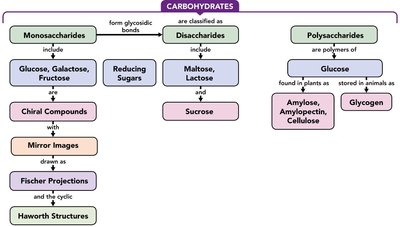
Monosaccharides: Simple sugars (e.g., glucose, galactose, fructose); chiral compounds with mirror images, often drawn as Fischer projections or cyclic Haworth structures.
Disaccharides: Formed by glycosidic bonds between two monosaccharides (e.g., maltose, lactose, sucrose).
Polysaccharides: Polymers of glucose; include amylose, amylopectin, cellulose (plants), and glycogen (animals).
Reducing Sugars
Monosaccharides and some disaccharides can act as reducing agents due to their free aldehyde or ketone groups.
Chapter 14: Carboxylic Acids, Esters, Amines, and Amides
Functional Groups and Properties
This chapter covers organic compounds containing carboxyl, ester, amine, and amide groups, focusing on their chemical behavior and biological significance.
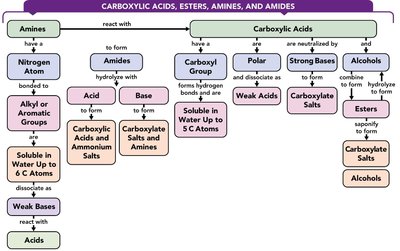
Carboxylic Acids: Contain a carboxyl group (-COOH); weak acids, soluble in water up to five carbon atoms.
Esters: Formed from carboxylic acids and alcohols; often have pleasant odors.
Amines: Contain nitrogen; can be alkyl or aromatic, act as weak bases.
Amides: Formed from carboxylic acids and amines or ammonia.
Key Reactions
Neutralization: Carboxylic acids react with bases to form carboxylate salts.
Hydrolysis: Esters and amides can be hydrolyzed to yield acids and alcohols or amines.
Chapter 15: Lipids
Classification and Biological Roles
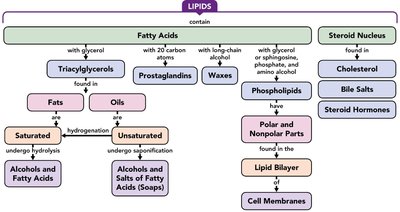
Lipids are a diverse group of hydrophobic biomolecules, including fats, oils, phospholipids, and steroids, essential for energy storage, membrane structure, and signaling.
Fatty Acids: Building blocks of many lipids; can be saturated or unsaturated.
Triacylglycerols: Composed of glycerol and three fatty acids; main storage form of energy in animals.
Phospholipids: Contain polar and nonpolar parts; major components of cell membranes.
Steroids: Characterized by a steroid nucleus; include cholesterol, bile salts, and steroid hormones.
Key Reactions
Hydrolysis: Breaks down fats into fatty acids and glycerol.
Saponification: Conversion of fats into soaps and glycerol by reaction with a base.
Chapter 16: Amino Acids, Proteins, and Enzymes
Structure and Function
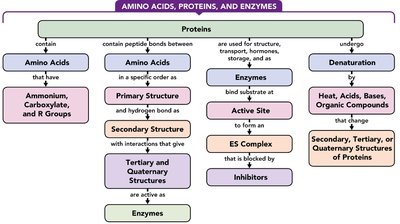
Amino acids are the monomers of proteins, which perform a vast array of functions in biological systems, including catalysis (enzymes), structure, and regulation.
Amino Acids: Contain ammonium, carboxylate, and R groups; linked by peptide bonds to form proteins.
Protein Structure:
Primary: Sequence of amino acids.
Secondary: Alpha helices and beta sheets formed by hydrogen bonding.
Tertiary/Quaternary: 3D folding and assembly of multiple polypeptides.
Enzymes: Proteins that catalyze biochemical reactions; have specific active sites and can be inhibited by various molecules.
Denaturation: Loss of protein structure and function due to heat, acids, bases, or organic compounds.
Chapter 17: Nucleic Acids and Protein Synthesis
Genetic Information and Expression
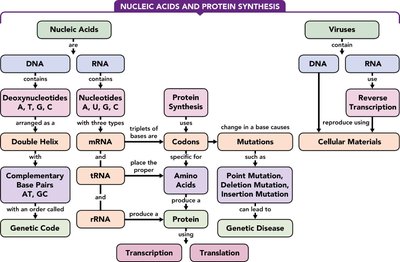
Nucleic acids (DNA and RNA) store and transmit genetic information, directing the synthesis of proteins through transcription and translation.
DNA: Composed of deoxynucleotides (A, T, G, C); forms a double helix with complementary base pairing.
RNA: Contains ribonucleotides (A, U, G, C); involved in protein synthesis as mRNA, tRNA, and rRNA.
Protein Synthesis:
Transcription: DNA is transcribed to mRNA.
Translation: mRNA is translated into a specific sequence of amino acids (protein).
Mutations: Changes in DNA sequence can lead to genetic diseases.
Viruses: Contain DNA or RNA and replicate using host cellular machinery, sometimes via reverse transcription.
Key Terms and Concepts
Codons: Triplets of nucleotides in mRNA that specify amino acids.
Genetic Code: The set of rules by which information encoded in DNA or RNA is translated into proteins.
Additional info: These notes are structured to provide a comprehensive yet concise review of the main topics and concepts from Chapters 11–17, as outlined in the provided materials and images. Students should refer to their textbook and course materials for more detailed explanations and practice problems.
