 Back
BackIonic and Molecular Compounds: Structure, Naming, and Properties
Study Guide - Smart Notes
 Tailored notes based on your materials, expanded with key definitions, examples, and context.
Ionic and Molecular Compounds
Introduction
Chemistry for Allied Health Majors explores the structure, formation, and properties of ionic and molecular compounds, which are fundamental to understanding chemical reactions and biological processes. This chapter focuses on how atoms combine to form compounds, the types of bonds involved, and the rules for naming and writing chemical formulas.
6.1 Ions: Transfer of Electrons
Formation of Ions
Atoms form ions by gaining or losing electrons to achieve a stable electron configuration, typically an octet (eight valence electrons). Ionic bonds are the strong attractive forces between positive (cation) and negative (anion) ions.
Cations: Formed when metals lose electrons (e.g., Na+, Mg2+).
Anions: Formed when nonmetals gain electrons (e.g., Cl-, O2-).
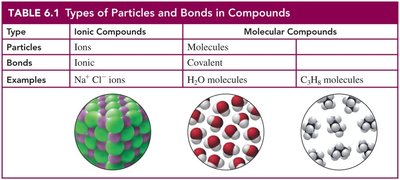
Types of Particles and Bonds in Compounds
Ionic compounds consist of ions held together by ionic bonds, while molecular compounds consist of molecules held together by covalent bonds.
Type | Ionic Compounds | Molecular Compounds |
|---|---|---|
Particles | Ions | Molecules |
Bonds | Ionic | Covalent |
Examples | Na+, Cl- ions | H2O, C2H6 molecules |
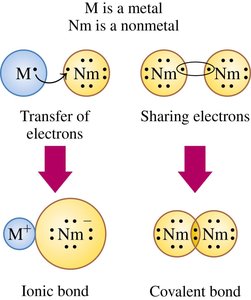
Octet Rule and Bond Formation
The octet rule states that atoms tend to gain, lose, or share electrons to achieve eight valence electrons. Metals (Groups 1A, 2A, 3A) lose electrons to form cations, while nonmetals (Groups 5A, 6A, 7A) gain electrons to form anions.
Examples of Ion Formation
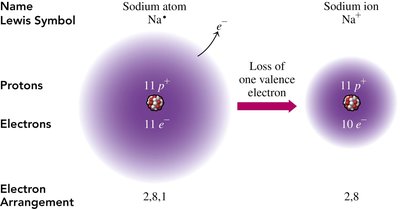
Sodium (Na): Loses one electron to form Na+ (electron configuration: 2,8).
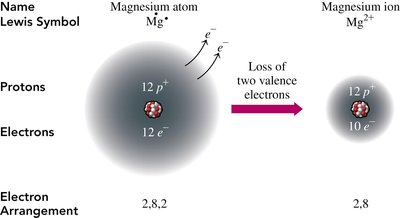
Magnesium (Mg): Loses two electrons to form Mg2+ (electron configuration: 2,8).
Chlorine (Cl): Gains one electron to form Cl- (electron configuration: 2,8,8).
Common Ions and Their Charges
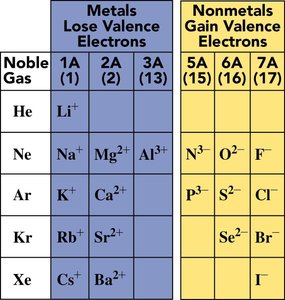
The charge of an ion can often be predicted from its group number in the periodic table.
Group | Cation | Anion |
|---|---|---|
1A (1) | Li+, Na+, K+ | |
2A (2) | Mg2+, Ca2+, Ba2+ | |
3A (13) | Al3+ | |
5A (15) | N3-, P3- | |
6A (16) | O2-, S2- | |
7A (17) | F-, Cl-, Br-, I- |
6.2 Ionic Compounds
Formation and Properties
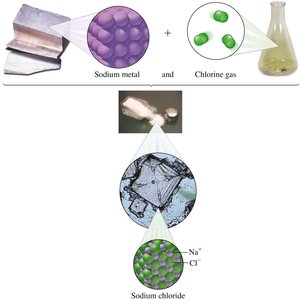
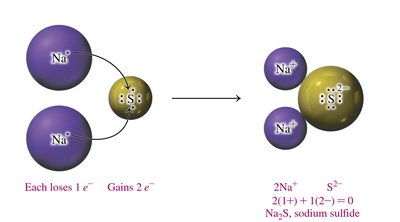
Ionic compounds are formed from the reaction of metals and nonmetals, resulting in a crystalline lattice of alternating positive and negative ions. For example, sodium reacts with chlorine to form sodium chloride (NaCl), commonly known as table salt.
High melting points
Solid at room temperature
Conduct electricity when dissolved in water
Writing Formulas for Ionic Compounds
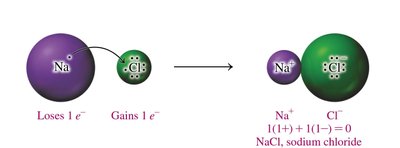
The chemical formula of an ionic compound reflects the lowest whole-number ratio of ions that results in a neutral compound (total positive charge equals total negative charge).
Example: Na+ + Cl- → NaCl
Example: Mg2+ + 2Cl- → MgCl2
6.3 Naming and Writing Ionic Formulas
Naming Rules
When naming ionic compounds:
The metal (cation) is named first, using the element name.
The nonmetal (anion) is named second, using the root of the element name plus the suffix -ide.
For metals with variable charges (transition metals), a Roman numeral indicates the charge.
Examples
Compound | Name |
|---|---|
KI | Potassium iodide |
MgBr2 | Magnesium bromide |
Al2O3 | Aluminum oxide |
Metals with Variable Charges
Transition metals can form more than one type of positive ion. The charge is specified with a Roman numeral in parentheses after the metal name (e.g., FeCl2: iron(II) chloride).
6.4 Polyatomic Ions
Definition and Examples
Polyatomic ions are groups of covalently bonded atoms that carry an overall charge. Most are negatively charged (anions), except for ammonium (NH4+).
Ion | Formula | Name |
|---|---|---|
OH- | Hydroxide | |
NO3- | Nitrate | |
SO42- | Sulfate | |
CO32- | Carbonate | |
NH4+ | Ammonium |
Naming Compounds with Polyatomic Ions
The name of the metal (or positive ion) is written first, followed by the name of the polyatomic ion. No prefixes are used.
Example: NaNO3 is sodium nitrate.
Example: CaSO4 is calcium sulfate.
6.5 Molecular Compounds: Sharing Electrons
Covalent Bonds and Molecular Compounds
Molecular compounds are formed when nonmetals share electrons, creating covalent bonds. The number of shared electrons depends on how many are needed to complete the octet.
Example: H2O (water), CO2 (carbon dioxide)
Naming Molecular Compounds
Prefixes are used to indicate the number of each type of atom:
Number | Prefix |
|---|---|
1 | mono- |
2 | di- |
3 | tri- |
4 | tetra- |
5 | penta- |
6 | hexa- |
7 | hepta- |
8 | octa- |
9 | nona- |
10 | deca- |
Example: CO2 is carbon dioxide.
Example: N2O3 is dinitrogen trioxide.
6.6 Lewis Structures for Molecules
Drawing Lewis Structures
Lewis structures represent the arrangement of valence electrons in molecules. Shared pairs (bonds) are shown as lines or pairs of dots, and lone pairs are shown as dots on individual atoms. The octet rule guides the arrangement, except for hydrogen (which only needs two electrons).
Single bond: one pair of shared electrons
Double bond: two pairs of shared electrons
Triple bond: three pairs of shared electrons
6.7 Electronegativity and Bond Polarity
Electronegativity
Electronegativity is a measure of an atom's ability to attract shared electrons in a bond. It increases across a period and decreases down a group.
Nonpolar covalent bond: Electrons shared equally (difference 0–0.4)
Polar covalent bond: Electrons shared unequally (difference 0.5–1.8)
Ionic bond: Electron transfer (difference >1.8)
6.8 Shapes of Molecules (VSEPR Theory)
VSEPR Theory
The Valence Shell Electron Pair Repulsion (VSEPR) theory predicts the three-dimensional shapes of molecules based on the repulsion between electron groups around a central atom.
Electron Groups | Bonded Atoms | Lone Pairs | Shape | Bond Angle |
|---|---|---|---|---|
2 | 2 | 0 | Linear | 180° |
3 | 3 | 0 | Trigonal planar | 120° |
3 | 2 | 1 | Bent | 120° |
4 | 4 | 0 | Tetrahedral | 109° |
4 | 3 | 1 | Trigonal pyramidal | 109° |
4 | 2 | 2 | Bent | 109° |
6.9 Polarity of Molecules and Intermolecular Forces
Polarity of Molecules
A molecule is polar if it contains polar bonds that do not cancel due to molecular shape, resulting in a dipole moment. Nonpolar molecules have either nonpolar bonds or symmetrical polar bonds that cancel out.
Intermolecular Forces
Ionic bonds: Strongest, between ions
Hydrogen bonds: Strong dipole-dipole attractions between H and F, O, or N
Dipole-dipole attractions: Between polar molecules
Dispersion forces: Weakest, between nonpolar molecules due to temporary dipoles
These forces affect physical properties such as melting and boiling points.
Summary Table: Types of Bonds and Forces
Type | Strength | Example |
|---|---|---|
Ionic bond | Strongest | NaCl |
Hydrogen bond | Strong | H2O |
Dipole-dipole | Moderate | HCl |
Dispersion | Weakest | Br2 |
