 Back
Nucleic Acid Structure: DNA, RNA, and Their Biological Functions
Study Guide - Smart Notes
 Tailored notes based on your materials, expanded with key definitions, examples, and context.
Nucleotides: The Building Blocks of Nucleic Acids
Structural Components of Nucleotides
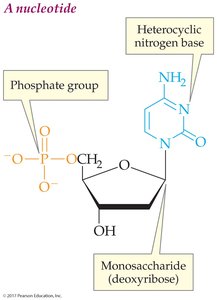
Nucleotides are the fundamental units of nucleic acids, such as DNA and RNA. Each nucleotide consists of three main components:
Phosphate group: Provides negative charge and enables linkage between nucleotides.
Monosaccharide (sugar): Ribose in RNA, deoxyribose in DNA.
Heterocyclic nitrogen base: Purines (adenine, guanine) and pyrimidines (cytosine, thymine, uracil).
Nucleosides are similar to nucleotides but lack the phosphate group.
Nitrogenous Bases
The nitrogenous bases are classified as:
Purines: Adenine (A), Guanine (G)
Pyrimidines: Cytosine (C), Thymine (T, DNA only), Uracil (U, RNA only)
These bases are aromatic, planar, and participate in hydrogen bonding.
Formation of Nucleic Acids
Condensation and Hydrolysis Reactions
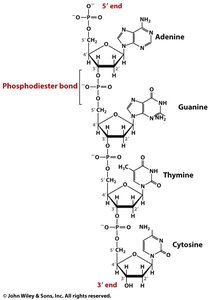
Nucleotides are joined together by condensation reactions (loss of water), forming phosphodiester bonds. Hydrolysis reactions break these bonds by adding water.
Condensation: Formation of nucleosides (sugar + base) and nucleotides (nucleoside + phosphate).
Hydrolysis: Breakdown of nucleic acids into nucleotides.
Polynucleotide Structure
Nucleic acids are linear polymers of nucleotides, connected by phosphodiester bonds between the 3' and 5' carbons of the sugar.
Directionality: Written from 5' phosphate end to 3' OH end.
Sequence example: 5' AGTC 3'
DNA vs. RNA: Structural and Functional Differences
Major Differences
DNA and RNA differ in several key aspects:
Feature | DNA | RNA |
|---|---|---|
Bases | A, G, C, T | A, G, C, U |
Sugar | Deoxyribose | Ribose |
Strandedness | Double-stranded | Single-stranded |
3D Structure of DNA: The Double Helix
Key Structural Features
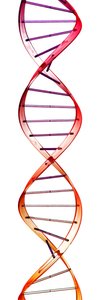
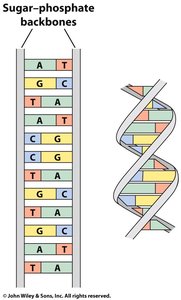
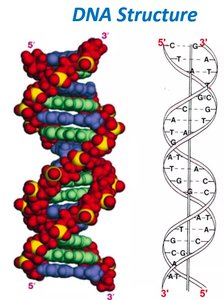
Double-stranded DNA forms a double helix, with the following characteristics:
Antiparallel strands: One strand runs 5' to 3', the other 3' to 5'.
Phosphate backbone: Located on the outside, bases point inward.
Planar bases: Perpendicular to the backbone, stacked like steps of a spiral staircase.
Structural Stability
The stability of the double helix is due to:
Dispersion forces: Between stacked aromatic bases (stacking energy).
Hydrogen bonding: Between complementary base pairs (A-T, G-C).
Base-Pairing and Complementarity
Chargaff’s Rules
Chargaff’s rules state that in double-stranded DNA:
The number of A equals T.
The number of G equals C.
This complementarity allows for accurate replication and information transfer.
Reverse Complement
To write the reverse complement of a DNA sequence, pair each base with its complement and reverse the direction:
A pairs with T
G pairs with C
Example: 5' ATT GCC AGG 3' → 3' TAA CGG TCC 5'
DNA Organization in the Cell
Genes, Chromosomes, Chromatin, and Nucleosomes
DNA is highly compacted in the cell:
Chromatin: Orderly tangle of DNA in non-dividing cells.
Chromosomes: Highly compacted, visible during cell division.
Nucleosomes: DNA wrapped around histone proteins (rich in Arg and Lys).
Gene: Segment of DNA directing synthesis of a single polypeptide.
Protein-DNA Interactions
General Principles
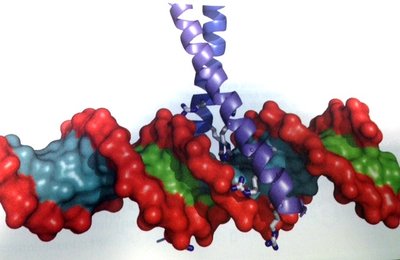
Proteins interact with DNA primarily through ionic interactions:
Positively-charged amino acids: Arg, Lys, His on proteins.
Negatively-charged phosphates: On DNA backbone.
Interactions are called salt bridges.
Mutations in DNA
Causes and Consequences
A mutation is a change in the DNA sequence, often caused by mutagens such as ionizing radiation or chemical agents. Mutations can alter base-pairing and, if not repaired, are propagated during DNA replication.
Example: Cytosine deamination produces uracil, which pairs with adenine instead of guanine.
Semiconservative replication: Each new DNA double helix contains one old and one new strand.
Central Dogma of Molecular Biology
Information Flow
The central dogma describes the flow of genetic information:
Replication: DNA → DNA
Transcription: DNA → RNA
Translation: RNA → Protein
Each process involves initiation, elongation, and termination phases.
Summary Table: DNA vs. RNA
Feature | DNA | RNA |
|---|---|---|
Base | A, G, C, T | A, G, C, U |
Sugar | Deoxyribose | Ribose |
Strandedness | Double-stranded | Single-stranded |
Function | Genetic storage | Genetic decoding, catalysis |
Additional info: These notes expand on the original lecture slides by providing definitions, examples, and structural context for nucleic acids, their organization, and their biological functions. All included images directly reinforce the structural and functional explanations provided.
