 Back
Arthritis: Types, Causes, Symptoms, and Treatments
Study Guide - Smart Notes
 Tailored notes based on your materials, expanded with key definitions, examples, and context.
Arthritis
Overview of Arthritis
Arthritis is a general term describing inflammation of the joints, commonly resulting in pain, swelling, and reduced mobility. It is caused by exposure to high compressive forces and excessive wear due to friction. There are two primary types of arthritis: Osteoarthritis and Rheumatoid arthritis.
Definition: Arthritis refers to joint inflammation, often leading to pain and stiffness.
Causes: Mechanical wear and tear, autoimmune reactions, aging, and genetic predisposition.
Symptoms: Joint pain, swelling, stiffness, and decreased range of motion.
Types of Arthritis
Osteoarthritis
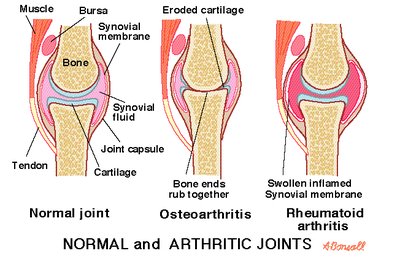
Osteoarthritis is the most common form of arthritis, often described as a "wear and tear" condition. It occurs when the cartilage covering the ends of bones deteriorates, causing bones to rub together and resulting in pain and inflammation.
Pathophysiology: Cartilage erosion leads to direct bone contact.
Symptoms: Pain, swelling, reduced joint mobility, and stiffness.
Treatment: Pain medications, joint replacements, exercise, and physical therapy.
Example: Elderly individuals commonly experience osteoarthritis in weight-bearing joints such as knees and hips.
Rheumatoid Arthritis
Rheumatoid arthritis is an autoimmune disorder in which the immune system attacks the synovial membrane tissue of the joints. This results in chronic inflammation, pain, and often permanent deformity.
Pathophysiology: Immune system attacks healthy joint tissue, especially the synovial membrane.
Symptoms: Swelling, pain, joint deformity, and loss of function.
Treatment: Medications to suppress the immune response, rest, physical therapy, and sometimes surgery. No known cure.
Example: Rheumatoid arthritis can affect multiple joints symmetrically, such as hands and wrists.
Treatments for Arthritis
Conventional and Alternative Treatments
A wide range of treatment options are available for arthritis, aiming to reduce pain, improve joint function, and slow disease progression.
Exercise: Maintains joint range of motion and flexibility. Activities like yoga and tai chi are beneficial.
Medications: Includes painkillers, anti-inflammatory drugs, topical pain blockers, steroid injections, and immunosuppressive drugs.
Physical Therapy: Strengthens muscles around the joint and improves mobility.
Surgical Treatments: Joint repair, replacement, and fusion procedures.
Alternative Therapies: Acupuncture, massage, and supplements such as glucosamine and chondroitin may help reduce pain.
Comparison of Normal and Arthritic Joints
Structural Differences
The structural differences between normal, osteoarthritic, and rheumatoid arthritic joints are significant and can be visualized in diagrams.
Joint Type | Key Features | Pathology |
|---|---|---|
Normal Joint | Healthy cartilage, synovial membrane, and joint capsule | No inflammation or pain |
Osteoarthritis | Eroded cartilage, bone ends rub together | Pain, inflammation, reduced mobility |
Rheumatoid Arthritis | Swollen, inflamed synovial membrane | Chronic inflammation, joint deformity |
Summary
Arthritis encompasses a range of joint disorders, primarily osteoarthritis and rheumatoid arthritis. Understanding their causes, symptoms, and treatments is essential for effective management and improving patient quality of life.
References: Johnson, Michael. (2017) Human biology: Concepts and current issues (8th ed). Pearson Education; Mayo Clinic (2021); MedicineNet.com (2012).
