 Back
Chemical Level of Organization: Human Biology Study Notes
Study Guide - Smart Notes
 Tailored notes based on your materials, expanded with key definitions, examples, and context.
Chemical Level of Organization
How Matter is Organized
The human body is composed of matter, which is anything that occupies space and has mass. Matter exists in three primary forms: solids (e.g., bone), liquids (e.g., blood), and gases (e.g., oxygen). All matter is made up of chemical elements, each consisting of atoms. Atoms are the smallest units of matter that retain the chemical properties of an element. Elements are organized in the periodic table, which classifies them based on their properties and atomic structure.
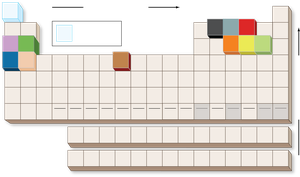
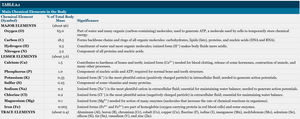
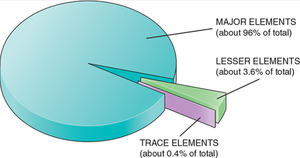
There are 26 elements present in the human body, categorized as major elements, lesser elements, and trace elements. Major elements constitute the bulk of body mass, while trace elements are present in minute quantities but are essential for physiological functions.
Structure of Atoms
Subatomic Particles
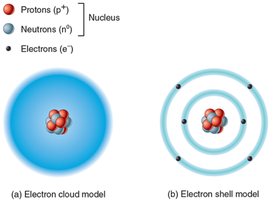
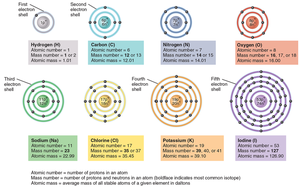
An atom consists of three types of subatomic particles:
Protons: Positively charged (+1), located in the nucleus.
Neutrons: No charge, located in the nucleus.
Electrons: Negatively charged (-1), found in electron shells surrounding the nucleus.
The arrangement of these particles determines the atom's properties and behavior in chemical reactions.
Atomic Number and Mass Number
The atomic number is the number of protons in the nucleus of an atom and defines the element. The number of electrons in a neutral atom equals the number of protons, making the atom electrically neutral. The mass number is the sum of protons and neutrons in the nucleus.
Atomic Number = Number of Protons
Mass Number = Number of Protons + Number of Neutrons
Isotopes are variants of elements with the same number of protons but different numbers of neutrons, resulting in different mass numbers.
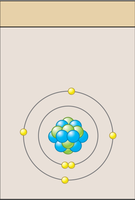
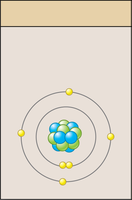
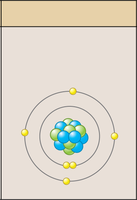
Isotopes
Isotopes are structural variations of an element. They have identical chemical properties but differ in their physical properties due to varying numbers of neutrons. For example, carbon exists as Carbon-12, Carbon-13, and Carbon-14, each with a different number of neutrons.
Ions, Molecules, and Compounds
Ions
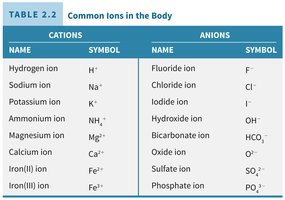
An ion is an atom or molecule with a net electrical charge due to unequal numbers of protons and electrons. Cations are positively charged, while anions are negatively charged. Ions are essential for many physiological processes, including nerve transmission and muscle contraction.
Molecules and Compounds
A molecule consists of two or more atoms sharing electrons, which may be of the same or different elements. A compound is a substance containing atoms of two or more different elements chemically bonded together.
Inorganic Compounds and Solutions
Water and Its Properties
Water is the main solvent in the body, dissolving many substances and facilitating biochemical reactions. Its properties include high heat capacity, high heat of vaporization, and cushioning ability, all vital for maintaining homeostasis and protecting organs.
Solvent: The medium in which solutes are dissolved.
Solute: The substance dissolved in the solvent.
Hydrophilic: Water-loving, polar molecules that dissolve in water.
Hydrophobic: Water-fearing, nonpolar molecules that do not dissolve in water.
Acids and Bases
pH Scale
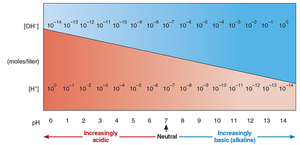
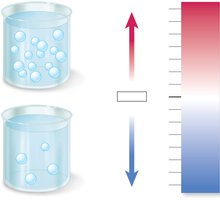
The pH scale measures the concentration of hydrogen ions (H+) in a solution, ranging from 0 (most acidic) to 14 (most basic). The scale is logarithmic, so each unit represents a tenfold change in H+ concentration.
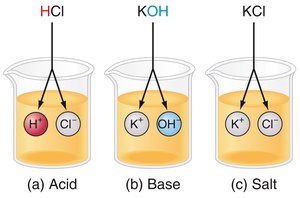
Acid: Releases H+ ions, lowering pH.
Base: Accepts H+ ions or releases OH-, raising pH.
Neutral: Equal concentrations of H+ and OH-, pH = 7.
Formula for pH:
Overview of Organic Compounds
Carbohydrates
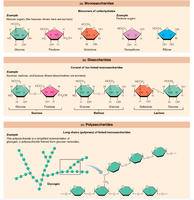
Carbohydrates are molecules composed of carbon, hydrogen, and oxygen. They serve as energy sources and structural components. Carbohydrates are classified as monosaccharides (simple sugars), disaccharides (two monosaccharides), and polysaccharides (many monosaccharides).
Monosaccharides: Glucose, fructose, galactose
Disaccharides: Sucrose, lactose, maltose
Polysaccharides: Glycogen (animals), starch and cellulose (plants)
Lipids
Lipids are hydrophobic molecules that provide energy storage, insulation, and protection. The basic monomer is a glycerol molecule bonded to three fatty acids. Lipids include triglycerides, phospholipids, and steroids.
Triglycerides: Long-term energy storage
Phospholipids: Major component of cell membranes
Steroids: Hormones, vitamin D, bile salts
Proteins
Proteins are polymers of amino acids and serve as structural materials, enzymes, transporters, and regulators. The three-dimensional shape (conformation) of a protein is crucial for its function. Denaturation is the loss of this shape, rendering the protein nonfunctional.
Amino acids: 20 types in living organisms
Peptides: Chains of amino acids (dipeptide, tripeptide, polypeptide)
Nucleic Acids
Nucleic acids are the largest molecules in the body, responsible for storing and transmitting genetic information. DNA is double-stranded and found in the nucleus and mitochondria, while RNA is single-stranded and found in the nucleus and cytoplasm. Both are composed of repeating units called nucleotides.
DNA: Contains deoxyribose sugar, phosphate, and bases (adenine, guanine, cytosine, thymine)
RNA: Contains ribose sugar, phosphate, and bases (adenine, guanine, cytosine, uracil)
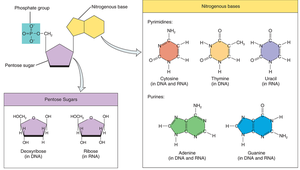
Formula for nucleotide structure:
Adenosine Triphosphate (ATP)
ATP is the principal energy-storing molecule in the body, often referred to as the "energy currency". It is required for muscular contraction, movement of chromosomes, intracellular transport, and synthesis of larger molecules from smaller ones.
Formula for ATP hydrolysis:
