Skip to main content
Introduction to Chemistry
My Course
Learn
Exam Prep
AI Tutor
Study Guides
Flashcards
Explore
Try the app
My Course
Learn
Exam Prep
AI Tutor
Study Guides
Flashcards
Explore
Try the app
Back
Acid and Base Strength definitions
You can tap to flip the card.
Strong Acid
You can tap to flip the card.
👆
Strong Acid
Substance that fully dissociates in water, producing only ions and favoring product formation.
Track progress
Control buttons has been changed to "navigation" mode.
1/15
Related flashcards
Related practice
Recommended videos
Acid and Base Strength quiz
Acid and Base Strength
15 Terms
Acid and Base Strength
14. Acids and Bases
5 problems
Topic
The pH Scale
14. Acids and Bases
5 problems
Topic
14. Acids and Bases
10 topics
30 problems
Chapter
Guided course
01:46
Acid and Base Strength Concept 4
3147
views
6
rank
Guided course
00:50
Acid and Base Strength Concept 3
3007
views
7
rank
Guided course
03:27
Acid and Base Strength Concept 2
3049
views
6
rank
Terms in this set (15)
Hide definitions
Strong Acid
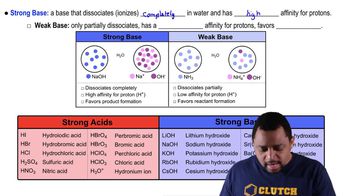
Substance that fully dissociates in water, producing only ions and favoring product formation.
Weak Acid
Substance that partially dissociates in water, with most molecules remaining in their original form.
Strong Base
Compound that completely dissociates in water, yielding a high concentration of hydroxide ions.
Weak Base
Compound that only partially dissociates in water, resulting in few hydroxide ions and favoring reactants.
Electrolyte
Substance that produces ions in solution, enabling electrical conductivity; strength depends on dissociation.
Dissociation
Process where a compound separates into ions when dissolved in water, affecting acid or base strength.
Hydronium Ion
Ion formed when water accepts a proton, represented as H3O+, central to acid-base reactions.
Hydroxide Ion
Negatively charged ion (OH−) produced when bases dissolve in water, responsible for basicity.
Conjugate Base
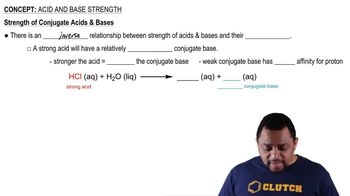
Species formed after an acid donates a proton, with strength inversely related to the original acid.
Conjugate Acid
Species formed when a base accepts a proton, with strength inversely related to the original base.
Affinity
Tendency of a species to accept or donate protons, influencing acid or base strength.
Product Formation
Result of a reaction where new ions or molecules are generated, favored by strong acids and bases.
Reactant Favoring
Condition where the original substances remain predominant, typical for weak acids and bases.
Reversible Reaction
Chemical process where both forward and reverse reactions occur, with equilibrium favoring one side.
Inverse Relationship
Pattern where increasing the strength of an acid or base decreases the strength of its conjugate counterpart.
 BackBack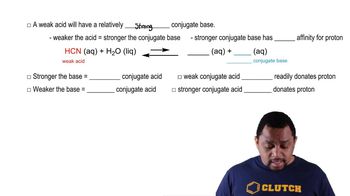
 01:46
01:46