Skip to main content
Introduction to Chemistry
My Course
Learn
Exam Prep
AI Tutor
Study Guides
Flashcards
Explore
Try the app
My Course
Learn
Exam Prep
AI Tutor
Study Guides
Flashcards
Explore
Try the app
Back
Acid-Base Introduction definitions
You can tap to flip the card.
Acid
You can tap to flip the card.
👆
Acid
Covalent compound with hydrogen ion bonded to a nonmetal or polyatomic ion, often producing sour taste and turning blue litmus paper red.
Track progress
Control buttons has been changed to "navigation" mode.
1/15
Related flashcards
Related practice
Recommended videos
Acid-Base Introduction quiz
Acid-Base Introduction
15 Terms
Acid-Base Introduction
14. Acids and Bases
5 problems
Topic
Arrhenius Acid and Base
14. Acids and Bases
5 problems
Topic
14. Acids and Bases
10 topics
30 problems
Chapter
Guided course
01:30
Acid-Base Introduction Concept 4
4592
views
15
rank
1
comments
Guided course
00:33
Acid-Base Introduction Concept 3
4615
views
20
rank
Guided course
00:48
Acid-Base Introduction Example 4
4498
views
14
rank
1
comments
Terms in this set (15)
Hide definitions
Acid
Covalent compound with hydrogen ion bonded to a nonmetal or polyatomic ion, often producing sour taste and turning blue litmus paper red.
Base
Ionic compound with a metal cation and hydroxide anion, or a nitrogen-containing amine, producing bitter taste and turning red litmus paper blue.
Covalent Compound
Molecule formed by sharing electrons between nonmetals, often found in acids.
Ionic Compound
Substance composed of metal cations and nonmetal anions held together by electrostatic forces, typical of bases.
Hydrogen Ion
Positively charged particle released by acids in water, responsible for sour taste and reactivity.
Hydroxide Ion
Negatively charged particle found in bases, responsible for slippery feel and bitter taste.
Aqueous Solution
Mixture where substances are dissolved in water, allowing acids and bases to ionize and exhibit characteristic behaviors.
Ionization
Process where molecules separate into charged particles when dissolved in water, key for acid and base activity.
Litmus Paper
Indicator strip that changes color to reveal acidic or basic nature of a solution.
Sour Taste
Sensory property caused by hydrogen ions, commonly associated with acids like those in citrus fruits.
Bitter Taste
Sensory property linked to bases, often experienced with substances like soap.
Slippery Feel
Tactile sensation produced by bases in solution, commonly noticed with soaps.
Reactivity with Metals
Characteristic of acids to produce hydrogen gas when interacting with metals such as magnesium.
Polyatomic Ion
Charged group of atoms acting as a single unit, often found in acids and bases.
Amines
Nitrogen-containing covalent compounds that can act as bases in aqueous solutions.
 BackBack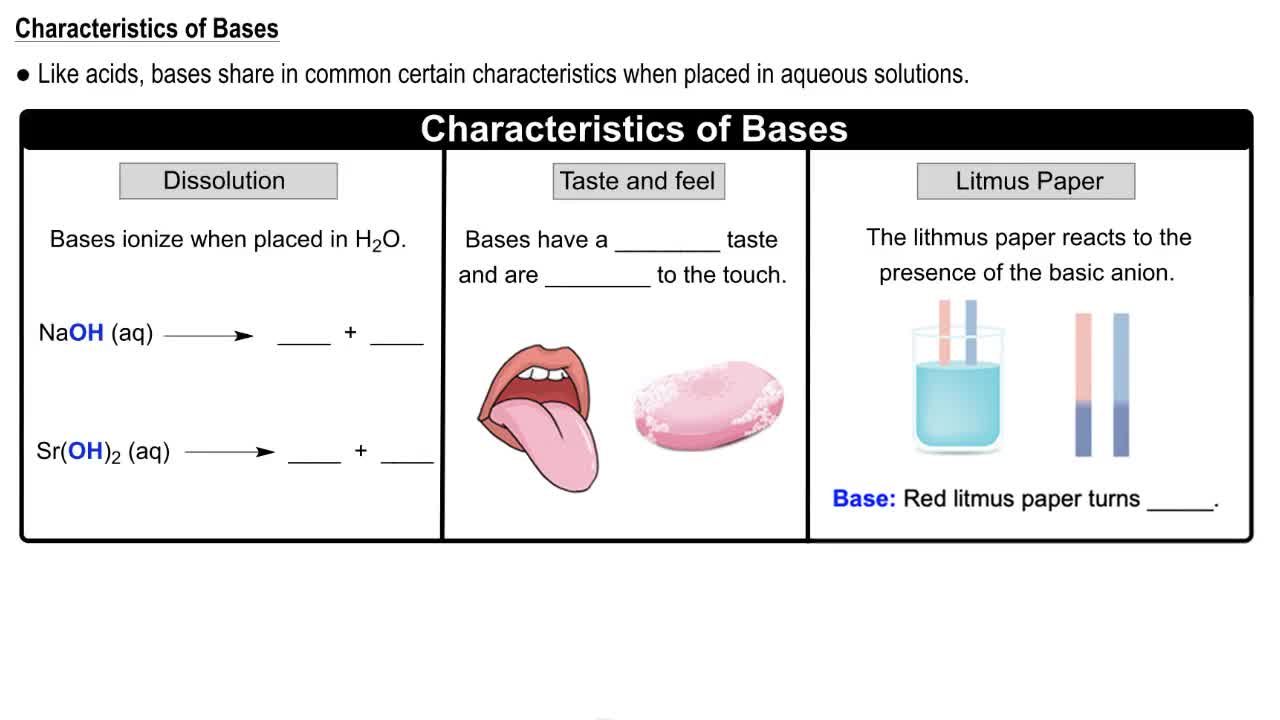
 01:30
01:30