What is the general structure of an acid in terms of its ions?
Acids are covalent compounds with a hydrogen ion connected to a nonmetal anion or a polyatomic ion, usually with hydrogen at the beginning except for acetic acid.
How does acetic acid differ from most other acids in its structure?
In acetic acid, the hydrogen is at the end of the compound rather than at the beginning.
What happens when acids are placed in water?
Acids ionize in water, breaking up into hydrogen ions (H+) and their corresponding anions.
What is the taste associated with acids and why?
Acids have a sour taste due to the presence of H+ ions, as found in citrus fruits.
How do acids react with metals?
Acids react with metals to produce hydrogen gas, such as hydrochloric acid reacting with magnesium to form MgCl2 and H2 gas.
What color change does blue litmus paper undergo in the presence of an acid?
Blue litmus paper turns red when dipped into an acidic solution.
What is the typical structure of a base?
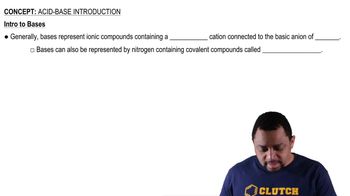
Bases are usually ionic compounds containing a metal cation and a hydroxide anion (OH-), or nitrogen-containing covalent compounds called amines.
How do bases behave in water?
Bases ionize in water, separating into their metal cations and hydroxide ions (OH-).
What is the taste and feel associated with bases?
Bases have a bitter taste and a slippery feel, commonly experienced in soaps.
What color change does red litmus paper undergo in the presence of a base?
Red litmus paper turns blue when dipped into a basic solution.
What is a simple way to identify a base from its chemical formula?
A base often has a metal connected to the hydroxide ion (OH-), such as NaOH or Sr(OH)2.
What is the main difference between acids and bases in terms of their ions in solution?
Acids produce H+ ions in solution, while bases produce OH- ions.
What is an example of a base that is not an ionic compound?
Amines are nitrogen-containing covalent compounds that can act as bases.
What is the result of placing sodium hydroxide in water?
Sodium hydroxide ionizes into sodium ions (Na+) and hydroxide ions (OH-) in water.
How can you remember the color change for bases using litmus paper?
Both 'base' and 'blue' start with 'b', so bases turn red litmus paper blue.
 Back
Back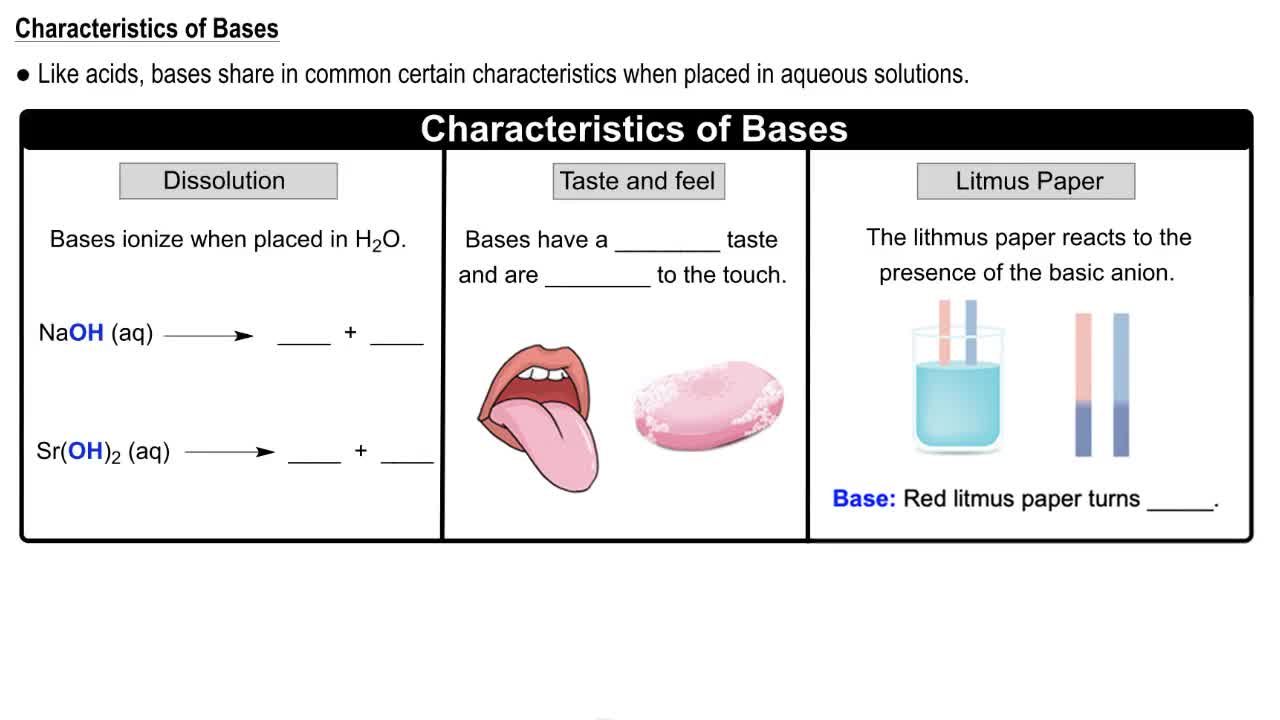
 01:30
01:30