Skip to main content
Introduction to Chemistry
My Course
Learn
Exam Prep
AI Tutor
Study Guides
Flashcards
Explore
Try the app
My Course
Learn
Exam Prep
AI Tutor
Study Guides
Flashcards
Explore
Try the app
Back
Atomic Mass (Simplified) definitions
You can tap to flip the card.
Atomic Mass
You can tap to flip the card.
👆
Atomic Mass
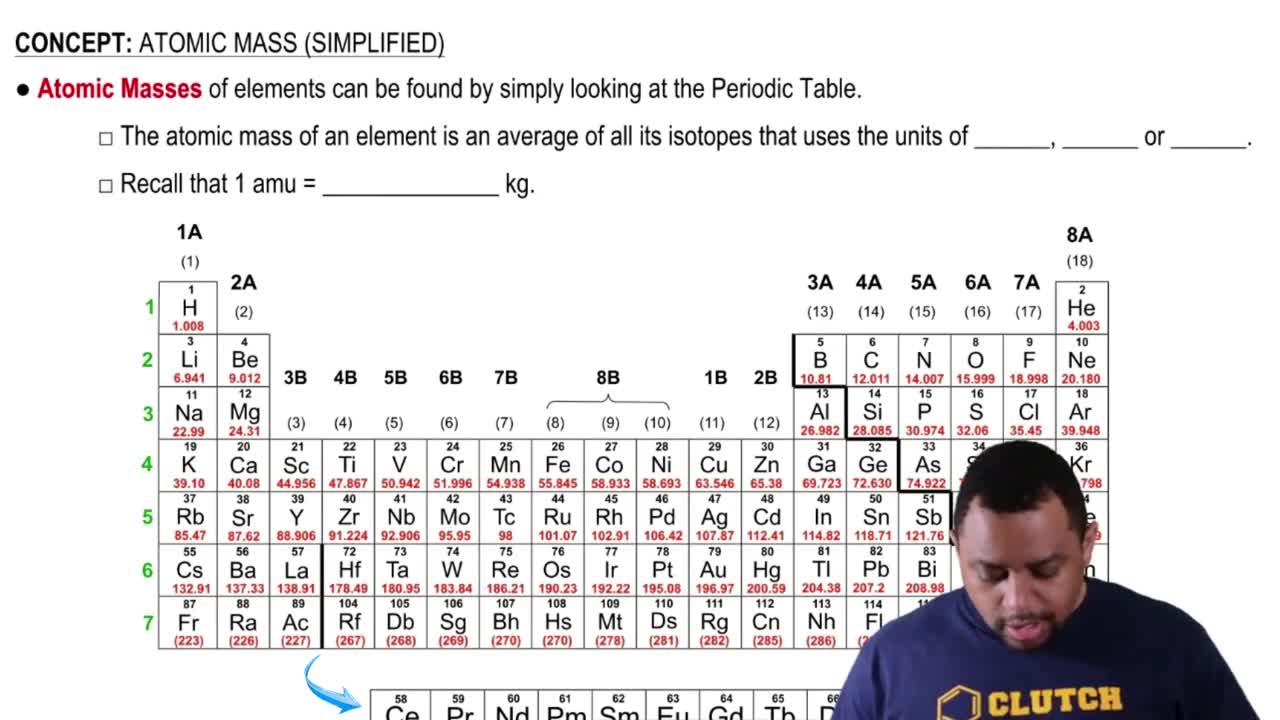
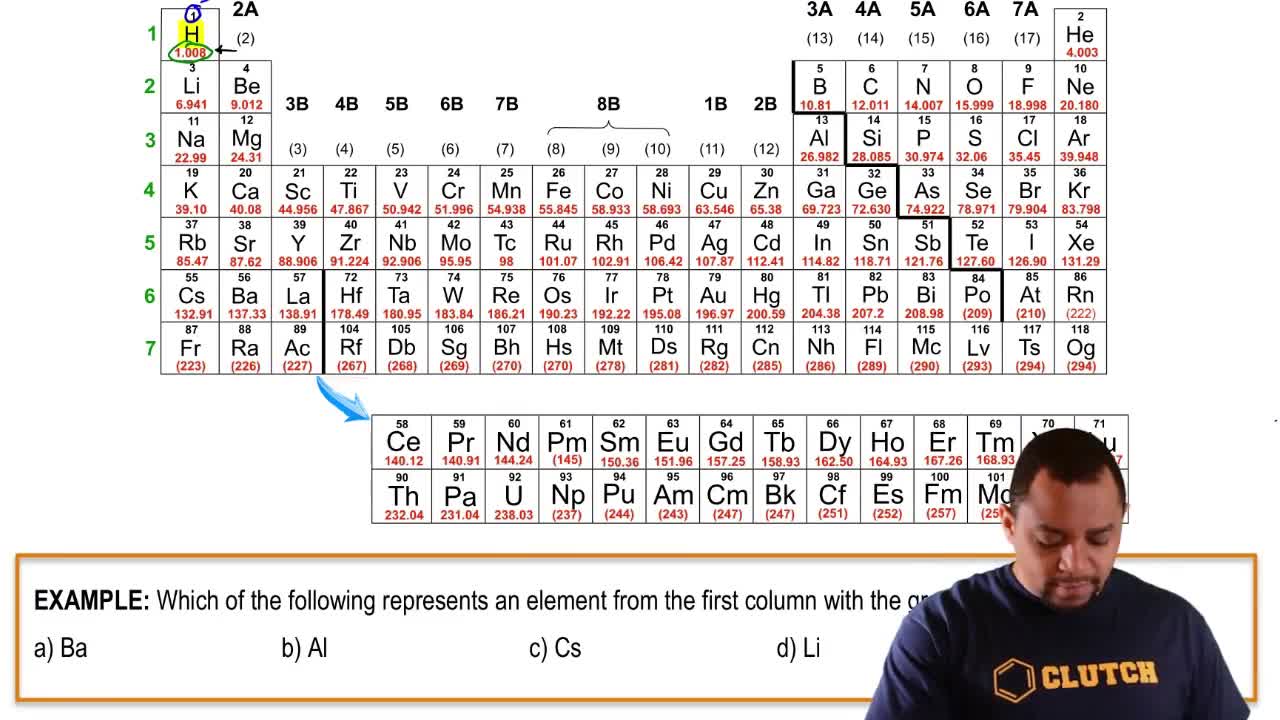
Average mass of all isotopes of an element, typically found as a non-whole number on the periodic table.
Track progress
Control buttons has been changed to "navigation" mode.
1/13
Related flashcards
Related practice
Recommended videos
Atomic Mass (Simplified) quiz #1
Atomic Mass (Simplified)
10 Terms
Atomic Mass (Simplified)
4. Atoms and Elements
5 problems
Topic
Periodic Table: Element Symbols
4. Atoms and Elements
5 problems
Topic
4. Atoms and Elements - Part 1 of 2
12 topics
34 problems
Chapter
4. Atoms and Elements - Part 2 of 2
1 topic
3 problems
Chapter
Guided course
01:51
Atomic Mass (Simplified) Concept 2
3770
views
22
rank
Guided course
01:13
Atomic Mass (Conceptual) Concept 1
4658
views
38
rank
Guided course
02:06
Atomic Mass (Conceptual) Example 1
10240
views
91
rank
Terms in this set (13)
Hide definitions
Atomic Mass
Average mass of all isotopes of an element, typically found as a non-whole number on the periodic table.
Isotope
Variant of an element with the same number of protons but different numbers of neutrons, affecting its mass.
Isotopic Mass
Specific mass associated with a particular isotope of an element, used in atomic mass calculations.
Percent Abundance
Percentage indicating how much of a particular isotope exists naturally for a given element.
Natural Abundance
Proportion of each isotope of an element as it occurs in nature, often expressed as a percentage.
Isotopic Abundance
Fractional value representing the proportion of a specific isotope, calculated by dividing percent abundance by 100.
Fractional Abundance
Decimal form of an isotope's natural occurrence, derived from its percent abundance.
Atomic Number
Whole number on the periodic table representing the number of protons in an element.
AMU
Unit of atomic mass equal to 1.66 x 10^-27 kilograms, used to express masses of atoms and subatomic particles.
Dalton
Alternative name for the atomic mass unit, commonly used in biochemistry and molecular biology.
Periodic Table
Tabular arrangement of elements where atomic masses and numbers can be found for reference.
Grams per Mole
Unit expressing the mass of one mole of a substance, often used for atomic and molecular masses.
Atomic Mass Formula
Mathematical expression combining isotopic masses and their abundances to calculate average atomic mass.
 BackBack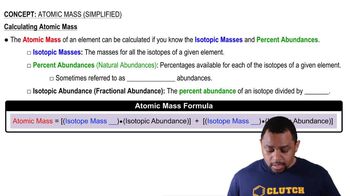
 01:51
01:51