Skip to main content
Introduction to Chemistry
My Course
Learn
Exam Prep
AI Tutor
Study Guides
Flashcards
Explore
Try the app
My Course
Learn
Exam Prep
AI Tutor
Study Guides
Flashcards
Explore
Try the app
Back
Auto-Ionization definitions
You can tap to flip the card.
Autoionization
You can tap to flip the card.
👆
Autoionization
A process where identical molecules interact to produce ions, commonly observed in pure water forming hydronium and hydroxide ions.
Track progress
Control buttons has been changed to "navigation" mode.
1/13
Related flashcards
Related practice
Recommended videos
Auto-Ionization quiz
Auto-Ionization
15 Terms
Auto-Ionization
14. Acids and Bases
5 problems
Topic
pH of Strong Acids & Bases
14. Acids and Bases
5 problems
Topic
14. Acids and Bases
10 topics
30 problems
Chapter
Guided course
01:58
Auto-Ionization Example
46
views
Guided course
01:24
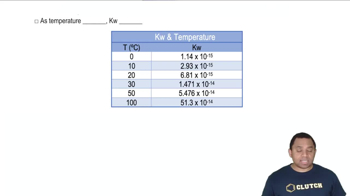
Kw Temperature Dependence
42
views
Guided course
02:22
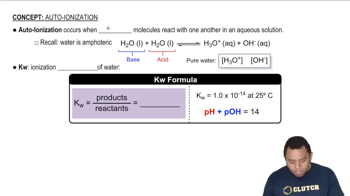
Auto-Ionization and Kw
41
views
Terms in this set (13)
Hide definitions
Autoionization
A process where identical molecules interact to produce ions, commonly observed in pure water forming hydronium and hydroxide ions.
Self-Ionization
A phenomenon where molecules of the same substance react to generate ions, as seen when water forms hydronium and hydroxide.
Aqueous Solution
A mixture where water acts as the solvent, allowing substances or ions to disperse uniformly throughout.
Hydronium Ion
A positively charged species formed when a water molecule gains a proton, represented as H3O+.
Hydroxide Ion
A negatively charged species resulting from a water molecule losing a proton, symbolized as OH-.
Acid
A substance or particle capable of donating a proton (H+) to another species in a chemical reaction.
Base
A substance or particle capable of accepting a proton (H+) from another species during a reaction.
Ion Product of Water
A constant (Kw) representing the product of hydronium and hydroxide ion concentrations in water at equilibrium.
Kw
A symbol for the equilibrium constant of water's autoionization, calculated as [H3O+][OH-].
Equilibrium Constant
A value expressing the ratio of product to reactant concentrations at equilibrium for a reversible reaction.
Temperature Dependence
A property where the value of a constant, such as Kw, changes as the temperature of the system varies.
25 Degrees Celsius
A standard reference temperature used for calculations involving Kw, where its value is 1.0 x 10^-14.
H+
A proton, often used interchangeably with hydronium ion in aqueous solutions, representing acidity.
 BackBack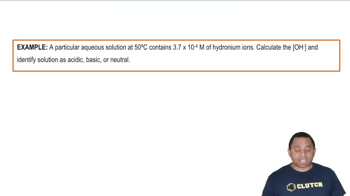
 01:58
01:58