Skip to main content
Introduction to Chemistry
My Course
Learn
Exam Prep
AI Tutor
Study Guides
Flashcards
Explore
Try the app
My Course
Learn
Exam Prep
AI Tutor
Study Guides
Flashcards
Explore
Try the app
Back
Dilutions quiz
You can tap to flip the card.
What is a standard or stock solution in chemistry?
You can tap to flip the card.
👆
What is a standard or stock solution in chemistry?
A standard or stock solution is a concentrated solution that is later diluted for laboratory use.
Track progress
Control buttons has been changed to "navigation" mode.
1/15
Related flashcards
Related practice
Recommended videos
Dilutions definitions
Dilutions
14 Terms
Dilutions
13. Solutions
2 problems
Topic
Solution Stoichiometry
13. Solutions
5 problems
Topic
13. Solutions - Part 1 of 2
12 topics
35 problems
Chapter
13. Solutions - Part 2 of 2
2 topics
6 problems
Chapter
Guided course
02:36
Dilutions Example 2
8627
views
40
rank
Guided course
00:58
Dilutions
8883
views
44
rank
Guided course
01:03
Dilutions
9446
views
53
rank
Terms in this set (15)
Hide definitions
What is a standard or stock solution in chemistry?
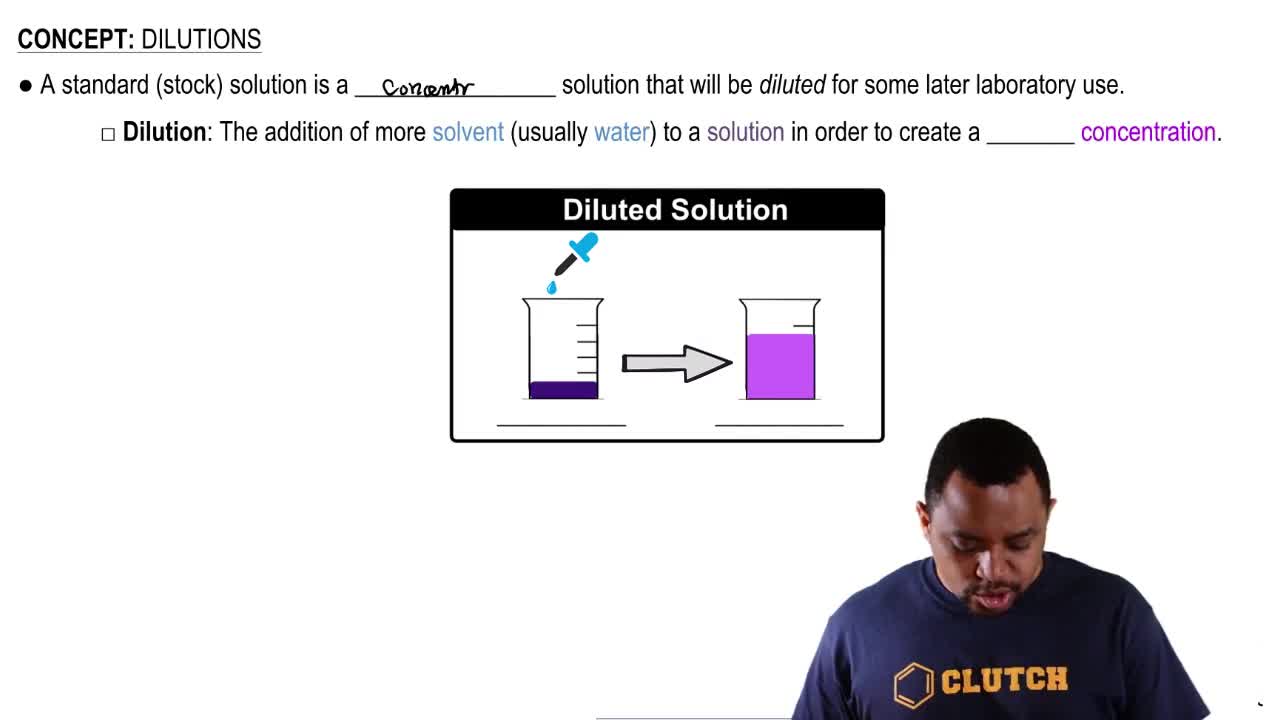
A standard or stock solution is a concentrated solution that is later diluted for laboratory use.
What does the process of dilution involve?
Dilution involves adding more solvent, usually water, to a solution to decrease its concentration.
How does the color of a solution typically change during dilution?
The color changes from a darker shade to a lighter shade, indicating a reduction in concentration.
What happens to the molarity of a solution when it is diluted?
The molarity decreases, going from a higher value to a lower value.
What is the equation used to calculate dilutions?
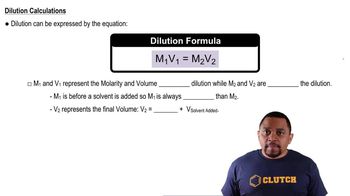
The dilution equation is M1V1 = M2V2.
In the dilution equation, what do M1 and V1 represent?
M1 and V1 are the molarity and volume before dilution.
In the dilution equation, what do M2 and V2 represent?
M2 and V2 are the molarity and volume after dilution.
Which is greater, M1 or M2, and why?
M1 is always greater than M2 because it represents the more concentrated solution before dilution.
How is the final volume after dilution (V2) calculated?
V2 is calculated by adding the initial volume (V1) to the volume of solvent added.
What is the main purpose of performing a dilution in the laboratory?
The main purpose is to create a solution with a lower concentration from a more concentrated stock solution.
What visual cue indicates that a solution has been diluted?
The solution becomes a lighter color, showing it is less concentrated.
If you start with a dark purple solution and add water, what happens to its concentration?
Its concentration decreases as the solution becomes more diluted.
Why is water commonly used as the solvent in dilutions?
Water is commonly used because it is a universal solvent and does not react with most solutes.
What does V1 represent in the context of a dilution?
V1 represents the initial volume of the concentrated solution before dilution.
What does the equation M1V1 = M2V2 ensure during a dilution?
It ensures that the amount of solute remains constant before and after dilution.
 BackBack
 02:36
02:36