Skip to main content
Introduction to Chemistry
My Course
Learn
Exam Prep
AI Tutor
Study Guides
Flashcards
Explore
Try the app
My Course
Learn
Exam Prep
AI Tutor
Study Guides
Flashcards
Explore
Try the app
Back
Dipole Moment (Simplified) definitions
You can tap to flip the card.
Electronegativity
You can tap to flip the card.
👆
Electronegativity
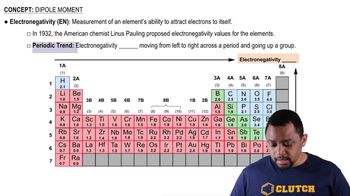
A measurement of an element's ability to attract electrons, increasing across a period and up a group, with fluorine as the highest.
Track progress
Control buttons has been changed to "navigation" mode.
1/15
Related flashcards
Related practice
Recommended videos
Dipole Moment (Simplified) quiz
Dipole Moment (Simplified)
15 Terms
Dipole Moment (Simplified)
10. Chemical Bonding
5 problems
Topic
Molecular Polarity (Simplified)
10. Chemical Bonding
5 problems
Topic
10. Chemical Bonding - Part 1 of 2
12 topics
35 problems
Chapter
10. Chemical Bonding - Part 2 of 2
4 topics
12 problems
Chapter
Guided course
01:07
Dipole Moment (Simplified) Example 3
8947
views
58
rank
Guided course
01:51
Dipole Moment (Simplified) Concept 1
3873
views
22
rank
Guided course
01:25
Dipole Moment (Simplified) Concept 2
11009
views
93
rank
Terms in this set (15)
Hide definitions
Electronegativity
A measurement of an element's ability to attract electrons, increasing across a period and up a group, with fluorine as the highest.
Linus Pauling
An American chemist who proposed the scale used to compare how strongly elements attract electrons in bonds.
Periodic Trend
A predictable pattern in properties, such as increasing electron-attracting ability from left to right and bottom to top in the table.
Dipole Moment
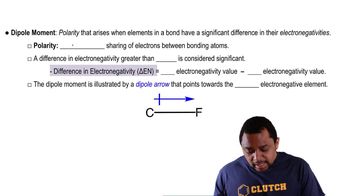
A measure of bond polarity resulting from unequal electron sharing due to a significant difference in electron-attracting ability.
Polarity
The unequal sharing of electrons in a bond, leading to regions of partial positive and negative charge.
Partial Charge
A slight electrical charge on atoms in a bond, indicated by delta symbols, resulting from unequal electron distribution.
Dipole Arrow
A symbol pointing sopposite the positive end in a bond, showing the direction of electron pull toward the more electron-attracting atom.
Pure Covalent Bond
A connection between atoms with identical electron-attracting abilities, resulting in equal electron sharing.
Nonpolar Covalent Bond
A connection where atoms have a small difference in electron-attracting ability, causing nearly equal electron sharing.
Polar Covalent Bond
A connection where atoms have a moderate difference in electron-attracting ability, causing unequal electron sharing and partial charges.
Ionic Bond
A connection formed when the difference in electron-attracting ability is so large that electrons are fully transferred, creating ions.
Cation
A positively charged particle formed when an atom loses electrons, often seen in highly polar or ionic connections.
Anion
A negatively charged particle formed when an atom gains electrons, typically present in highly polar or ionic connections.
Electron Cloud
A region around an atom where electrons are likely to be found, its size influenced by the atom's electron-attracting ability.
Delta EN
The numerical difference between the electron-attracting abilities of two bonded atoms, used to predict bond type.
 BackBack
 01:07
01:07