Skip to main content
Introduction to Chemistry
My Course
Learn
Exam Prep
AI Tutor
Study Guides
Flashcards
Explore
Try the app
My Course
Learn
Exam Prep
AI Tutor
Study Guides
Flashcards
Explore
Try the app
Back
Electrolytes (Simplified) definitions
You can tap to flip the card.
Electrolyte
You can tap to flip the card.
👆
Electrolyte
A compound that enables electrical current to flow in solution by forming ions when dissolved or melted.
Track progress
Control buttons has been changed to "navigation" mode.
1/15
Related flashcards
Related practice
Recommended videos
Electrolytes (Simplified) quiz #1
Electrolytes (Simplified)
10 Terms
Electrolytes (Simplified)
7. Chemical Reactions
5 problems
Topic
Molecular Equations
7. Chemical Reactions
5 problems
Topic
7. Chemical Reactions
8 topics
24 problems
Chapter
Guided course
00:57
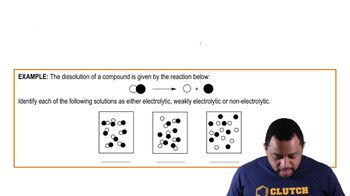
Electrolytes (Simplified) Example 2
4185
views
13
rank
Guided course
01:07
Electrolytes (Simplified) Example 3
4127
views
15
rank
Guided course
00:34
Electrolytes (Simplified) Example 1
4672
views
11
rank
2
comments
Terms in this set (15)
Hide definitions
Electrolyte
A compound that enables electrical current to flow in solution by forming ions when dissolved or melted.
Conductivity
A physical property describing how efficiently electrical current passes through a material due to mobile charged particles.
Strong Electrolyte
A solute that fully separates into ions in water, resulting in high electrical conductivity.
Weak Electrolyte
A solute that only partly forms ions in solution, leading to limited electrical conductivity.
Nonelectrolyte
A substance that remains as molecules in solution and does not allow electrical current to flow.
Dissociation
The process where a compound splits into ions when dissolved, affecting its ability to conduct electricity.
Solubility Rules
Guidelines used to predict whether a compound will dissolve and form ions in water.
Ionic Compound
A substance composed of positive and negative ions held together by electrostatic forces, often forming electrolytes.
Strong Acid
A substance that completely forms hydrogen ions in water, making the solution highly conductive.
Strong Base
A substance that fully produces hydroxide ions in solution, resulting in efficient electrical conduction.
Weak Acid
A substance that only partially forms hydrogen ions in water, so most molecules remain intact.
Weak Base
A substance that only slightly forms hydroxide ions in solution, resulting in mostly undissociated molecules.
Aqueous Solution
A mixture where water surrounds dissolved particles, often ions, enabling electrical conduction if ions are present.
Molecular Compound
A substance made of covalently bonded atoms that typically does not form ions in water.
Alcohol
A covalent compound containing carbon, hydrogen, and an -OH group, usually not forming ions in solution.
 BackBack
 00:57
00:57