Skip to main content
Introduction to Chemistry
My Course
Learn
Exam Prep
AI Tutor
Study Guides
Flashcards
Explore
Try the app
My Course
Learn
Exam Prep
AI Tutor
Study Guides
Flashcards
Explore
Try the app
Back
Electromagnetic Spectrum (Simplified) definitions
You can tap to flip the card.
Electromagnetic Spectrum
You can tap to flip the card.
👆
Electromagnetic Spectrum
A continuous range of electromagnetic radiation types, ordered by wavelength and frequency, from long radio waves to gamma rays.
Track progress
Control buttons has been changed to "navigation" mode.
1/15
Related flashcards
Related practice
Recommended videos
Electromagnetic Spectrum (Simplified) quiz
Electromagnetic Spectrum (Simplified)
15 Terms
Electromagnetic Spectrum (Simplified)
9. Electrons in Atoms and the Periodic Table
5 problems
Topic
Bohr Model (Simplified)
9. Electrons in Atoms and the Periodic Table
5 problems
Topic
9. Electrons in Atoms and the Periodic Table - Part 3 of 4
12 topics
36 problems
Chapter
Guided course
03:47
Electromagnetic Spectrum (Simplified) Concept 1
4256
views
27
rank
Guided course
01:24
Electromagnetic Spectrum (Simplified) Concept 2
9544
views
75
rank
Guided course
01:02
Electromagnetic Spectrum (Simplified) Example 1
9762
views
100
rank
Terms in this set (15)
Hide definitions
Electromagnetic Spectrum
A continuous range of electromagnetic radiation types, ordered by wavelength and frequency, from long radio waves to gamma rays.
Electromagnetic Radiation
A form of energy traveling at light speed through space as oscillating electric and magnetic fields.
Wavelength
The distance between consecutive wave crests, decreasing across the spectrum from radio waves to gamma rays.
Frequency
The number of wave cycles passing a point per second, increasing as wavelength decreases in the spectrum.
Photon
A discrete packet of light energy, theorized by Planck and Einstein, that makes up electromagnetic radiation.
Quantum
A group or collection of light energy packets, each called a photon.
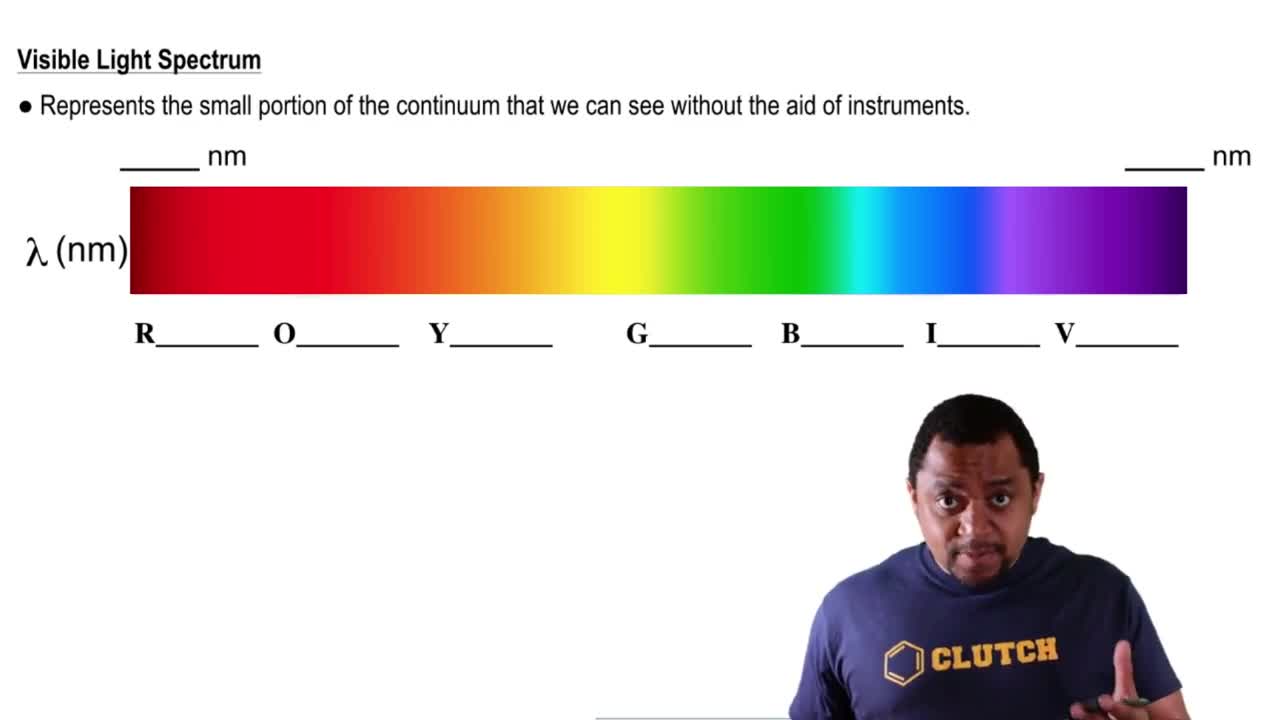
Visible Light
The small portion of the spectrum detectable by the human eye, spanning red to violet colors.
Infrared
A region of the spectrum just beyond red light, associated with heat and not visible to the human eye.
Ultraviolet
A region of the spectrum just beyond violet light, with higher energy than visible light and invisible to the eye.
Gamma Rays
The highest energy and frequency region of the spectrum, with the shortest wavelengths.
Radio Waves
A low-frequency, long-wavelength region of the spectrum, including AM and FM bands.
Microwaves
A region of the spectrum between radio waves and infrared, used in communication and heating.
X-rays
A high-energy region of the spectrum, just below gamma rays, commonly used in medical imaging.
Hertz
The unit of frequency, representing one wave cycle per second, symbolized by Hz.
Lambda
The Greek letter used as the symbol for wavelength, typically measured in meters.
 BackBack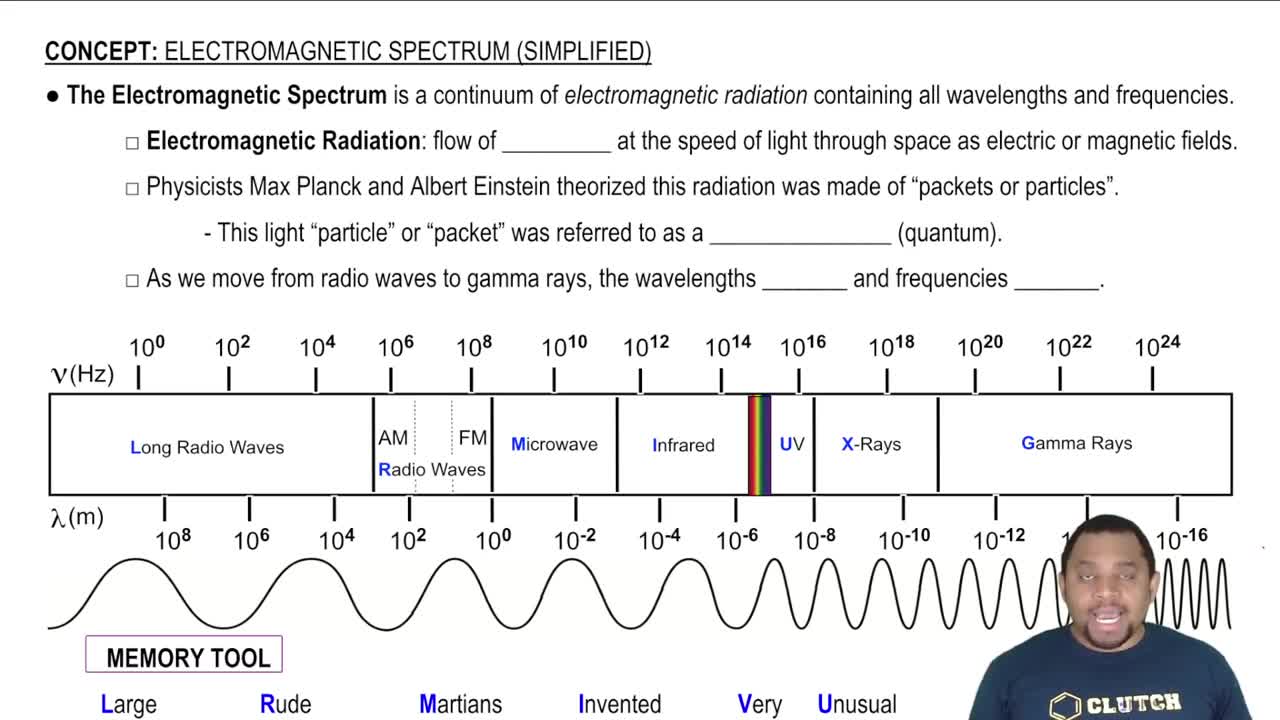
 03:47
03:47