The electromagnetic spectrum is a continuum of all electromagnetic radiation, containing all wavelengths and frequencies.
What is electromagnetic radiation?
Electromagnetic radiation is the flow of light energy traveling at the speed of light through space as electric or magnetic fields.
Who theorized that electromagnetic radiation is made of packets called photons?
Max Planck and Albert Einstein theorized that electromagnetic radiation is made of packets called photons.
What happens to wavelength and frequency as you move from radio waves to gamma rays on the spectrum?
Wavelength decreases and frequency increases as you move from radio waves to gamma rays.
What is the relationship between frequency and energy in the electromagnetic spectrum?
Frequency and energy are directly related; as frequency increases, energy also increases.
What does the symbol 'mu' (μ) represent in the context of the electromagnetic spectrum?
The symbol 'mu' (μ) represents frequency, measured in Hertz (Hz).
What does the symbol 'lambda' (λ) represent in the electromagnetic spectrum?
The symbol 'lambda' (λ) represents wavelength, typically measured in meters.
What are the main types of waves in order on the electromagnetic spectrum from lowest to highest energy?
The main types are long radio waves, radio waves, microwaves, infrared, visible light, ultraviolet, X-rays, and gamma rays.
What is the visible light spectrum and why is it important?
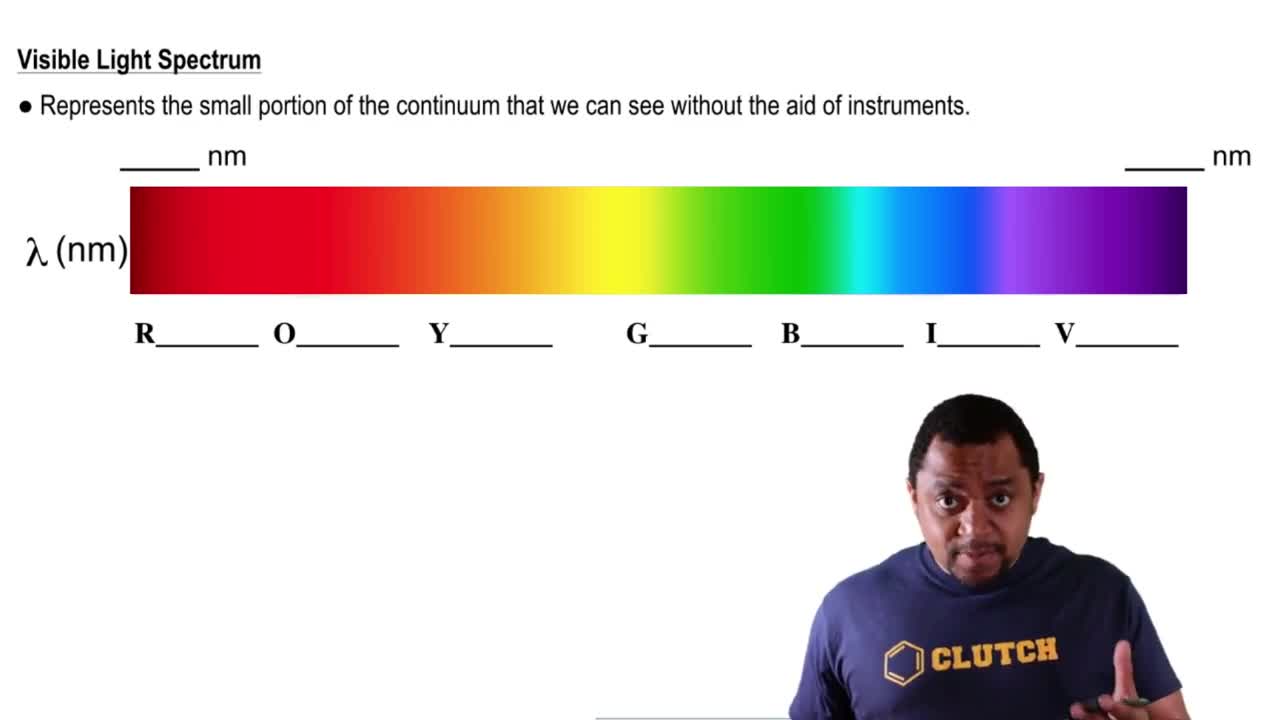
The visible light spectrum is the small portion of the electromagnetic spectrum that can be seen by the human eye without instruments.
What memory tool can help you remember the order of the electromagnetic spectrum?
The phrase 'large rude Martians invented very unusual x-ray guns' helps remember the order: long radio waves, radio waves, microwaves, infrared, visible, ultraviolet, X-rays, gamma rays.
What is the mnemonic for remembering the colors of the visible light spectrum?
'ROY G BIV' stands for red, orange, yellow, green, blue, indigo, and violet.
Which color in the visible spectrum is closest to infrared, and which is closest to ultraviolet?
Red is closest to infrared, and violet is closest to ultraviolet.
What is the approximate wavelength range of visible light?
Visible light ranges from about 700 nanometers (red) to 380 nanometers (violet).
How do AM and FM radio waves differ in terms of frequency?
AM radio waves have lower frequencies, while FM radio waves have higher frequencies, usually in megahertz.
Why does the wavelength decrease and frequency increase as you move right on the electromagnetic spectrum?
As you move right, the waves become more tightly packed, so the distance between crests (wavelength) decreases and the number of waves per second (frequency) increases.
 Back
Back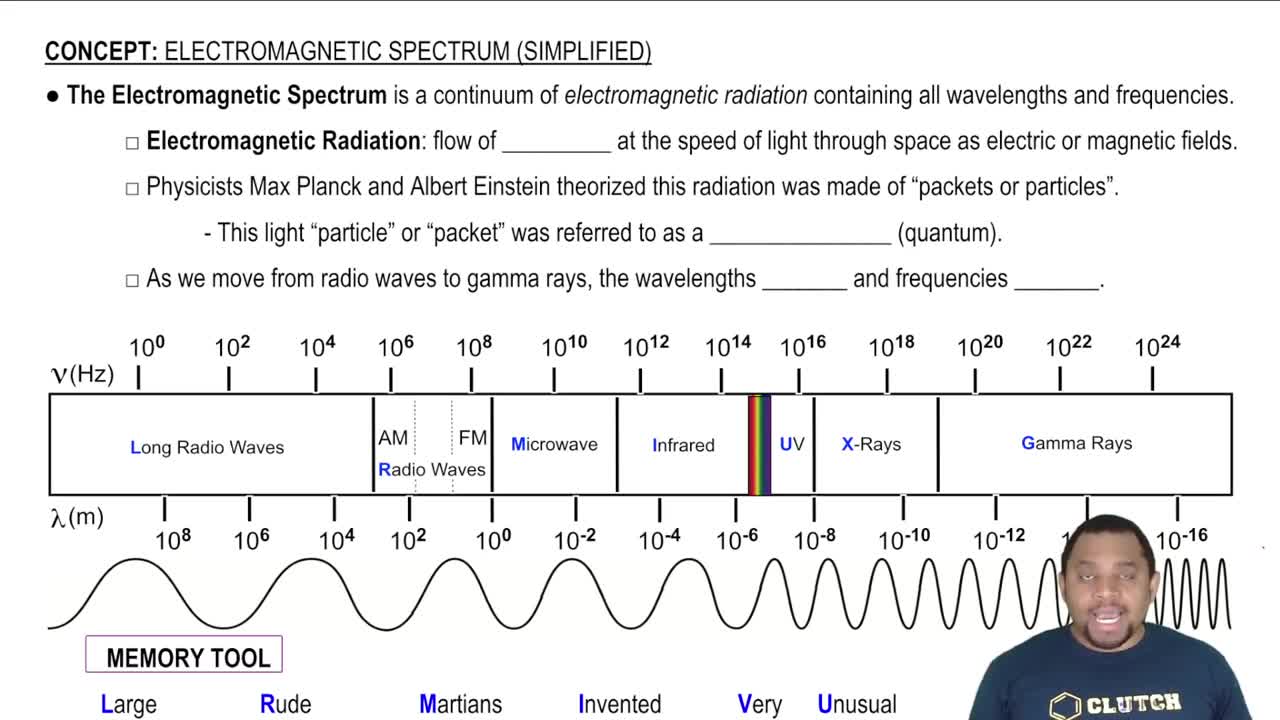
 03:47
03:47