Skip to main content
Introduction to Chemistry
My Course
Learn
Exam Prep
AI Tutor
Study Guides
Flashcards
Explore
Try the app
My Course
Learn
Exam Prep
AI Tutor
Study Guides
Flashcards
Explore
Try the app
Back
Electron Arrangements definitions
You can tap to flip the card.
Electron Arrangement
You can tap to flip the card.
👆
Electron Arrangement
Distribution of electrons among energy levels in an atom, indicating how many electrons occupy each shell.
Track progress
Control buttons has been changed to "navigation" mode.
1/12
Related flashcards
Related practice
Recommended videos
Electron Arrangements quiz #1
Electron Arrangements
10 Terms
Electron Arrangements
9. Electrons in Atoms and the Periodic Table
5 problems
Topic
The Electron Configuration: Exceptions (Simplified)
9. Electrons in Atoms and the Periodic Table
5 problems
Topic
9. Electrons in Atoms and the Periodic Table - Part 3 of 4
12 topics
36 problems
Chapter
Guided course
00:54
Electron Arrangements Concept 1
3920
views
9
rank
Guided course
03:51
Electron Arrangements Example 1
3818
views
10
rank
Terms in this set (12)
Hide definitions
Electron Arrangement
Distribution of electrons among energy levels in an atom, indicating how many electrons occupy each shell.
Energy Level
Region around the nucleus where electrons are likely to be found, each with a specific energy and capacity.
Principal Quantum Number
Numerical value representing the main energy level of an electron, increasing with distance from the nucleus.
Atomic Orbital
Space within an energy level where an electron is most likely to be located, with size and energy depending on its shell.
Shell
Group of atomic orbitals sharing the same principal quantum number, often visualized as concentric layers around the nucleus.
Period
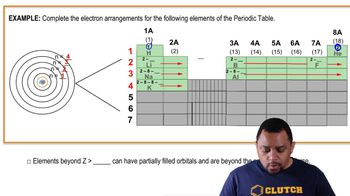
Horizontal row on the periodic table, corresponding to the highest occupied energy level in an atom.
Periodic Table
Tabular arrangement of elements, where rows indicate increasing energy levels for electron arrangements.
Nucleus
Central core of an atom, around which electrons occupy various energy levels.
Electron
Negatively charged subatomic particle found in specific energy levels around the nucleus.
Size
Extent of an atomic orbital, which increases as the principal quantum number rises.
Capacity
Maximum number of electrons that an energy level or orbital can hold, increasing with higher energy levels.
Row
Sequence of elements across the periodic table, indicating the number of occupied energy levels in their atoms.
 BackBack
 00:54
00:54