According to the modern model of the atom, where are electrons most likely to be found?
Electrons are most likely to be found in regions of high probability called orbitals, which are defined by the shell number and subshell letter.
What is the term for the region where there is a high probability of finding an electron in an atom?
The region of high probability of finding an electron is called an orbital.
What does the electron cloud model describe in terms of atomic structure?
The electron cloud model describes the regions around the nucleus where electrons are most likely to be found, represented as orbitals with specific shapes and orientations.
What is an electron cloud in the context of atomic structure?
An electron cloud is the region around the nucleus where electrons are most likely to be found, corresponding to the probability distribution of electrons in orbitals.
How many unpaired electrons are present in a phosphorus atom based on its electron configuration?
A phosphorus atom has three unpaired electrons, which are found in its three p orbitals.
How many 5f orbitals are present in an atom?
There are 7 orbitals in the 5f subshell of an atom.
Who proposed that electron paths cannot be precisely predicted in an atom?
The electron cloud model, based on quantum mechanics, proposes that electron paths cannot be precisely predicted; instead, only the probability of finding an electron in a certain region can be described.
How are the shapes and number of atomic orbitals determined for each subshell?
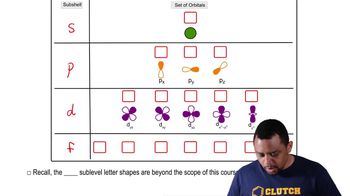
The shapes and number of atomic orbitals are determined by the subshell letter: s has 1 spherical orbital, p has 3 dumbbell-shaped orbitals, d has 5 orbitals, and f has 7 orbitals.
How are the p orbitals designated in terms of their orientation within a 3D coordinate system?
The p orbitals are designated as px, py, and pz, corresponding to their orientation along the x, y, and z axes of a coordinate graph. Each orbital is aligned with one of these axes.
What is the pattern in the number of orbital shapes as you move from s to p to d to f subshells?
The number of orbital shapes increases by 2 with each subshell, starting from 1 for s, 3 for p, 5 for d, and 7 for f. This pattern reflects the increasing complexity of subshells.
 Back
Back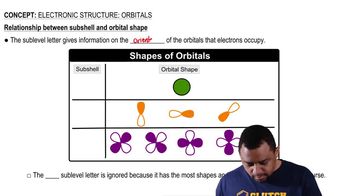
 02:09
02:09