Skip to main content
Introduction to Chemistry
My Course
Learn
Exam Prep
AI Tutor
Study Guides
Flashcards
Explore
Try the app
My Course
Learn
Exam Prep
AI Tutor
Study Guides
Flashcards
Explore
Try the app
Back
Emission Spectrum (Simplified) definitions
You can tap to flip the card.
Emission Spectrum
You can tap to flip the card.
👆
Emission Spectrum
A pattern of colored lines produced when light from excited atoms is separated into its component wavelengths by a prism.
Track progress
Control buttons has been changed to "navigation" mode.
1/15
Related flashcards
Related practice
Recommended videos
Emission Spectrum (Simplified) quiz #1
Emission Spectrum (Simplified)
10 Terms
Emission Spectrum (Simplified)
9. Electrons in Atoms and the Periodic Table
5 problems
Topic
Electronic Structure
9. Electrons in Atoms and the Periodic Table
5 problems
Topic
9. Electrons in Atoms and the Periodic Table - Part 3 of 4
12 topics
36 problems
Chapter
Guided course
01:47
Emission Spectrum (Simplified) Concept 1
3327
views
6
rank
Guided course
01:07
Emission Spectrum (Simplified) Example 1
2620
views
17
rank
Terms in this set (15)
Hide definitions
Emission Spectrum
A pattern of colored lines produced when light from excited atoms is separated into its component wavelengths by a prism.
Shell
A region around an atomic nucleus where electrons are likely to be found, each with a specific energy level.
Electron
A negatively charged subatomic particle that can occupy different energy levels within an atom.
Energy Level
A specific amount of energy associated with an electron's position within an atom's shell.
Ground State
The lowest possible energy configuration for an electron within an atom.
Prism
A transparent optical element that splits incoming light into its component wavelengths, forming distinct spectral lines.
Wavelength
The distance between consecutive peaks of a wave, determining the color of light in the spectrum.
Frequency
The number of wave cycles passing a point per second, related to the energy of emitted light.
Slit
A narrow opening that focuses emitted light, allowing closely packed wavelengths to be separated and measured.
Line Spectrum
A series of discrete colored lines, each representing a specific wavelength emitted by electrons transitioning between energy levels.
Transition
A change in an electron's energy level, resulting in the emission or absorption of light.
Discrete Line
A single, distinct color observed in the emission spectrum, corresponding to a specific electron energy change.
Emitted Light
Radiation released when an electron moves from a higher to a lower energy shell within an atom.
Component Wavelength
An individual wavelength present in the light emitted by an atom, separated by a prism.
Energy
A quantifiable property released or absorbed during electron transitions, measurable through wavelength and frequency.
 BackBack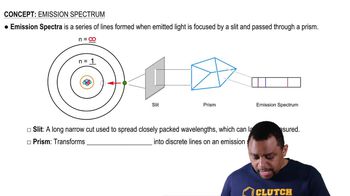
 01:47
01:47