Skip to main content
Introduction to Chemistry
My Course
Learn
Exam Prep
AI Tutor
Study Guides
Flashcards
Explore
Try the app
My Course
Learn
Exam Prep
AI Tutor
Study Guides
Flashcards
Explore
Try the app
Back
The Equilibrium Constant quiz
You can tap to flip the card.
What does the equilibrium constant 'k' represent in a chemical reaction?
You can tap to flip the card.
👆
What does the equilibrium constant 'k' represent in a chemical reaction?
It represents the ratio of products to reactants at a specific temperature, indicating the extent of the reaction's progress.
Track progress
Control buttons has been changed to "navigation" mode.
1/15
Related flashcards
Related practice
Recommended videos
The Equilibrium Constant definitions
The Equilibrium Constant
13 Terms
The Equilibrium Constant
15. Chemical Equilibrium
5 problems
Topic
Le Chatelier's Principle
15. Chemical Equilibrium
5 problems
Topic
15. Chemical Equilibrium
6 topics
16 problems
Chapter
Guided course
02:50
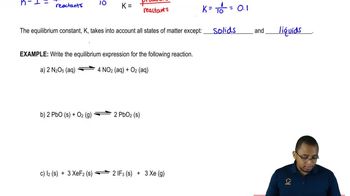
The Equilibrium Constant Concept 1
4797
views
27
rank
2
comments
Guided course
03:43
The Equilibrium Constant Example 1
4379
views
25
rank
Terms in this set (15)
Hide definitions
What does the equilibrium constant 'k' represent in a chemical reaction?
It represents the ratio of products to reactants at a specific temperature, indicating the extent of the reaction's progress.
How does temperature affect the equilibrium constant 'k'?
Increasing temperature raises the value of 'k', while decreasing temperature lowers it.
What does a 'k' value greater than 1 indicate about a reaction?
It indicates that products are favored, meaning the reaction proceeds in the forward direction to produce more products.
What does a 'k' value less than 1 suggest about the direction of a reaction?
It suggests that reactants are favored, so the reaction proceeds in the reverse direction.
What does it mean when the equilibrium constant 'k' equals 1?
It means the amounts of products and reactants are equal, signifying a balanced state in the reaction.
Which states of matter are ignored in the calculation of the equilibrium constant 'k'?
The concentrations of solids and liquids are not considered in the calculation of 'k'.
Why is the equilibrium constant 'k' described as a ratio?
Because it is calculated as the concentration of products divided by the concentration of reactants.
If the product concentration is 10 and reactant concentration is 1, what is the value of 'k'?
The value of 'k' would be 10, which is greater than 1, indicating products are favored.
If the product concentration is 1 and reactant concentration is 10, what is the value of 'k'?
The value of 'k' would be 0.1, which is less than 1, indicating reactants are favored.
What does the magnitude of 'k' tell us about a chemical reaction?
It tells us how far the reaction has shifted toward products or reactants at a given temperature.
What direction is favored when 'k' is greater than 1?
The forward direction is favored, leading to the formation of more products.
What direction is favored when 'k' is less than 1?
The reverse direction is favored, leading to the formation of more reactants.
Why are solids and liquids excluded from the equilibrium constant calculation?
Their concentrations do not change during the reaction, so they are not included in the calculation.
At what value of 'k' are products and reactants present in equal amounts?
When 'k' equals 1, products and reactants are present in equal amounts.
Is the equilibrium constant 'k' the same at all temperatures?
No, 'k' changes with temperature; it is specific to each temperature.
 BackBack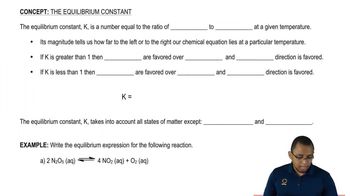
 02:50
02:50