Skip to main content
Introduction to Chemistry
My Course
Learn
Exam Prep
AI Tutor
Study Guides
Flashcards
Explore
Try the app
My Course
Learn
Exam Prep
AI Tutor
Study Guides
Flashcards
Explore
Try the app
Back
Galvanic Cell (Simplified) quiz
You can tap to flip the card.
What is the main function of a galvanic cell?
You can tap to flip the card.
👆
What is the main function of a galvanic cell?
A galvanic cell converts stored chemical energy into electrical energy spontaneously.
Track progress
Control buttons has been changed to "navigation" mode.
1/15
Related flashcards
Related practice
Recommended videos
Galvanic Cell (Simplified) definitions
Galvanic Cell (Simplified)
15 Terms
Galvanic Cell (Simplified)
16. Oxidation and Reduction
5 problems
Topic
Balancing Redox Reactions: Basic Solutions
16. Oxidation and Reduction
5 problems
Topic
16. Oxidation and Reduction
6 topics
15 problems
Chapter
Guided course
02:41
Galvanic Cell (Simplified) Example 2
2822
views
2
rank
Guided course
03:20
Galvanic Cell (Simplified) Concept 3
2841
views
Guided course
01:02
Galvanic Cell (Simplified) Example 4
2471
views
Terms in this set (15)
Hide definitions
What is the main function of a galvanic cell?
A galvanic cell converts stored chemical energy into electrical energy spontaneously.
Which electrode in a galvanic cell is the site of oxidation?
The anode is the site of oxidation in a galvanic cell.
What charge does the anode have in a galvanic cell?
The anode is negatively charged in a galvanic cell.
Where does reduction occur in a galvanic cell?
Reduction occurs at the cathode in a galvanic cell.
What is the charge of the cathode in a galvanic cell?
The cathode is positively charged in a galvanic cell.
In which direction do electrons flow in a galvanic cell?
Electrons flow from the anode to the cathode in a galvanic cell.
What is the purpose of the salt bridge in a galvanic cell?
The salt bridge allows the flow of ions between half-cells and completes the electrical circuit.
What type of ions should the salt bridge contain for proper operation?
The salt bridge should contain neutral ions, which have no acidic or basic properties.
How is the electricity generated by a galvanic cell measured?
The electricity is measured using a voltmeter.
What is the main difference between a galvanic cell and an electrolytic cell?
A galvanic cell generates electricity spontaneously, while an electrolytic cell requires external electrical energy to operate.
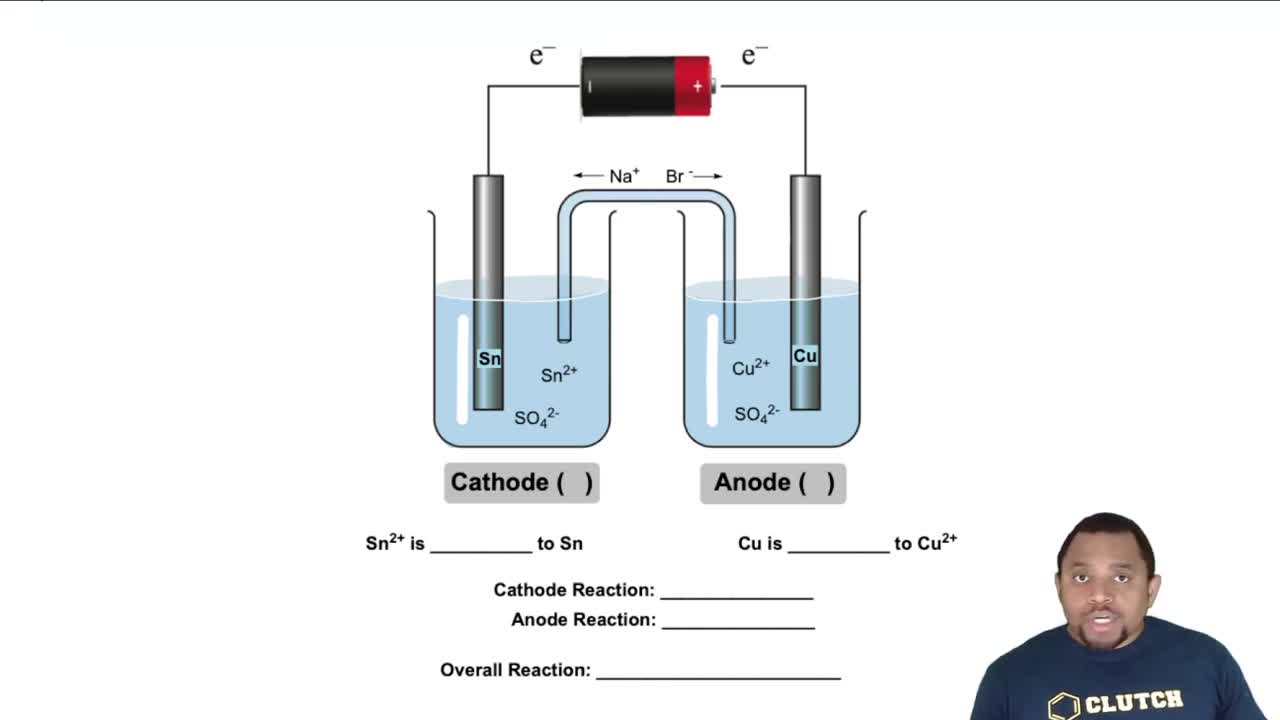
What is the charge of the cathode in an electrolytic cell?
The cathode is negatively charged in an electrolytic cell.
What is the charge of the anode in an electrolytic cell?
The anode is positively charged in an electrolytic cell.
What is always true about the location of oxidation and reduction in both cell types?
Oxidation always occurs at the anode and reduction always occurs at the cathode in both cell types.
Why does an electrolytic cell require a battery?
A battery is needed to force electrons to move from the anode to the cathode in a non-spontaneous reaction.
Name an application of electrolytic cells.
Electrolytic cells are used in rechargeable batteries, such as AA, AAA, and lithium batteries.
 BackBack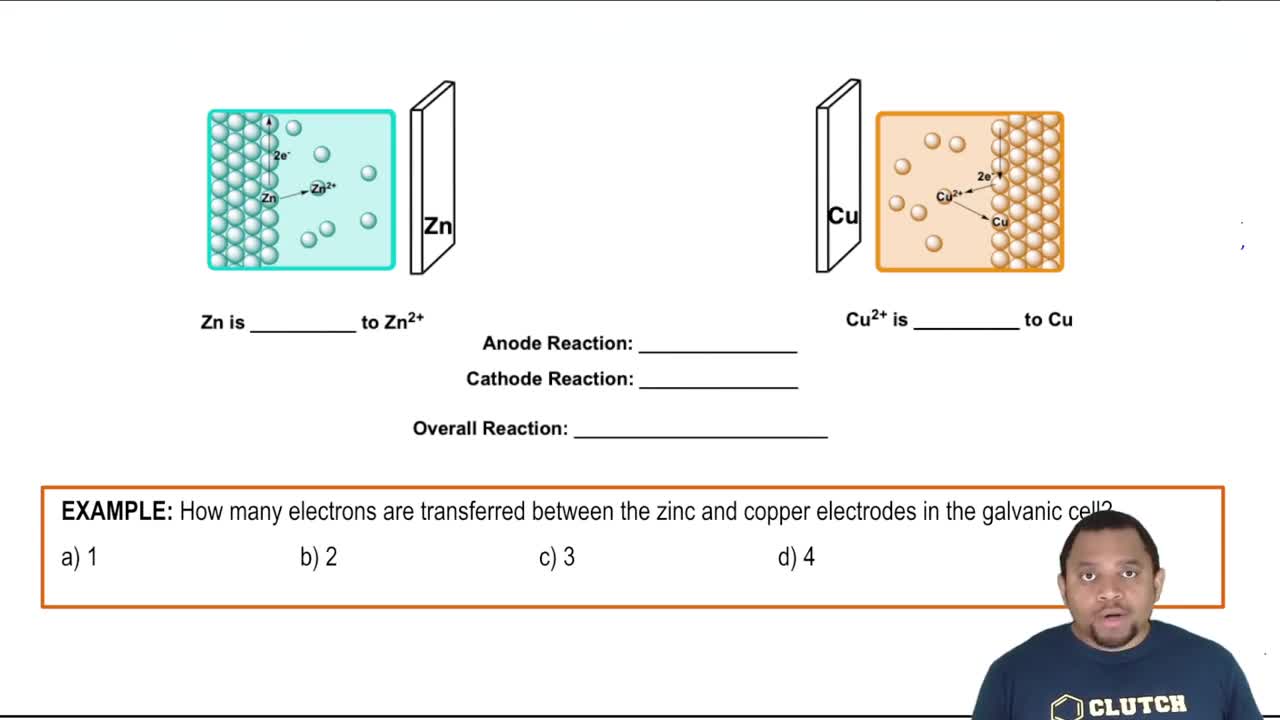
 02:41
02:41