Skip to main content
Introduction to Chemistry
My Course
Learn
Exam Prep
AI Tutor
Study Guides
Flashcards
Explore
Try the app
My Course
Learn
Exam Prep
AI Tutor
Study Guides
Flashcards
Explore
Try the app
Back
Intermolecular Forces and Physical Properties definitions
You can tap to flip the card.
Intermolecular Forces
You can tap to flip the card.
👆
Intermolecular Forces
Attractive interactions between molecules that determine many observable characteristics of substances.
Track progress
Control buttons has been changed to "navigation" mode.
1/14
Related flashcards
Related practice
Recommended videos
Intermolecular Forces and Physical Properties quiz
Intermolecular Forces and Physical Properties
15 Terms
Intermolecular Forces and Physical Properties
12. Liquids, Solids, and Intermolecular Forces
5 problems
Topic
Atomic, Ionic and Molecular Solids
12. Liquids, Solids, and Intermolecular Forces
5 problems
Topic
12. Liquids, Solids, and Intermolecular Forces
4 topics
12 problems
Chapter
Guided course
01:04
Intermolecular Forces and Physical Properties Concept 2
2146
views
3
rank
Guided course
01:52
Intermolecular Forces and Physical Properties Example 2
2084
views
4
rank
Guided course
01:21
Intermolecular Forces and Physical Properties Example 1
2205
views
8
rank
Terms in this set (14)
Hide definitions
Intermolecular Forces
Attractive interactions between molecules that determine many observable characteristics of substances.
Physical Properties
Measurable attributes such as boiling point, melting point, surface tension, and viscosity that describe matter.
Boiling Point
Temperature where liquid and gas phases are in equilibrium, allowing vaporization and condensation to occur.
Melting Point
Temperature where solid and liquid phases are in equilibrium, marking the transition between melting and freezing.
Surface Tension
Cohesive effect at a liquid's surface caused by molecular attractions, enabling phenomena like insects walking on water.
Viscosity
Resistance of a substance to flow; higher values mean slower movement, as seen in honey compared to water.
Vapor Pressure
Pressure exerted by a gas above its liquid in equilibrium, inversely related to the strength of molecular attractions.
Equilibrium
State where two phases, such as liquid and gas or solid and liquid, coexist with balanced rates of change.
Condensation
Process where gas molecules lose energy and transition into the liquid phase, contributing to vapor pressure.
Vaporization
Transition of molecules from the liquid phase to the gas phase, occurring at the boiling point.
Cohesive Forces
Attractions between like molecules within a substance, responsible for effects like surface tension.
Hydrogen Bonding
A particularly strong type of molecular attraction, especially significant in water, enhancing surface tension.
Resistance to Flow
Characteristic describing how slowly a substance moves, directly related to viscosity.
Temperature
Measure of thermal energy; increasing it can decrease viscosity and affect phase transitions.
 BackBack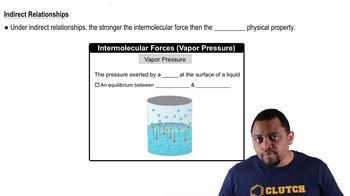
 01:04
01:04