Skip to main content
Introduction to Chemistry
My Course
Learn
Exam Prep
AI Tutor
Study Guides
Flashcards
Explore
Try the app
My Course
Learn
Exam Prep
AI Tutor
Study Guides
Flashcards
Explore
Try the app
Back
Intermolecular Forces and Physical Properties quiz
You can tap to flip the card.
What are intermolecular forces?
You can tap to flip the card.
👆
What are intermolecular forces?
Intermolecular forces are attractive forces that exist between molecules and influence physical properties.
Track progress
Control buttons has been changed to "navigation" mode.
1/15
Related flashcards
Related practice
Recommended videos
Intermolecular Forces and Physical Properties definitions
Intermolecular Forces and Physical Properties
14 Terms
Intermolecular Forces and Physical Properties
12. Liquids, Solids, and Intermolecular Forces
5 problems
Topic
Atomic, Ionic and Molecular Solids
12. Liquids, Solids, and Intermolecular Forces
5 problems
Topic
12. Liquids, Solids, and Intermolecular Forces
4 topics
12 problems
Chapter
Guided course
01:04
Intermolecular Forces and Physical Properties Concept 2
2139
views
3
rank
Guided course
01:52
Intermolecular Forces and Physical Properties Example 2
2081
views
4
rank
Guided course
01:21
Intermolecular Forces and Physical Properties Example 1
2202
views
8
rank
Terms in this set (15)
Hide definitions
What are intermolecular forces?
Intermolecular forces are attractive forces that exist between molecules and influence physical properties.
How do stronger intermolecular forces affect boiling point?
Stronger intermolecular forces result in a higher boiling point.
What is the boiling point?
Boiling point is the temperature at which a liquid and a gas are in equilibrium, allowing vaporization and condensation to occur.
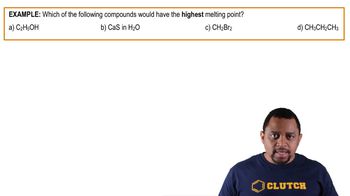
How do intermolecular forces influence melting point?
Greater intermolecular forces lead to a higher melting point.
What is the melting point?
Melting point is the temperature at which a solid and a liquid are in equilibrium, allowing melting and freezing to occur.
What is surface tension?
Surface tension is a measure of the attractive forces at the surface of a liquid.
How do intermolecular forces affect surface tension?
Stronger intermolecular forces increase surface tension.
What phenomenon allows insects to walk on water, and what causes it?
Insects can walk on water due to surface tension, which is caused by strong intermolecular forces like hydrogen bonding.
What is viscosity?
Viscosity is the resistance to flow for a substance.
How do intermolecular forces affect viscosity?
Stronger intermolecular forces result in higher viscosity.
How can viscosity be decreased?
Viscosity can be decreased by increasing the temperature of the substance.
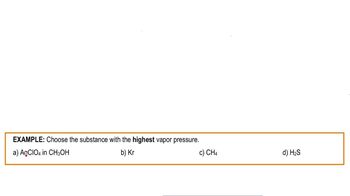
What is vapor pressure?
Vapor pressure is the pressure exerted by a gas at the surface of a liquid.
How are intermolecular forces and vapor pressure related?
They are inversely related; stronger intermolecular forces result in lower vapor pressure.
What is the relationship between vapor pressure and the equilibrium of condensation and vaporization?
Vapor pressure results from the equilibrium between condensation and vaporization at the surface of a liquid.
Which physical properties increase with stronger intermolecular forces?
Boiling point, melting point, surface tension, and viscosity all increase with stronger intermolecular forces.
 BackBack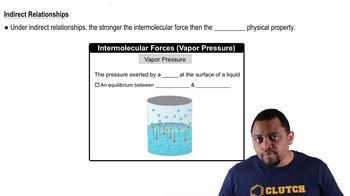
 01:04
01:04