Skip to main content
Introduction to Chemistry
My Course
Learn
Exam Prep
AI Tutor
Study Guides
Flashcards
Explore
Try the app
My Course
Learn
Exam Prep
AI Tutor
Study Guides
Flashcards
Explore
Try the app
Back
Lewis Dot Structures: Multiple Bonds quiz
You can tap to flip the card.
Why do atoms form multiple bonds in Lewis dot structures?
You can tap to flip the card.
👆
Why do atoms form multiple bonds in Lewis dot structures?
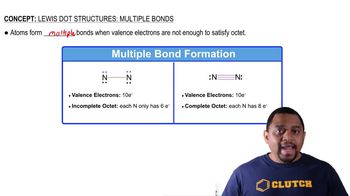
Atoms form multiple bonds when valence electrons are insufficient to satisfy the octet rule, ensuring each atom ideally has eight electrons around it.
Track progress
Control buttons has been changed to "navigation" mode.
1/15
Related flashcards
Related practice
Recommended videos
Lewis Dot Structures: Multiple Bonds definitions
Lewis Dot Structures: Multiple Bonds
12 Terms
Lewis Dot Structures: Multiple Bonds
10. Chemical Bonding
5 problems
Topic
Lewis Dot Structures: Ions (Simplified)
10. Chemical Bonding
5 problems
Topic
10. Chemical Bonding - Part 1 of 2
12 topics
35 problems
Chapter
10. Chemical Bonding - Part 2 of 2
4 topics
12 problems
Chapter
Guided course
02:55
Lewis Dot Structures: Multiple Bonds Example 1
3600
views
21
rank
Guided course
01:57
Lewis Dot Structures: Multiple Bonds Concept 1
3884
views
15
rank
Terms in this set (15)
Hide definitions
Why do atoms form multiple bonds in Lewis dot structures?
Atoms form multiple bonds when valence electrons are insufficient to satisfy the octet rule, ensuring each atom ideally has eight electrons around it.
What is the octet rule?
The octet rule states that elements ideally want eight electrons around them to resemble the electron arrangement of a noble gas.
How many electrons are shared in a single covalent bond?
A single covalent bond shares two electrons between atoms.
In a single-bonded nitrogen molecule, how many electrons surround each nitrogen atom?
Each nitrogen atom has six electrons around it in a single-bonded nitrogen molecule.
Why is a single bond between two nitrogen atoms insufficient to satisfy the octet rule?
A single bond leaves each nitrogen atom with only six electrons, which does not fulfill the octet rule.
How does forming a triple bond between two nitrogen atoms help satisfy the octet rule?
A triple bond allows each nitrogen atom to have eight electrons around it, satisfying the octet rule.
How many total valence electrons are used in both single and triple bonded nitrogen molecules?
Both single and triple bonded nitrogen molecules use a total of 10 valence electrons.
What is the duet rule, and which element follows it?
The duet rule states that an atom only needs two electrons to resemble helium, and hydrogen follows this rule.
What types of multiple bonds can atoms form to fulfill the octet rule?
Atoms can form double or triple bonds to fulfill the octet rule.
How many electrons are shared in a triple bond?
A triple bond shares six electrons between two atoms.
Why is the triple bond structure preferred for nitrogen over the single bond structure?
The triple bond structure is preferred because it allows each nitrogen atom to have eight electrons, fulfilling the octet rule.
What is the electron arrangement goal for most elements in Lewis dot structures?
Most elements aim to have eight electrons around them to achieve a noble gas electron arrangement.
How are electrons shared in covalent bonds according to the transcript?
Electrons in covalent bonds are shared between the atoms involved in the bond.
What exception to the octet rule is mentioned in the transcript?
Hydrogen is an exception, as it follows the duet rule instead of the octet rule.
What is the main purpose of creating multiple bonds in Lewis dot structures?
The main purpose is to ensure that atoms have enough electrons to satisfy the octet rule.
 BackBack
 02:55
02:55