Skip to main content
Introduction to Chemistry
My Course
Learn
Exam Prep
AI Tutor
Study Guides
Flashcards
Explore
Try the app
My Course
Learn
Exam Prep
AI Tutor
Study Guides
Flashcards
Explore
Try the app
Back
Molecular Formula definitions
You can tap to flip the card.
Molecular Formula
You can tap to flip the card.
👆
Molecular Formula
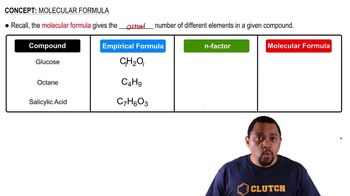
Shows the actual count of each type of atom present in a single molecule of a compound.
Track progress
Control buttons has been changed to "navigation" mode.
1/12
Related flashcards
Related practice
Recommended videos
Molecular Formula quiz
Molecular Formula
15 Terms
Molecular Formula
6. Chemical Composition
5 problems
Topic
Mole Concept
6. Chemical Composition
5 problems
Topic
6. Chemical Composition
4 topics
12 problems
Chapter
Guided course
05:03
Molecular Formula Example 1
5174
views
44
rank
Guided course
02:08
Molecular Formula
13219
views
136
rank
Terms in this set (12)
Hide definitions
Molecular Formula
Shows the actual count of each type of atom present in a single molecule of a compound.
Empirical Formula
Represents the simplest whole-number ratio of elements in a compound, not the actual atom count.
Subscript
A small number written after an element symbol indicating the quantity of that atom in a formula.
N Factor
A multiplier applied to the empirical formula's subscripts to obtain the molecular formula.
Glucose
A compound with a molecular formula derived by multiplying its empirical formula by 6.
Octane
A compound whose molecular formula results from doubling the subscripts of its empirical formula.
Salicylic Acid
A compound where the empirical and molecular formulas are identical due to an n factor of 1.
Element
A pure substance consisting of only one type of atom, represented in chemical formulas.
Compound
A substance formed from two or more elements chemically combined in fixed proportions.
Mass Percentage
The proportion by mass of each element present in a compound, used to determine formulas.
Ratio
A comparison of the quantities of elements, foundational for empirical formula determination.
Subscript Multiplication
The process of scaling empirical formula subscripts by the n factor to yield the molecular formula.
 BackBack
 05:03
05:03