Skip to main content
Introduction to Chemistry
My Course
Learn
Exam Prep
AI Tutor
Study Guides
Flashcards
Explore
Try the app
My Course
Learn
Exam Prep
AI Tutor
Study Guides
Flashcards
Explore
Try the app
Back
Multiple Bonds definitions
You can tap to flip the card.
Single Bond
You can tap to flip the card.
👆
Single Bond
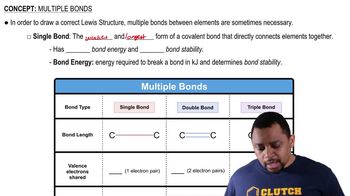
The longest and weakest covalent connection, involving two electrons, with the lowest energy and stability.
Track progress
Control buttons has been changed to "navigation" mode.
1/12
Related flashcards
Related practice
Recommended videos
Multiple Bonds quiz
Multiple Bonds
15 Terms
Multiple Bonds
10. Chemical Bonding
5 problems
Topic
Lewis Dot Structures: Multiple Bonds
10. Chemical Bonding
5 problems
Topic
10. Chemical Bonding - Part 1 of 2
12 topics
35 problems
Chapter
10. Chemical Bonding - Part 2 of 2
4 topics
12 problems
Chapter
Guided course
01:10
Multiple Bonds Example 1
4367
views
16
rank
Guided course
02:26
Multiple Bonds Concept 1
4590
views
15
rank
Terms in this set (12)
Hide definitions
Single Bond
The longest and weakest covalent connection, involving two electrons, with the lowest energy and stability.
Double Bond
A covalent connection involving four electrons, offering intermediate strength, energy, and stability.
Triple Bond
The shortest and strongest covalent connection, involving six electrons, with the highest energy and stability.
Bond Energy
The amount of energy, measured in kilojoules, needed to break a chemical connection between atoms.
Bond Strength
A measure of how difficult it is to break a chemical connection; increases from single to triple connections.
Bond Stability
A property reflecting how resistant a chemical connection is to breaking; higher with more shared electrons.
Electron Pair
A set of two electrons shared between atoms, forming the basis of covalent connections.
Valence Electrons
The outermost electrons involved in forming chemical connections, determining bond type and strength.
Covalent Bond
A type of chemical connection where atoms share electron pairs to achieve stability.
Lewis Structure
A diagram showing how valence electrons are arranged among atoms, indicating single, double, or triple connections.
Kilojoule
A unit of energy measurement used to express the energy required to break chemical connections.
Bond Length
The distance between two bonded atoms; decreases as the number of shared electron pairs increases.
 BackBack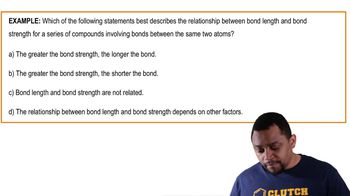
 01:10
01:10