Skip to main content
Introduction to Chemistry
My Course
Learn
Exam Prep
AI Tutor
Study Guides
Flashcards
Explore
Try the app
My Course
Learn
Exam Prep
AI Tutor
Study Guides
Flashcards
Explore
Try the app
Back
Naming Acids definitions
You can tap to flip the card.
Acid
You can tap to flip the card.
👆
Acid
A covalent compound, typically starting with hydrogen, that releases H+ ions when dissolved in water.
Track progress
Control buttons has been changed to "navigation" mode.
1/13
Related flashcards
Related practice
Recommended videos
Naming Acids quiz #1
Naming Acids
10 Terms
Naming Acids
5. Molecules and Compounds
5 problems
Topic
Naming Binary Molecular Compounds
5. Molecules and Compounds
5 problems
Topic
5. Molecules and Compounds
11 topics
32 problems
Chapter
Guided course
02:15
Naming Acids
10805
views
84
rank
Guided course
02:49
Naming Acids
8778
views
62
rank
Guided course
02:21
Naming Acids Example 1
8834
views
60
rank
Terms in this set (13)
Hide definitions
Acid
A covalent compound, typically starting with hydrogen, that releases H+ ions when dissolved in water.
Covalent Compound
A substance formed by nonmetals sharing electrons, resulting in molecules with no overall charge.
Hydrogen Ion
A positively charged particle, symbolized as H+, responsible for the acidic properties of solutions.
Hydronium Ion
An alternative name for H+, emphasizing its role in aqueous acidic solutions.
Nonmetal
An element found on the right side of the periodic table, often forming covalent bonds in acids.
Binary Acid
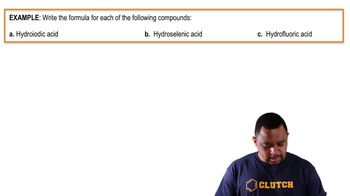
A molecule containing hydrogen and a single nonmetal (excluding oxygen), named with 'hydro-' and '-ic acid.'
Oxyacid
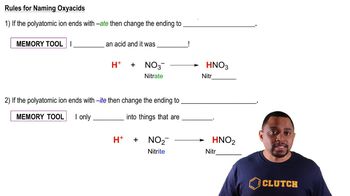
A compound with hydrogen and a polyatomic ion containing oxygen, named based on the ion's suffix.
Polyatomic Ion
A charged group of covalently bonded atoms, often containing oxygen, crucial in oxyacid formation.
Nitrate Ion
A polyatomic ion with the formula NO3−, which forms nitric acid when combined with hydrogen.
Nitrite Ion
A polyatomic ion with the formula NO2−, which forms nitrous acid when combined with hydrogen.
Base Name
The root portion of a nonmetal's name used in acid nomenclature, sometimes modified for certain elements.
Suffix
The ending part of a chemical name, such as '-ic acid' or '-ous acid,' indicating the acid type.
Exception
A case where standard acid naming rules do not apply, such as acetic acid or acids with sulfur and phosphorus.
 BackBack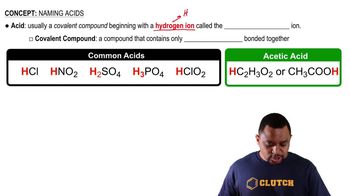
 02:15
02:15