Skip to main content
Introduction to Chemistry
My Course
Learn
Exam Prep
AI Tutor
Study Guides
Flashcards
Explore
Try the app
My Course
Learn
Exam Prep
AI Tutor
Study Guides
Flashcards
Explore
Try the app
Back
Osmolarity quiz
You can tap to flip the card.
What does osmolarity represent in a solution?
You can tap to flip the card.
👆
What does osmolarity represent in a solution?
Osmolarity represents the number of moles of ions per liter of solution.
Track progress
Control buttons has been changed to "navigation" mode.
1/15
Related flashcards
Related practice
Recommended videos
Osmolarity definitions
Osmolarity
15 Terms
Osmolarity
13. Solutions
5 problems
Topic
Solubility: Temperature Effect
13. Solutions
5 problems
Topic
13. Solutions - Part 1 of 2
12 topics
35 problems
Chapter
13. Solutions - Part 2 of 2
2 topics
6 problems
Chapter
Guided course
00:37
Osmolarity
7265
views
32
rank
Guided course
02:18
Osmolarity Example 3
7191
views
43
rank
Guided course
01:16
Osmolarity Example 2
7634
views
30
rank
Terms in this set (15)
Hide definitions
What does osmolarity represent in a solution?
Osmolarity represents the number of moles of ions per liter of solution.
How is osmolarity similar to molarity?
Both measure concentration per liter, but osmolarity focuses on ions while molarity focuses on solute.
What is the formula for calculating osmolarity using method 1?
Osmolarity = moles of ions / liters of solution.
What type of solutes does osmolarity specifically pertain to?
Osmolarity pertains specifically to solutes that are ions.
How does method 2 calculate osmolarity from molarity?
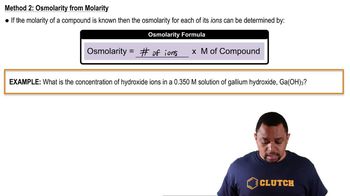
Method 2 uses the formula: osmolarity = number of ions in the compound x molarity of the compound.
What information is needed to use method 1 for osmolarity calculation?
You need the moles of ions and the liters of solution.
What information is needed to use method 2 for osmolarity calculation?
You need the molarity of the compound and the number of ions in the compound.
What is another name for osmolarity?
Osmolarity is sometimes referred to as ionic molarity.
What is the unit for osmolarity?
Osmolarity is measured in moles of ions per liter.
Why is osmolarity important in solutions with ionic compounds?
It helps quantify the concentration of ions, which affects properties like conductivity and osmotic pressure.
How would you calculate osmolarity for NaCl if its molarity is 1 M?
NaCl dissociates into 2 ions, so osmolarity = 2 x 1 M = 2 Osm/L.
What is the difference between moles of solute and moles of ions in a solution?
Moles of solute refer to the total compound, while moles of ions refer to the individual ions produced from dissociation.
If a compound produces 3 ions per formula unit, how do you find its osmolarity from its molarity?
Multiply the molarity by 3 to get the osmolarity.
What is the key step in method 2 for calculating osmolarity?
Identify the number of ions produced by the compound and multiply by its molarity.
Why does osmolarity increase when a compound produces more ions?
Because each ion contributes to the total concentration, so more ions mean higher osmolarity.
 BackBack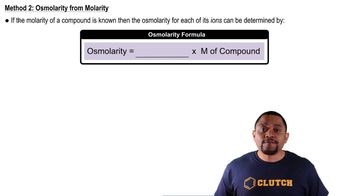
 00:37
00:37