Skip to main content
Introduction to Chemistry
My Course
Learn
Exam Prep
AI Tutor
Study Guides
Flashcards
Explore
Try the app
My Course
Learn
Exam Prep
AI Tutor
Study Guides
Flashcards
Explore
Try the app
Back
Percent Yield definitions
You can tap to flip the card.
Stoichiometry
You can tap to flip the card.
👆
Stoichiometry
A calculation method used to predict the amount of product possible from a given amount of starting material in a chemical reaction.
Track progress
Control buttons has been changed to "navigation" mode.
1/13
Related flashcards
Related practice
Recommended videos
Percent Yield quiz
Percent Yield
15 Terms
Percent Yield
8. Quantities in Chemical Reactions
4 problems
Topic
Thermochemical Equations
8. Quantities in Chemical Reactions
5 problems
Topic
8. Quantities in Chemical Reactions
4 topics
12 problems
Chapter
Guided course
03:09
Percent Yield
8878
views
88
rank
Guided course
04:43
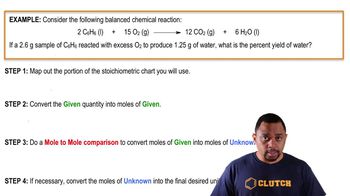
Percent Yield Example 1
8181
views
82
rank
Terms in this set (13)
Hide definitions
Stoichiometry
A calculation method used to predict the amount of product possible from a given amount of starting material in a chemical reaction.
Percent Yield
A measure of reaction efficiency, calculated by comparing the actual product obtained to the maximum possible amount, expressed as a percentage.
Actual Yield
The pure amount of product collected from a laboratory experiment, often less than the calculated maximum due to real-world losses.
Theoretical Yield
The maximum amount of product expected from a reaction, determined by stoichiometric calculations using starting quantities.
Efficiency
A reflection of how closely the experimental results match the calculated maximum, often indicated by percent yield.
Chemical Reaction
A process in which substances interact to form new products, with efficiency measured by comparing actual and theoretical yields.
Formula Sheet
A reference resource that may or may not provide essential equations, such as the percent yield formula, during exams.
Units
Standardized quantities, such as grams or moles, that must match when calculating percent yield to ensure accuracy.
Product
The substance formed as a result of a chemical reaction, whose amount is measured to assess reaction success.
Spillage
A common laboratory occurrence where some material is lost, contributing to lower actual yields compared to theoretical predictions.
External Influences
Uncontrolled factors, such as environmental conditions, that can reduce the amount of product obtained in an experiment.
Percent Yield Formula
An equation requiring the ratio of actual to theoretical yield, multiplied by 100, to determine reaction efficiency.
Yield Categories
Classifications such as excellent, very good, good, and poor, used to describe the quality of a reaction's percent yield.
 BackBack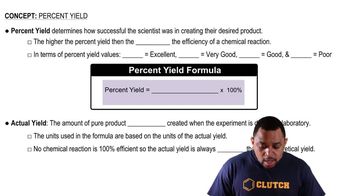
 03:09
03:09