Skip to main content
Introduction to Chemistry
My Course
Learn
Exam Prep
AI Tutor
Study Guides
Flashcards
Explore
Try the app
My Course
Learn
Exam Prep
AI Tutor
Study Guides
Flashcards
Explore
Try the app
Back
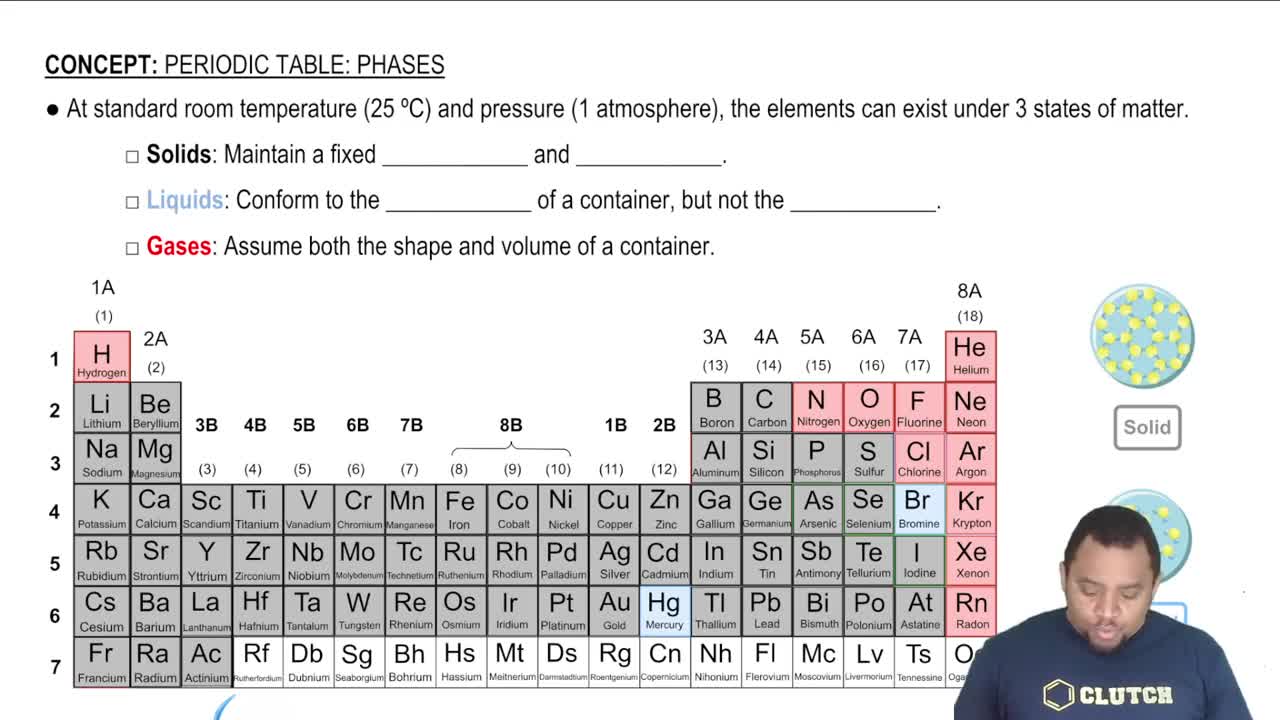
Periodic Table: Phases (Simplified) definitions
You can tap to flip the card.
Standard Room Temperature
You can tap to flip the card.
👆
Standard Room Temperature
A reference point of 25 degrees Celsius used to compare properties of elements under typical laboratory conditions.
Track progress
Control buttons has been changed to "navigation" mode.
1/15
Related flashcards
Related practice
Recommended videos
Periodic Table: Phases (Simplified) quiz #1
Periodic Table: Phases (Simplified)
10 Terms
Periodic Table: Phases (Simplified)
4. Atoms and Elements
5 problems
Topic
Periodic Table: Main Group Element Charges
4. Atoms and Elements
5 problems
Topic
4. Atoms and Elements - Part 1 of 2
12 topics
34 problems
Chapter
4. Atoms and Elements - Part 2 of 2
1 topic
3 problems
Chapter
Guided course
1:46
Periodic Table: Phases (Simplified) Example 1
6899
views
60
rank
Guided course
03:25
Periodic Table: Phases (Simplified) Concept 1
8544
views
74
rank
Terms in this set (15)
Hide definitions
Standard Room Temperature
A reference point of 25 degrees Celsius used to compare properties of elements under typical laboratory conditions.
Standard Pressure
A reference point of 1 atmosphere, commonly used to describe the behavior of elements in a controlled environment.
Solid
A state where molecules are locked in place, maintaining fixed shape and volume, and not conforming to their container.
Liquid
A state where molecules are close but can move freely, allowing adaptation to container shape but not volume.
Gas
A state with widely spaced molecules, enabling both shape and volume of the container to be assumed.
Periodic Table
A systematic arrangement of elements, highlighting their states at standard temperature and pressure.
Noble Gases
A group in the periodic table, all existing as gases at standard conditions, found in group 8A.
Synthetic Elements
Laboratory-created substances, typically found in the 7th row, with unpredictable states due to instability.
State of Matter
A physical form—solid, liquid, or gas—adopted by elements depending on temperature and pressure.
Volume
The amount of three-dimensional space occupied, which solids and gases maintain or assume in a container.
Shape
A property retained by solids, adapted by liquids, and assumed by gases based on their molecular arrangement.
Molecule
A group of atoms whose arrangement and movement determine the state—solid, liquid, or gas—of a substance.
Unstable Element
A substance with high atomic mass, often synthetic, whose state at standard conditions cannot be reliably predicted.
Container
An object whose shape and volume influence how solids, liquids, and gases behave within it.
7th Row
A section of the periodic table containing synthetic, highly unstable elements with unpredictable physical states.
 BackBack
 1:46
1:46