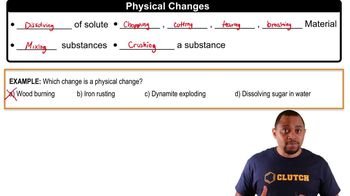
A physical change is a change in the physical state of a substance without changing its chemical composition or identity.
Give two examples of physical changes.
Examples include dissolving a solute in a liquid and crushing a soda can.
What is a chemical change?
A chemical change alters the chemical composition and identity of a substance, resulting in new chemical bonds and products.
Name two common examples of chemical changes.
Rusting of metals and burning materials are common examples of chemical changes.
What happens to the identity of a substance during a physical change?
The identity of the substance remains the same during a physical change.
What are some keywords that indicate a physical change?
Keywords include dissolving, mixing, chopping, cutting, tearing, breaking, and crushing.
What are two visual signs that a chemical change has occurred?
A color change or an odor change can indicate a chemical change.
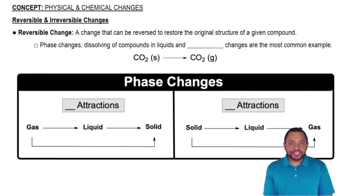
What is a reversible change?
A reversible change is a change that can be undone to restore the original substance, such as phase changes or dissolving.
Give an example of a reversible change involving carbon dioxide.
Solid carbon dioxide (CO2) can change to gaseous CO2 without changing its chemical identity, which is a reversible change.
What is the process called when a gas turns directly into a solid?
This process is called deposition.
What is the term for the phase change from solid to liquid?
The phase change from solid to liquid is called melting or fusion.
What is sublimation in terms of phase changes?
Sublimation is the process where a solid changes directly into a gas without becoming a liquid first.
What is an irreversible change?
An irreversible change is a permanent change that cannot be undone to restore the original material, usually involving chemical changes.
Describe the chemical reaction between nitrogen and hydrogen gases.
Nitrogen gas (N2) and hydrogen gas (H2) combine to form ammonia (NH3), which is an irreversible chemical change.
Why can't you reverse the formation of ammonia from nitrogen and hydrogen under normal conditions?
Because the chemical bonds formed in ammonia are stable, and normal conditions do not allow the process to reverse and separate NH3 back into N2 and H2.
 Back
Back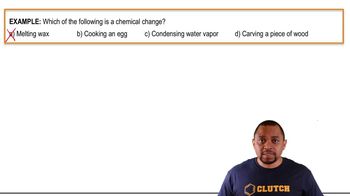
 01:52
01:52