Skip to main content
Introduction to Chemistry
My Course
Learn
Exam Prep
AI Tutor
Study Guides
Flashcards
Explore
Try the app
My Course
Learn
Exam Prep
AI Tutor
Study Guides
Flashcards
Explore
Try the app
Back
Pressure Units quiz
You can tap to flip the card.
What is the SI unit for pressure and who is it named after?
You can tap to flip the card.
👆
What is the SI unit for pressure and who is it named after?
The SI unit for pressure is the Pascal (Pa), named after Blaise Pascal.
Track progress
Control buttons has been changed to "navigation" mode.
1/15
Related flashcards
Related practice
Recommended videos
Pressure Units definitions
Pressure Units
13 Terms
Pressure Units
11 Gases
3 problems
Topic
Kinetic Molecular Theory
11 Gases
5 problems
Topic
11 Gases
10 topics
26 problems
Chapter
Guided course
01:15
Pressure Units
11442
views
184
rank
1
comments
Guided course
00:48
Pressure Units Example 1
9239
views
136
rank
1
comments
Guided course
01:54
Pressure Units
9254
views
96
rank
1
comments
Terms in this set (15)
Hide definitions
What is the SI unit for pressure and who is it named after?
The SI unit for pressure is the Pascal (Pa), named after Blaise Pascal.
How is pressure defined in terms of force and area?
Pressure is defined as the force exerted by gas molecules on the walls of their container, calculated as pressure = force/area.
What are the SI units for force and area when calculating pressure?
Force is measured in newtons (N) and area is measured in meters squared (m²).
What are the three most commonly used non-SI units for pressure in chemistry?
The most commonly used non-SI units are atmospheres (ATM), millimeters of mercury (mmHg), and torr.
What is the relationship between atmospheres and millimeters of mercury?
1 atmosphere (ATM) equals 760 millimeters of mercury (mmHg).
How many torr are equivalent to 1 atmosphere?
1 atmosphere (ATM) is equivalent to 760 torr.
Are pressure values for pascals, kilopascals, bars, and psi typically required to be memorized?
No, these values are usually provided in questions or formula sheets and are not required to be memorized.
What is the value of 1 bar in terms of psi?
1.01325 bars is equal to 14.696 psi.
What is the value of 1 atmosphere in bars?
1 atmosphere is approximately equal to 1.01325 bars.
What is the value of 1 atmosphere in pascals?
1 atmosphere is equal to 1.01325 × 10⁵ pascals.
What is the value of 1 kilopascal in pascals?
1 kilopascal (kPa) is equal to 1,000 pascals (Pa).
Why is understanding the relationship between different pressure units important in chemistry?
It is essential for converting between units and applying pressure concepts in chemical calculations.
What physical process causes gas pressure in a container?
Gas pressure is caused by molecules bouncing around and colliding with the walls of their container.
Which pressure units are most likely to appear on quizzes and exams without being provided?
Atmospheres (ATM), millimeters of mercury (mmHg), and torr are most likely to appear and should be memorized.
What is the formula for calculating pressure?
Pressure = Force / Area.
 BackBack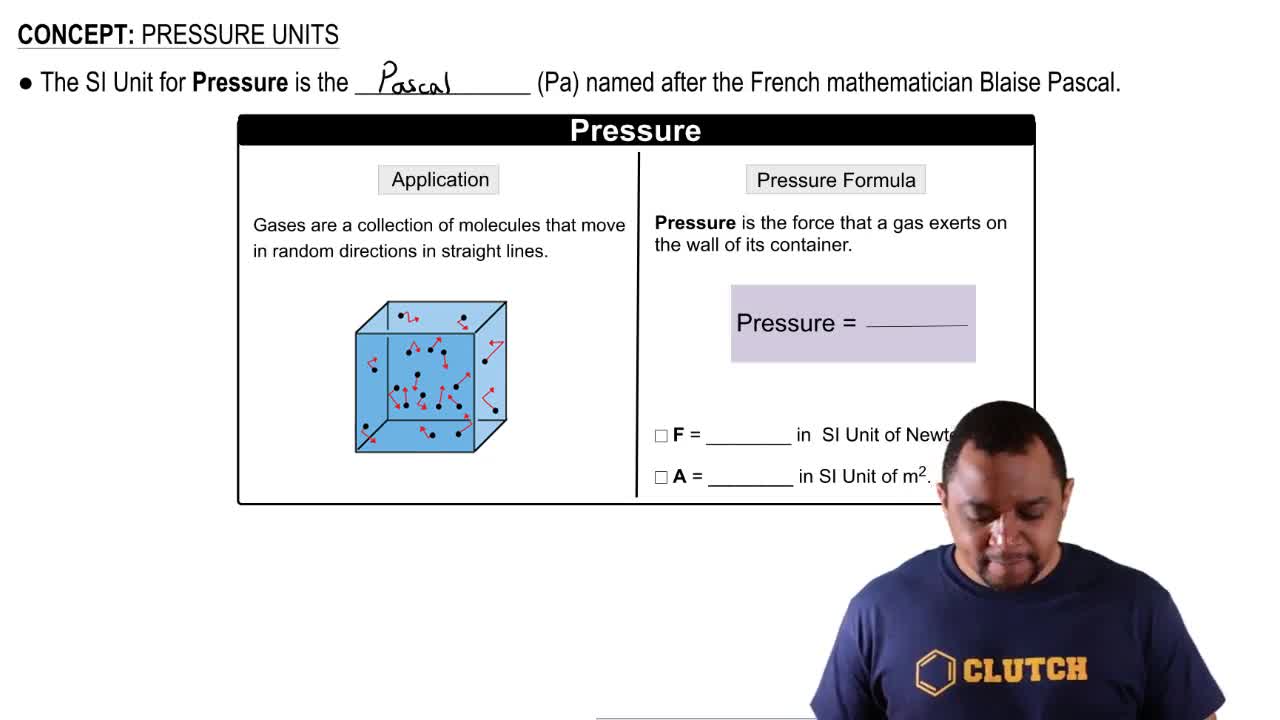
 01:15
01:15