Skip to main content
Introduction to Chemistry
My Course
Learn
Exam Prep
AI Tutor
Study Guides
Flashcards
Explore
Try the app
My Course
Learn
Exam Prep
AI Tutor
Study Guides
Flashcards
Explore
Try the app
Back
Solubility and Intermolecular Forces definitions
You can tap to flip the card.
Polarity
You can tap to flip the card.
👆
Polarity
Describes the distribution of electrical charge within a molecule, influencing its ability to mix with other substances.
Track progress
Control buttons has been changed to "navigation" mode.
1/13
Related flashcards
Related practice
Recommended videos
Solubility and Intermolecular Forces quiz
Solutions: Solubility and Intermolecular Forces
15 Terms
Solubility and Intermolecular Forces
13. Solutions
5 problems
Topic
Solutions: Mass Percent
13. Solutions
5 problems
Topic
13. Solutions - Part 1 of 2
12 topics
35 problems
Chapter
13. Solutions - Part 2 of 2
2 topics
6 problems
Chapter
Guided course
01:03
Solubility and Mixtures
54
views
2
rank
Guided course
01:44
Gas Solubility Example
40
views
Guided course
02:42
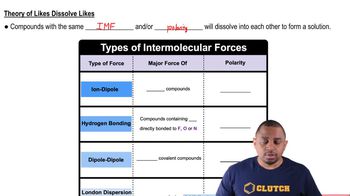
Intermolecular Forces in Solutions
53
views
Terms in this set (13)
Hide definitions
Polarity
Describes the distribution of electrical charge within a molecule, influencing its ability to mix with other substances.
Intermolecular Force
Refers to the attraction between molecules, determining whether substances can dissolve into each other.
Hydrogen Bonding
A strong polar interaction occurring when hydrogen is bonded to highly electronegative atoms, enabling mixing with other polar compounds.
Dipole-Dipole Force
A polar interaction between molecules with permanent dipoles, allowing them to dissolve with other polar substances.
London Dispersion Force
A weak, non-polar interaction present in all molecules, but dominant in non-polar compounds, preventing mixing with polar substances.
Solution
A homogeneous mixture where substances dissolve completely into each other, forming a single phase.
Mixture
A combination of two or more substances that retain their individual properties and can be homogeneous or heterogeneous.
Homogeneous Mixture
A uniform combination where components are evenly distributed and dissolve into each other.
Heterogeneous Mixture
A non-uniform combination where components remain separate and do not dissolve into each other.
Solvent
The component in a mixture that dissolves another substance, often determining the mixture's polarity.
Likes Dissolve Likes
A principle stating that substances with similar polarity or intermolecular forces will mix and form solutions.
Non-Polar Compound
A substance lacking significant charge separation, unable to mix with polar compounds like water.
Polar Compound
A substance with uneven charge distribution, allowing it to mix with other polar substances.
 BackBack
 01:03
01:03