Skip to main content
Introduction to Chemistry
My Course
Learn
Exam Prep
AI Tutor
Study Guides
Flashcards
Explore
Try the app
My Course
Learn
Exam Prep
AI Tutor
Study Guides
Flashcards
Explore
Try the app
Back
Solubility Rules definitions
You can tap to flip the card.
Solubility
You can tap to flip the card.
👆
Solubility
A chemical property describing how much of a substance can dissolve in a solvent to form a homogeneous mixture.
Track progress
Control buttons has been changed to "navigation" mode.
1/15
Related flashcards
Related practice
Recommended videos
Solubility Rules quiz #1
Solubility Rules
10 Terms
Solubility Rules
7. Chemical Reactions
5 problems
Topic
Electrolytes (Simplified)
7. Chemical Reactions
5 problems
Topic
7. Chemical Reactions
8 topics
24 problems
Chapter
Guided course
00:28
Solubility Rules
10087
views
45
rank
Guided course
01:32
Solubility Rules Example 2
8949
views
76
rank
Guided course
02:30
Solubility Rules
10468
views
91
rank
Terms in this set (15)
Hide definitions
Solubility
A chemical property describing how much of a substance can dissolve in a solvent to form a homogeneous mixture.
Solute
A substance that is dissolved in a solvent, often breaking into ions if soluble.
Solvent
A medium, typically a liquid like water, in which other substances are dissolved.
Solution
A uniform mixture formed when a solute dissolves completely in a solvent.
Aqueous Ion
A charged particle surrounded by water molecules after a soluble compound dissociates.
Precipitate
A solid formed when an insoluble compound results from mixing solutions.
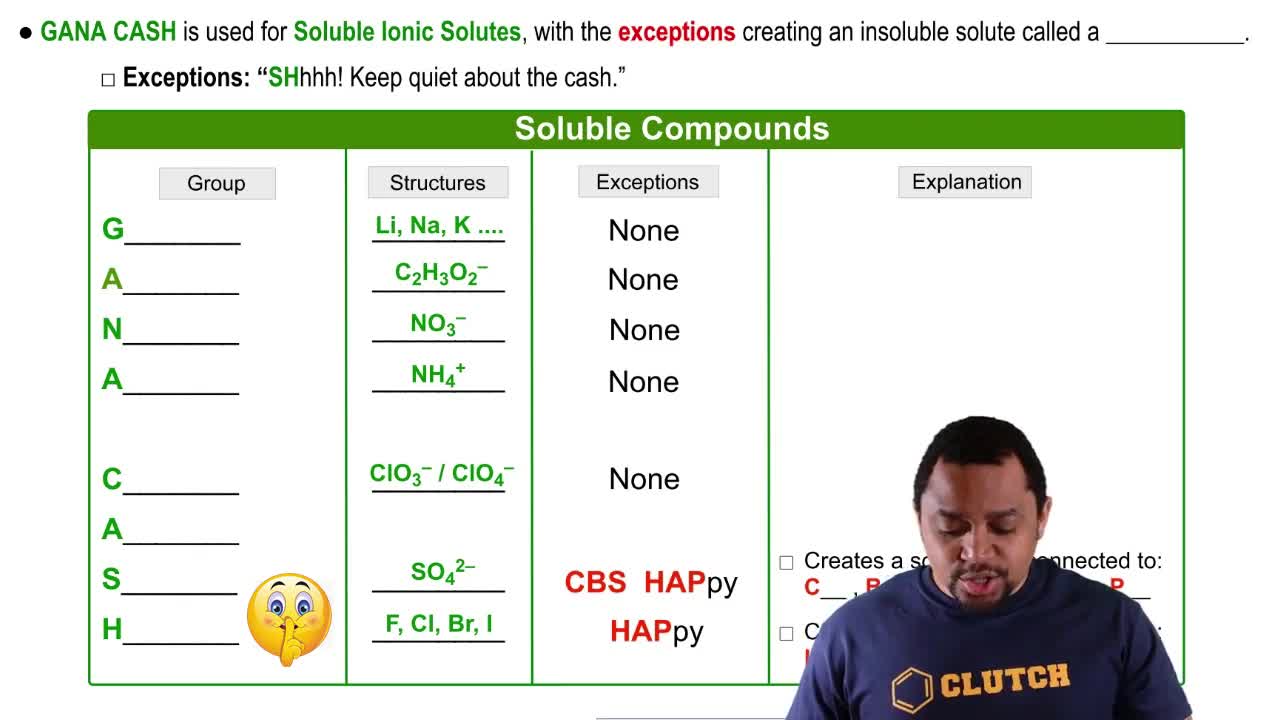
Group 1A Elements
Alkali metals like sodium and potassium, whose compounds are always soluble in water.
Acetate
An ion, C2H3O2−, whose compounds are generally soluble with no exceptions.
Nitrate
An ion, NO3−, that forms soluble compounds without exceptions.
Ammonium
A polyatomic ion, NH4+, that ensures solubility when present in ionic compounds.
Halogens
Group 7A elements like chlorine and bromine, usually forming soluble salts except with silver, lead, or mercury.
Sulfate
An ion, SO4^2−, forming soluble salts except with calcium, barium, strontium, silver, or lead.
Carbonate
An ion, CO3^2−, whose compounds are generally insoluble except with Group 1A or ammonium.
Hydroxide
An ion, OH−, usually forming insoluble compounds except with calcium, barium, or strontium.
Phosphate
An ion, PO4^3−, typically resulting in insoluble compounds unless paired with Group 1A or ammonium.
 BackBack
 00:28
00:28