Skip to main content
Introduction to Chemistry
My Course
Learn
Exam Prep
AI Tutor
Study Guides
Flashcards
Explore
Try the app
My Course
Learn
Exam Prep
AI Tutor
Study Guides
Flashcards
Explore
Try the app
Back
Wavelength and Frequency (Simplified) definitions
You can tap to flip the card.
Electromagnetic Radiation
You can tap to flip the card.
👆
Electromagnetic Radiation
A form of energy that travels through space as both waves and particles, including visible light and other types of radiation.
Track progress
Control buttons has been changed to "navigation" mode.
1/14
Related flashcards
Related practice
Recommended videos
Wavelength and Frequency (Simplified) quiz
Wavelength and Frequency (Simplified)
15 Terms
Wavelength and Frequency (Simplified)
9. Electrons in Atoms and the Periodic Table
5 problems
Topic
Electromagnetic Spectrum (Simplified)
9. Electrons in Atoms and the Periodic Table
5 problems
Topic
9. Electrons in Atoms and the Periodic Table - Part 3 of 4
12 topics
36 problems
Chapter
Guided course
01:12
Wavelength and Frequency (Simplified) Concept 2
3359
views
31
rank
Guided course
3:05
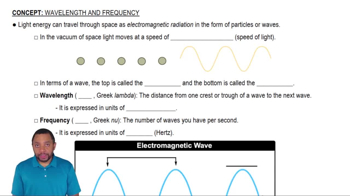
Wavelength and Frequency (Simplified) Concept 1
3929
views
44
rank
2
comments
Guided course
00:59
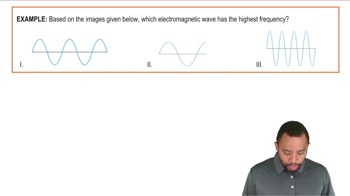
Wavelength and Frequency (Simplified) Example 1
11080
views
166
rank
1
comments
Terms in this set (14)
Hide definitions
Electromagnetic Radiation
A form of energy that travels through space as both waves and particles, including visible light and other types of radiation.
Photon
A tiny packet of light energy that can behave as both a particle and a wave, central to understanding light's dual nature.
Wave
A repeating pattern of crests and troughs that can transfer energy through space without moving matter.
Crest
The highest point reached by a wave, representing the topmost part in a wave diagram.
Trough
The lowest point reached by a wave, representing the bottommost part in a wave diagram.
Wavelength
The distance measured in meters between two consecutive crests or troughs in a wave.
Frequency
The number of complete waves passing a point each second, measured in hertz or inverse seconds.
Speed of Light
A constant value of 3.00 x 10^8 meters per second, representing how fast light travels in a vacuum.
Hertz
A unit equal to one cycle per second, used to express how often a wave repeats.
Inverse Proportionality
A relationship where an increase in one quantity results in a decrease in another, such as frequency and wavelength.
Direct Proportionality
A relationship where two quantities increase or decrease together, such as frequency and energy.
Energy
A property of light that increases with higher frequency and decreases with lower frequency.
Origin
The starting reference point in a wave diagram, often used to measure distances like wavelength.
Meter
The standard unit of length in the metric system, used to measure distances such as wavelength.
 BackBack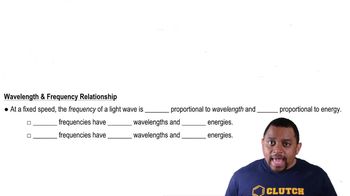
 01:12
01:12