Back
BackChapter 1: Foundations of Chemistry – Matter, Measurement, and Properties
Study Guide - Smart Notes
 Tailored notes based on your materials, expanded with key definitions, examples, and context.
Chemistry in Context
Historical Development and Importance
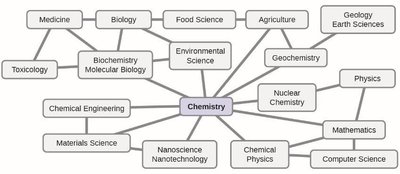
Chemistry is the study of the composition, properties, and interactions of matter. Its origins trace back over 2,500 years, beginning with Greek philosophers who proposed that matter consisted of four elements: earth, air, fire, and water. Alchemists later attempted to transform base metals into noble metals, laying early groundwork for modern chemistry. Today, chemistry is recognized as the central science, connecting disciplines such as biology, physics, environmental science, and engineering.
Chemistry's central role: Understanding chemistry is essential for fields like medicine, food science, environmental science, and more.
Everyday examples: Digesting food, synthesizing polymers, refining crude oil, and many other processes involve chemical changes.
The Scientific Method
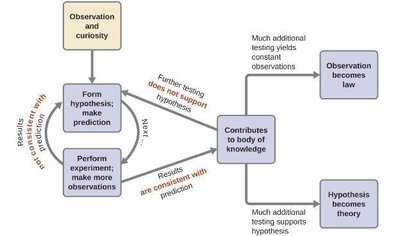
Chemistry relies on the scientific method, a systematic approach based on observation and experimentation. Scientists formulate hypotheses, test them, and develop theories and laws to explain natural phenomena.
Hypothesis: A tentative explanation for observations.
Theory: A well-substantiated, comprehensive, testable explanation.
Law: A summary of many experimental observations, describing or predicting aspects of the natural world.
Domains of Chemistry
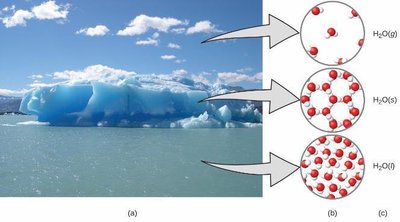
Chemists study matter and energy in three domains:
Macroscopic: Observable phenomena (e.g., icebergs, water).
Microscopic: Molecular and atomic level, often visualized with microscopes or models.
Symbolic: Chemical symbols and formulas representing matter.
Phases and Classification of Matter
States of Matter
Matter exists in several physical states, each with distinct properties:
Solid: Rigid, definite shape and volume.
Liquid: Flows, takes the shape of its container, definite volume.
Gas: Takes both the shape and volume of its container.
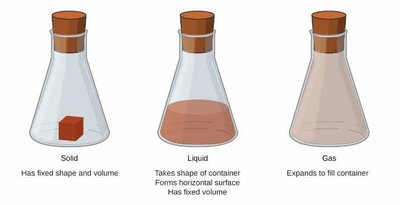
Plasma is a fourth state, consisting of charged particles, found in stars and lightning.
Mass vs. Weight
Mass: Amount of matter in an object; constant regardless of location.
Weight: Force exerted by gravity on an object; varies with location.
Law of Conservation of Matter
The total quantity of matter remains unchanged during physical or chemical changes.
Classification of Matter
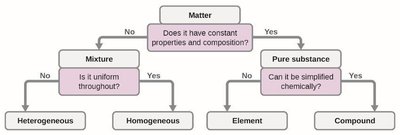
Matter can be classified based on its composition:
Pure substances: Constant composition; can be elements or compounds.
Mixtures: Variable composition; can be homogeneous (solutions) or heterogeneous.
Atoms and Molecules
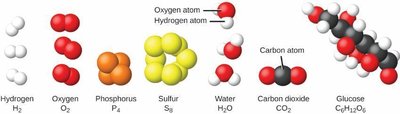
An atom is the smallest unit of an element, while a molecule consists of two or more atoms bonded together.
Elements: Pure substances that cannot be broken down further.
Compounds: Pure substances composed of two or more elements chemically bonded.
Physical and Chemical Properties
Physical Properties and Changes
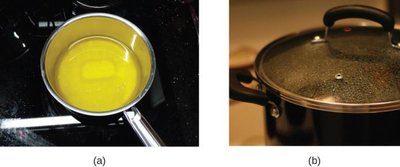
Physical properties are characteristics not associated with changes in chemical composition, such as density, color, and melting point. Physical changes alter the state or properties of matter without changing its composition.
Examples: Melting butter, condensation of steam.
Chemical Properties and Changes
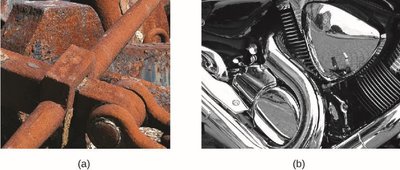
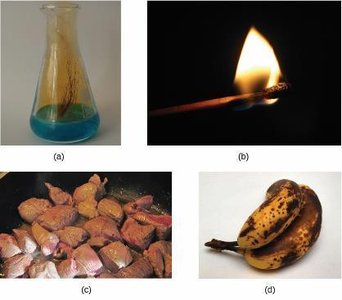
Chemical properties describe the ability of a substance to undergo changes that transform it into different substances.
Examples: Flammability, reactivity, rusting of iron.
Hazard Classification
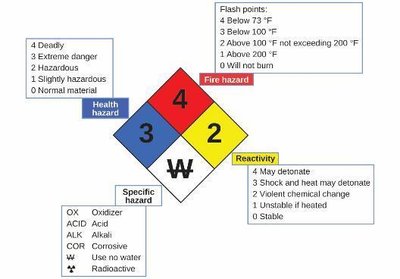
The National Fire Protection Agency (NFPA) hazard diamond summarizes major hazards of chemical substances, including health, fire, reactivity, and specific hazards.
Extensive vs. Intensive Properties
Extensive properties: Depend on the amount of matter (e.g., mass, volume).
Intensive properties: Independent of the amount of matter (e.g., density, temperature).
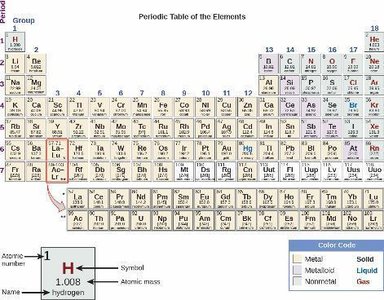
Measurements
Measurement Process and Units
Measurements are fundamental to chemistry, providing quantitative information. Each measurement includes a number, a unit, and an indication of uncertainty.
SI Units: The International System of Units is used in chemistry.
Property | Name of Unit | Symbol |
|---|---|---|
Length | meter | m |
Mass | kilogram | kg |
Time | second | s |
Temperature | kelvin | K |
Electric current | ampere | A |
Amount of substance | mole | mol |
Luminous intensity | candela | cd |
Unit Prefixes
Prefix | Symbol | Factor |
|---|---|---|
femto | f | 10-15 |
pico | p | 10-12 |
nano | n | 10-9 |
micro | μ | 10-6 |
milli | m | 10-3 |
centi | c | 10-2 |
deci | d | 10-1 |
kilo | k | 103 |
mega | M | 106 |
giga | G | 109 |
tera | T | 1012 |
Common SI Units
Length: Meter (m)
Mass: Kilogram (kg)
Temperature: Kelvin (K), Celsius (°C)
Time: Second (s)
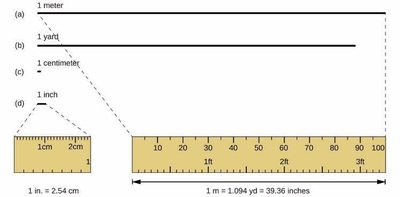
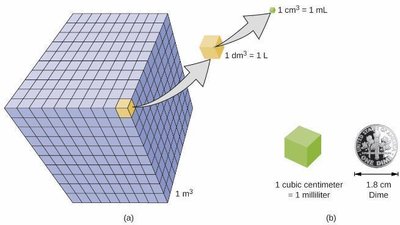
Derived Units: Volume and Density
Volume: Cubic meter (m3), liter (L), milliliter (mL)
Density: Ratio of mass to volume; units include kg/m3, g/cm3, g/L
Formula:
Measurement Uncertainty, Accuracy, and Precision
Exact vs. Uncertain Numbers
Counting yields exact numbers, while measurements are subject to uncertainty. The uncertainty is indicated by significant figures.
Exact numbers: Defined quantities (e.g., 1 ft = 12 in).
Uncertain numbers: Measurements with estimated digits.
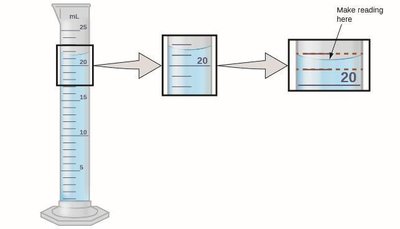
Significant Figures
All nonzero digits are significant.
Captive zeros (between nonzero digits) are significant.
Trailing zeros are significant if to the right of the decimal.
Leading zeros are not significant.
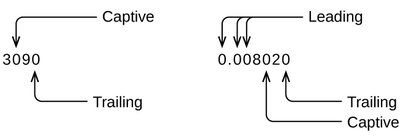
Significant Figures in Calculations
Addition/Subtraction: Round to the least number of decimal places.
Multiplication/Division: Round to the least number of significant figures.
Rounding: If the digit to be dropped is less than 5, round down; if more than 5, round up; if 5, round to even.
Accuracy and Precision
Accuracy: Closeness to the true value.
Precision: Reproducibility of results.
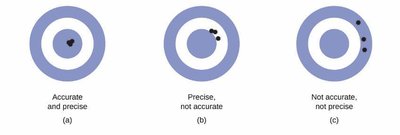
Mathematical Treatment of Measurement Results
Dimensional Analysis
Dimensional analysis is a method for converting units and solving problems using conversion factors.
Conversion factor: Ratio of two equivalent quantities with different units.
Example:
Length | Volume | Mass |
|---|---|---|
1 m = 1.0936 yd | 1 L = 1.0567 qt | 1 kg = 2.2046 lb |
1 in = 2.54 cm (exact) | 1 qt = 0.94635 L | 1 lb = 453.59 g |
1 km = 0.62137 mi | 1 ft3 = 28.317 L | 1 oz = 28.349 g |
1 mi = 1609.3 m | 1 tbsp = 14.1787 mL | 1 troy oz = 31.103 g |
Temperature Conversions
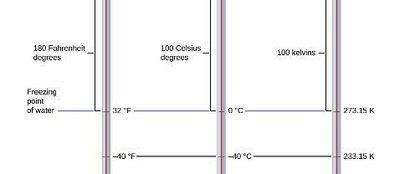
Celsius: Water freezes at 0 °C, boils at 100 °C.
Fahrenheit: Water freezes at 32 °F, boils at 212 °F.
Kelvin: Absolute scale; water freezes at 273.15 K, boils at 373.15 K.
Conversion formulas: