 Back
Chapter 11: Gases – Properties, Laws, and Applications
Study Guide - Smart Notes
 Tailored notes based on your materials, expanded with key definitions, examples, and context.
Gases: Properties and Behavior
Gas Pressure and Molecular Motion
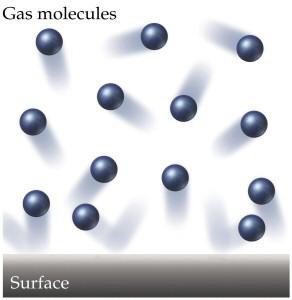
Gas molecules are in constant motion, and as they collide with surfaces, they exert a force known as pressure. Pressure is defined as force per unit area. The total pressure exerted by a gas is the sum of the forces from all molecular collisions on a surface at any instant.
Pressure Difference: Gases flow from areas of high pressure to low pressure, and the greater the difference, the stronger the flow.
Applications: Gas pressure can move objects or cause startling effects, such as popping ears or moving liquids through straws.

Soda Straws & Gas Pressure
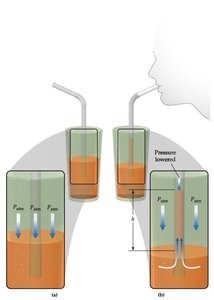
When drinking through a straw, the pressure inside and outside the straw determines the movement of liquid. If the pressure inside the straw is lower than outside, the liquid is pushed up by the higher external pressure.
Atmospheric Pressure
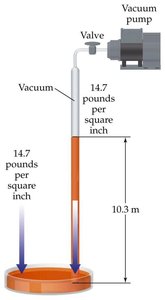
The atmosphere exerts pressure on everything it contacts. At sea level, this pressure averages 14.7 psi (pounds per square inch), equivalent to 1 atm (atmosphere). Most atmospheric mass is concentrated within the first 10 miles above Earth's surface.
Water Column Analogy: Atmospheric pressure is equivalent to the pressure exerted by a 10.3 m column of water.
Properties of Gases
Gases exhibit unique properties due to the freedom of their molecules:
Expansion: Gases expand to fill their container.
Shape: Gases take the shape of their container.
Low Density: Gases have much lower density than solids or liquids due to large spaces between molecules.
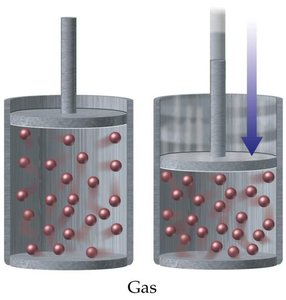
Compressibility: Gases can be compressed because of the empty space between molecules.
Homogeneous Mixtures: Mixtures of gases behave as homogeneous fluids.
Kinetic Molecular Theory
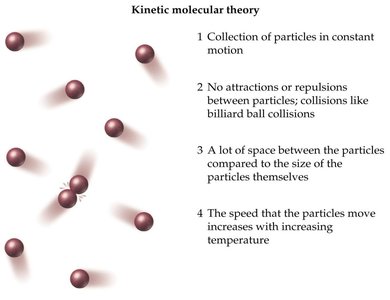
The Kinetic Molecular Theory explains the behavior of gases:
Gas particles (atoms or molecules) are in constant motion.
Attractions between particles are negligible.
Collisions are elastic; particles bounce off without sticking.
There is a lot of empty space between particles compared to their size.
The average kinetic energy is directly proportional to the Kelvin temperature.
Indefinite Shape and Volume
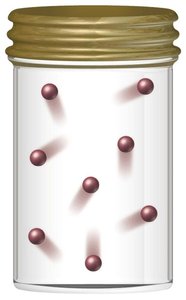
Gases have indefinite shape and volume because their molecules possess enough kinetic energy to overcome attractions, allowing them to spread out and fill any container.
Compressibility of Gases
Due to the large amount of unoccupied space in a gas, molecules can be squeezed closer together, making gases highly compressible.
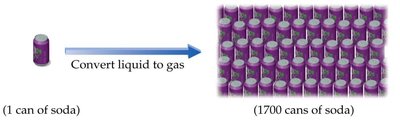
Low Density of Gases
Gases have low density because of the significant empty space between molecules. For example, converting the water in a soda can to steam would fill the space of 1700 cans.
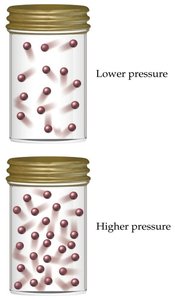
Pressure of a Gas
Gas pressure results from the constant movement and collisions of molecules with surfaces. It depends on:
Number of gas particles in a given volume
Volume of the container
Average speed of gas particles
Measuring Air Pressure
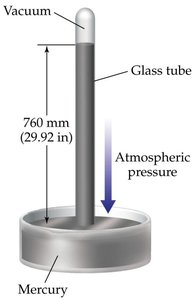
Air pressure is measured using a barometer, which uses a column of mercury supported by air pressure. The force of air on the mercury's surface is balanced by gravity's pull on the mercury column.
Pressure Imbalance in the Ear
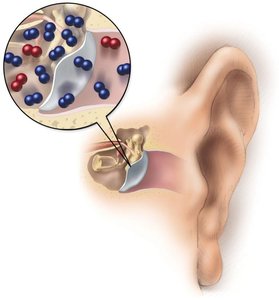
Rapid changes in atmospheric pressure can cause a pressure imbalance across the eardrum, leading to a "popped eardrum." This occurs when the membrane is pushed out due to unequal pressure.
Common Units of Pressure
Pressure can be measured in several units. The table below summarizes the main units and their equivalence at sea level:
Unit | Average Air Pressure at Sea Level |
|---|---|
pascal (Pa) | 101,325 |
kilopascal (kPa) | 101.325 |
atmosphere (atm) | 1 (exactly) |
millimeters of mercury (mmHg) | 760 (exactly) |
inches of mercury (inHg) | 29.92 |
torr (torr) | 760 (exactly) |
pounds per square inch (psi) | 14.7 |
Gas Laws
Boyle’s Law
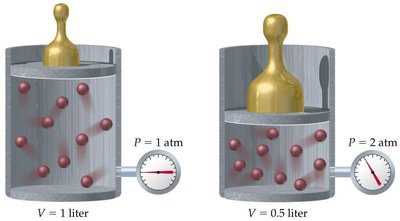
Boyle’s Law states that the pressure of a gas is inversely proportional to its volume at constant temperature and amount of gas. As pressure increases, volume decreases by the same factor.
Mathematical expression:
Two-state form:
Boyle’s Law & Breathing
Breathing is an application of Boyle’s Law. During inhalation, the chest cavity expands, volume increases, and pressure inside the lungs drops, causing air to flow in. During exhalation, the chest cavity contracts, volume decreases, and pressure rises, causing air to flow out.
Example Problem: Boyle’s Law
Given: , , Find: Equation:
Temperature Scales
Temperature can be measured in Celsius, Kelvin, Fahrenheit, and Rankine. The Kelvin scale is used in gas law calculations, where absolute zero (0 K) is the lowest possible temperature.
Standard Conditions (STP)
Standard Temperature and Pressure (STP) are reference points for gas comparisons:
Standard pressure: 1.00 atm
Standard temperature: 0°C (273 K)
Charles’ Law
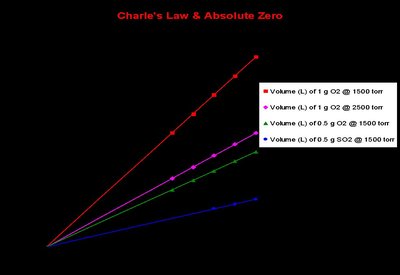
Charles’ Law states that the volume of a gas is directly proportional to its temperature (in Kelvin) at constant pressure and amount of gas.
Mathematical expression:
Kelvin conversion:

Absolute Zero
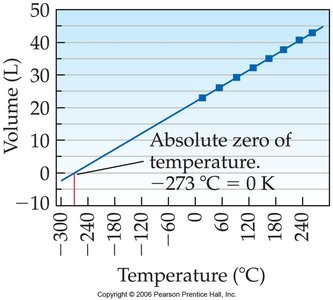
Absolute zero is the theoretical temperature at which a gas would have zero volume and no pressure. It is calculated by extrapolating the volume-temperature graph.
Combined Gas Law
The Combined Gas Law integrates Boyle’s and Charles’ Laws to predict changes in volume when both pressure and temperature change:
Equation:
Avogadro’s Law
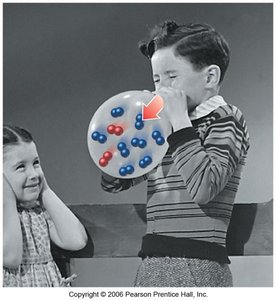
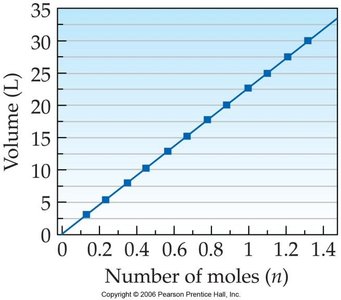
Avogadro’s Law states that the volume of a gas is directly proportional to the number of gas molecules (moles) at constant pressure and temperature.
Mathematical expression:
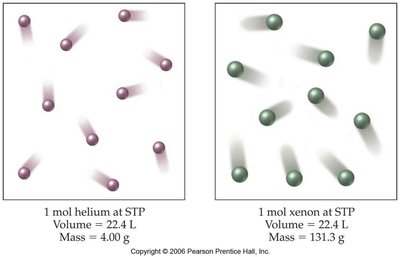
Equal volumes of gases contain equal numbers of molecules.
1 mole of gas at STP occupies 22.4 L.
Ideal Gas Law
The Ideal Gas Law combines all gas laws into a single equation:
Equation:
R is the gas constant (0.0821 L·atm/mol·K)
Use for gases at one condition; use Combined Gas Law for changing conditions.
Molar Mass of a Gas
The molar mass of an unknown gas can be determined by measuring its mass, volume, temperature, and pressure, then applying the Ideal Gas Law.
Ideal vs. Real Gases
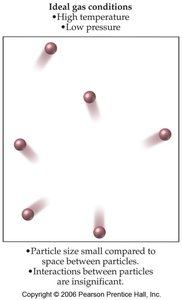
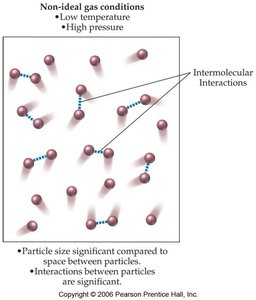
Real gases deviate from ideal behavior at high pressure or low temperature. Ideal gas laws assume no attractions and negligible volume, but these assumptions fail under non-ideal conditions.
Mixtures of Gases and Partial Pressure
Mixtures of Gases
Air is a mixture of gases, but each gas behaves independently. All gases in a mixture occupy the same volume and temperature.
Gas | % in Air (by volume) |
|---|---|
Nitrogen (N2) | 78 |
Oxygen (O2) | 21 |
Argon (Ar) | 0.94 |
Carbon dioxide (CO2) | 0.0037 |
Partial Pressure
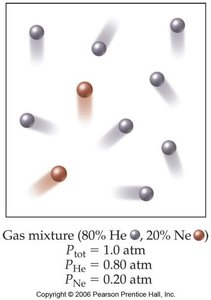
Each gas in a mixture exerts a pressure independent of the others, called partial pressure. The sum of partial pressures equals the total pressure (Dalton’s Law of Partial Pressures):
Equation:
Finding Partial Pressure
To find the partial pressure of a gas, multiply the total pressure by the fractional composition (percentage divided by 100).
Example: In a mixture of 80% He and 20% Ne at 1.0 atm,
Partial Pressure and Health
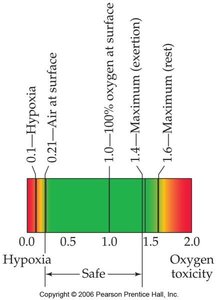
Humans require a partial pressure of O2 around 0.21 atm. Lower partial pressures can cause hypoxia, while higher pressures can cause oxygen toxicity. Deep-sea divers must manage partial pressures to avoid health risks.
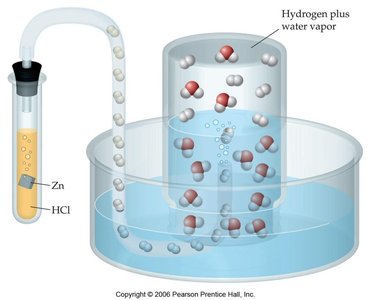
Vapor Pressure of Water
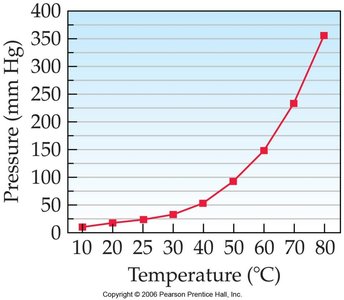
When gases are collected over water, water vapor contributes to the total pressure. The vapor pressure depends on temperature and can be found in tables.
Temp. (°C) | Pressure (mmHg) |
|---|---|
10 | 9.2 |
20 | 17.5 |
25 | 23.8 |
30 | 31.8 |
40 | 55.3 |
50 | 92.5 |
60 | 149.4 |
70 | 233.7 |
80 | 355.1 |
Reactions Involving Gases
Stoichiometry and Gas Laws
Gas laws can be combined with reaction stoichiometry to calculate volumes, masses, or moles of gases involved in chemical reactions. The Ideal Gas Law allows conversion between volume and moles, which can then be used in stoichiometric calculations.
Molar Volume at STP
At STP, 1 mole of any gas occupies 22.4 L. This molar volume is used as a conversion factor in calculations.
Example Problem: Water Formation
Given: 1.24 L H2 at STP Find: grams of H2O formed Conversion factors: 1 mol H2O = 18.02 g; 2 mol H2O ≡ 2 mol H2; 1 mol H2 ≡ 22.4 L
Additional info: All equations are provided in LaTeX format for clarity and academic rigor. Images included are directly relevant to the explanation of each paragraph, reinforcing key concepts visually.
