Ch. 16 - Reactions of Aldehydes and Ketones • More Reactions of Carboxylic Acid Derivatives
Bruice - Organic Chemistry 8th Edition
Bruice8th EditionOrganic ChemistryISBN: 9780135213711Non è quello che usi tu?Cambia libro di testo
Capitolo 16, Problema 36

Hydration of an aldehyde is also catalyzed by hydroxide ion. Propose a mechanism for the reaction.

Guida verificata passo dopo passo
1
The first step in the mechanism is the nucleophilic attack of the hydroxide ion (OH⁻) on the carbonyl carbon of the aldehyde. This occurs because the carbonyl carbon is electrophilic due to the partial positive charge caused by the electronegativity difference between carbon and oxygen.
As the hydroxide ion attacks the carbonyl carbon, the π-electrons of the C=O bond are pushed onto the oxygen atom, creating a tetrahedral intermediate. This intermediate has a negatively charged oxygen atom (alkoxide ion).
In the next step, the negatively charged oxygen atom (alkoxide) abstracts a proton (H⁺) from water (H₂O), which acts as a proton donor. This step neutralizes the negative charge on the oxygen and forms a geminal diol (a compound with two hydroxyl groups attached to the same carbon).
The reaction is reversible, and the equilibrium between the aldehyde and the geminal diol is influenced by the stability of the aldehyde and the reaction conditions (e.g., pH, solvent).
The hydroxide ion acts as a catalyst in this reaction, as it is regenerated at the end of the mechanism. This means that the hydroxide ion facilitates the reaction without being consumed in the process.

Risposta video verificata per un problema simile:

Questa soluzione video è stata consigliata dai nostri tutor come utile per risolvere questo problema.
Durata del video:
1m

Concetti chiave

Ecco i concetti essenziali che devi comprendere per rispondere correttamente alla domanda.

Aldehyde Structure and Reactivity

Aldehydes are organic compounds characterized by the presence of a carbonyl group (C=O) at the end of a carbon chain. This structure makes them highly reactive, particularly in nucleophilic addition reactions. Understanding the electrophilic nature of the carbonyl carbon is crucial, as it is susceptible to attack by nucleophiles, such as water in hydration reactions.
Video consigliato:
01:34
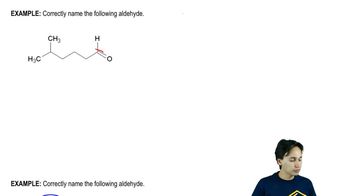
Name the aldehyde

Nucleophilic Addition Mechanism

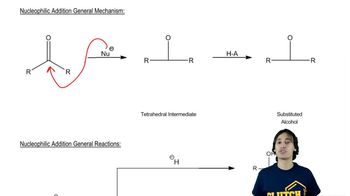
The nucleophilic addition mechanism involves the attack of a nucleophile on the electrophilic carbon of a carbonyl group. In the case of aldehydes, hydroxide ions (OH-) can act as nucleophiles, leading to the formation of a tetrahedral intermediate. This intermediate can then undergo protonation to yield the corresponding alcohol, illustrating the transformation of the aldehyde into a hydrated form.
Video consigliato:
08:27
Nucleophilic Addition

Role of Hydroxide Ion as a Catalyst

Hydroxide ions can catalyze the hydration of aldehydes by facilitating the nucleophilic attack on the carbonyl carbon. As a base, OH- can enhance the reactivity of water, allowing for a more efficient formation of the tetrahedral intermediate. This catalytic role is essential in organic reactions, as it lowers the activation energy and increases the reaction rate without being consumed in the process.
Video consigliato:
Percorso guidato
3:39
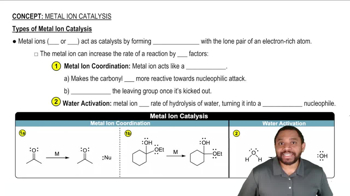
Metal Ion Catalysis Concept 1